
- Catalogs
- Viessmann Werke GmbH & Co KG
- Power to gas


Power to gas
Power to gas
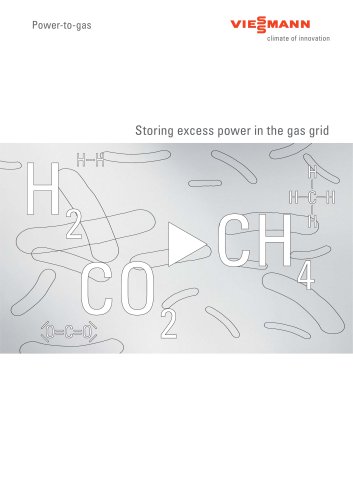
The document discusses the concept of storing excess power in the gas grid using power-to-gas technology. This involves converting surplus renewable energy into methane, which can be stored and later used as needed.
Power-to-Gas Process
Excess power from renewable sources like wind and solar is converted into hydrogen through electrolysis. This hydrogen is then combined with carbon dioxide (CO2) to produce synthetic methane. The CO2 can be sourced from industrial processes, air, or biogas plants.
Role of Microorganisms
MicrobEnergy GmbH specializes in using microorganisms to convert hydrogen and carbon into methane. These microorganisms operate under ambient conditions without stringent purity requirements for the source gases.
Integration with Energy Grids
The synthetic methane can be stored in gas facilities or injected into the natural gas grid. This integration allows for the conversion of power into primary energy, which can be used for heating or reconverted into electricity via combined heat and power stations.
Benefits and Opportunities
The German natural gas grid's large storage capacity presents opportunities for storing synthetic methane. This technology supports the transition from conventional to renewable energy sources by linking electricity and natural gas grids.
Conclusion
Power-to-gas technology offers a solution to balance the variability of renewable energy sources, reducing reliance on conventional power stations and enhancing energy storage capabilities.
Catalog excerpts
Power-to-gas VIEgMAN Storing excess power in the gas grid
Open the catalog to page 1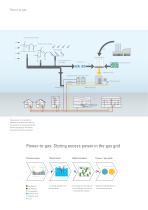
Offshore wind energy Onshore wind energy Methanisation Excess power from renewables Methane (CH 4) Combined heat and power units Transfer station Heating network Natural gas grid Power grid Excess power is converted into methane using electrolysis and CO2. The methane can be transported and stored in the gas grid, and can be converted into power as required. Power-to-gas: Storing excess power in the gas grid Excess power Excess power Producing hydrogen from Methane is injected directly excess power into the natural gas grid. Photovoltaics Offshore wind Onshore wind Load it into synthetic methane...
Open the catalog to page 2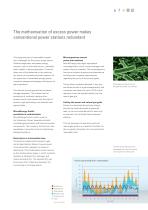
The methanisation of excess power makes conventional power stations redundant The German natural gas grid has immense storage capacities. This means that the production of synthetic methane from excess wind or solar power with the help of power-to-gas technology now presents real opportunities. MicrobEnergy GmbH – specialists in methanisation MicrobEnergy GmbH, which is part of the Viessmann Group, develops and sells microbiological products and technical system components. The company, furthermore, also specialises in process control and optimising biological systems. Microorganisms convert...
Open the catalog to page 3
Viessmann Werke GmbH & Co. KG 35107 Allendorf (Eder) Telephone +49 (0)6452 70-0 Fax +49 (0)6452 70-2780 www.viessmann.com 9440 790 GB 03/2013 Copyright Viessmann. Duplication and alternative use only with prior written consent. Subject to technical modifications.
Open the catalog to page 4All Viessmann Werke GmbH & Co KG catalogs and technical brochures
 Vitocal 150-A/151-A
20 Pages
 Vitocal 200-A
4 Pages
 Vitodens 200-W
4 Pages
 Vitodens-222-F
4 Pages
 Vitodens 050-W
4 Pages
 Product Range Overview
20 Pages
 Photovoltaic systems
20 Pages
 Hybrid solutions
24 Pages
 Gas condensing technology
40 Pages
 Oil condensing technology
32 Pages
 Etanomics
16 Pages
 Wood boilers
42 Pages
 Heat pumps
72 Pages
 DHW cylinder Vitocell
36 Pages
 Mechanical ventilation systems
36 Pages
 Thermal solar systems
34 Pages
 Gas processing plants
16 Pages
 Power-generating heating systems
24 Pages
 Wood boilers from 8 to 170 kW
42 Pages
 Gas condensing technology
48 Pages
 Fuel cell boiler
16 Pages
 Solutions generating energy
24 Pages
 Heat pumps up to 2000 kW
40 Pages
 CHP units for heat and power
20 Pages
 Biogas upgrading plants
20 Pages
 Energy from the sun
46 Pages
 Heating with wood
56 Pages
 Heating with oil
72 Pages
 VITOTWIN 300-W
4 Pages
 DHW cylinders Vitocell
32 Pages
 Micro CHP boiler
12 Pages
 A perfect climate for your home
20 Pages
 Power from the sun
20 Pages
 Heating with gas
74 Pages















Archived catalogs

- Photovoltaic solar panel
- Monocrystalline silicon solar panel
- Infrared heater
- Superheated water boiler
- Steam boiler
- Gas boiler
- Electric power radiant heater
- Industrial radiant heating circuit
- Industrial boiler
- Compact boiler
- Three-pass boiler
- Fuel oil boiler
- Fuel cell
- Natural gas boiler
- Condensing boiler
- Water/water heat pump
- Reversible heat pump
- Electric water heater
- Hydrogen fuel cell
- Heat exchanger water heater