
- Catalogs
- Viavi Solutions UK Ltd..
- The Essentials of Ethernet Service Activation

The Essentials of Ethernet Service Activation
The Essentials of Ethernet Service Activation
The document discusses the essentials of Ethernet service activation, focusing on VIAVI Solutions' Fusion TrueSpeed VNF, an automated TCP throughput test adhering to IETF RFC 6349 standards. It highlights the importance of reliable Ethernet services due to increasing demand from businesses and consumers.
Key Features of Fusion TrueSpeed VNF
- Automated TCP throughput testing with key metrics like TCP efficiency and buffer delay.
- Interoperability with VIAVI instruments and VNFs, allowing tests across various network elements.
- "TCP Doctor" for expert diagnosis of test results, identifying root causes of poor TCP performance.
- Integrated traffic shaper to demonstrate TCP performance with and without shaping.
- Centralized server reporting accessible via a web interface for VNFs.
Best Practice Workflow
- J-QuickCheck: Basic connectivity and throughput test.
- Single-Service: Enhanced RFC 2544.
- Multi-Service: Y.1564 SAMComplete for Ethernet KPI verification.
- J-Proof Layer 2 Control Plane Transparency Test.
- RFC 6349 Fusion TrueSpeed VNF: Layer 4 TCP Throughput.
Advantages
- Ease of use with a "one button" implementation for RFC 6349 tests.
- Scalability and performance isolation through interoperability between physical instruments and VNFs.
- Centralized reporting for historical data collection and easy access for network operations teams.
Conclusion
The Fusion TrueSpeed VNF solution enhances the efficiency and accuracy of Ethernet service activation, providing a streamlined workflow for service providers to ensure customer satisfaction.
Catalog excerpts
The Essentials of Ethernet Service Activation 5. RFC 6349 Fusion TrueSpeed VNFTM Layer 4 TCP Throughput
Open the catalog to page 1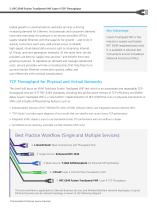
5. RFC 6349 Fusion TrueSpeed VNF Layer 4 TCP Throughput Global growth in communications and data services is driving increasing demand for Ethernet. As businesses and consumers demand more and more data, the pressure is on service providers (SP) to supply reliable Ethernet with the capacity for growth – and to do it quickly. Customers want easy, well-priced access to reliable high-speed, cloud-based data services such as streaming, Internet of Things, and next-generation networks. At the same time, service providers are keen to supply new services—and benefit from new, growing revenues. To capitalize...
Open the catalog to page 2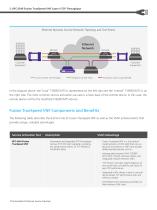
5. RFC 6349 Fusion TrueSpeed VNF Layer 4 TCP Throughput Ethernet Business Service Network Topology and Test Points Ethernet Network Customer Equipment Customer Equipment End to End Test with Portables Portable to Switch using LBM/LBR In the diagram above, the “local” T-BERD/MTS is represented on the left side and the “remote” T-BERD/MTS is on the right side. The most common service activation use case is a loop-back of the remote device. In this case, the remote device will be the handheld T-BERD/MTS device. Fusion TrueSpeed VNF Components and Benefits The following table describes the distinct...
Open the catalog to page 3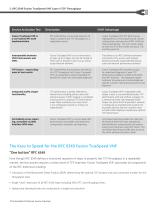
5. RFC 6349 Fusion TrueSpeed VNF Layer 4 TCP Throughput Service Activation Test Description VIAVI Advantage Fusion TrueSpeed VNF is a one-button RFC 6349 implementation Interoperable between • Fusion TrueSpeed VNF runs on instruments VIAVI instruments and at rates up to 10 Gbps, and can be hosted on VNFs VNFs such as Windows and Linux as well as actual network elements TCP Doctor - expert diag- • RFC 6349 defines the procedure and metrics nosis of test results of a TCP throughput test; Fusion TrueSpeed VNF uses proprietary expert knowledge to decode the results into actionable diagnoses Integrated...
Open the catalog to page 4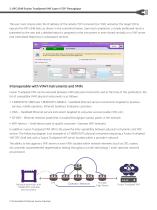
5. RFC 6349 Fusion TrueSpeed VNF Layer 4 TCP Throughput The user must simply enter the IP address of the remote TCP instrument (or VNF) and enter the target CIR to execute the RFC 6349 tests as shown in the screenshot below. Upon test completion, a simple dashboard result is presented to the user and a detailed report is prepared on the instrument or even stored centrally on a VNF server (see Centralized Reporting in subsequent section). Interoperable with VIAVI Instruments and VNFs Fusion TrueSpeed VNF can be executed between VIAVI physical instruments and at the time of this publication, the...
Open the catalog to page 5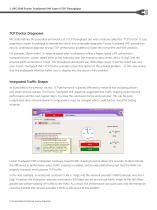
5. RFC 6349 Fusion TrueSpeed VNF Layer 4 TCP Throughput TCP Doctor Diagnoses RFC 6349 defines the procedure and metrics of a TCP throughput test with a feature called the “TCP Doctor.” It uses proprietary expert knowledge to decode the results into actionable diagnoses. Fusion TrueSpeed VNF provides an easy to understand diagnosis of poor TCP performance problems on both the instrument and VNF products. For example, “down-shifts” in network speed refer to situations where a higher speed LAN connection is transported over a lower speed WAN. In the following case, the enterprise data center LAN...
Open the catalog to page 6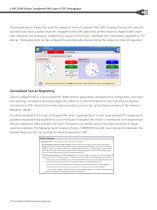
The example below shows that with the integrated Fusion TrueSpeed VNF traffic shaping function, the network provider could show a similar result for Unshaped traffic (left side) and a perfect result for Shaped traffic (right side). Moreover, the unshaped / shaped test is all part of the Fusion TrueSpeed VNF “one button" approach to TCP testing. The shaping tests can be configured to automatically execute during the single-test chain of execution. Fusion TrueSpeed VNF is a server-based RFC 6349 solution and enables centralized test configuration, execution, and reporting. Centralized reporting...
Open the catalog to page 7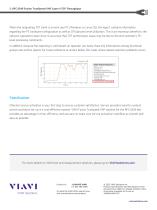
5. RFC 6349 Fusion TrueSpeed VNF Layer 4 TCP Throughput When the originating TCP client is an end-user PC (Windows or Linux OS), the report contains information regarding the PC hardware configuration as well as CPU/process level utilization. This is an enormous benefit to the network operations team since it can prove that TCP performance issues may be due to the end customer's PC-level processing constraints. In addition, because the reporting is centralized, an operator can easily share the information among functional groups and archive reports for future reference as shown below (for cases...
Open the catalog to page 8All Viavi Solutions UK Ltd.. catalogs and technical brochures
 E500 Data Center Cabinet
2 Pages
 UAT 978 MHz Option
2 Pages
 ATC-5000NG
2 Pages
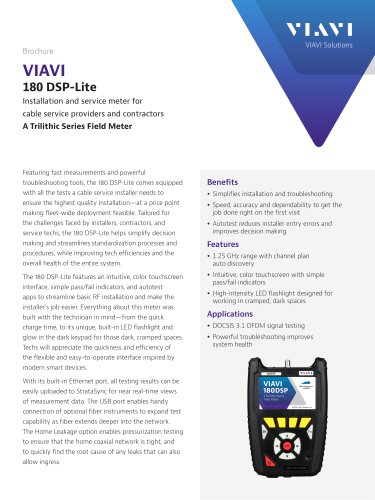 180 DSP-Lite
2 Pages
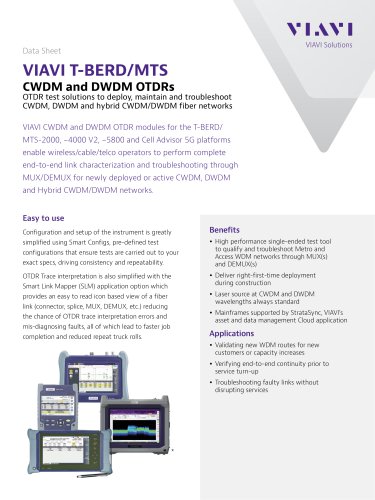 VIAVI T-BERD/MTS
3 Pages
 NITRO GEO
11 Pages
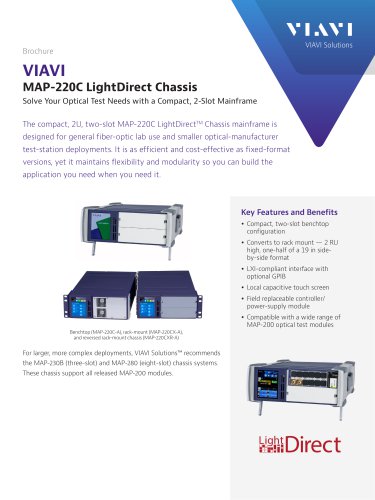 MAP-220C LightDirect Chassis
2 Pages
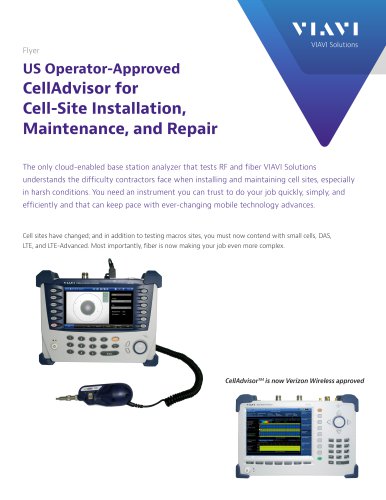 US Operator-Approved
2 Pages
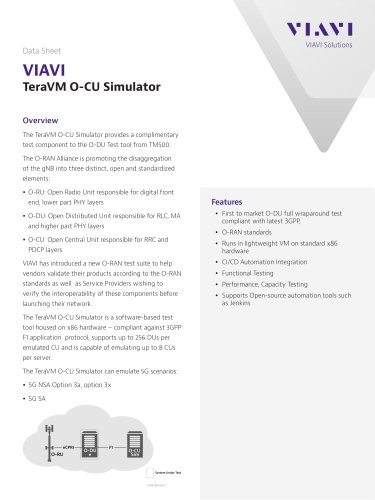 TeraVM O-CU Simulator
4 Pages
 NITRO Wireless
2 Pages
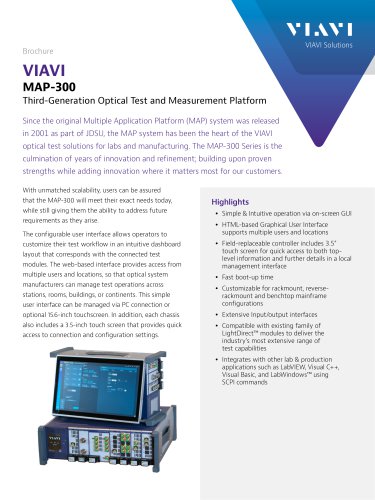 MAP-300
3 Pages
 TeraVM O-CU Test DU Sim
5 Pages
 TeraVM
2 Pages

- Management software solution
- Measuring machine
- Microscope
- Optical microscope
- Industrial gateway
- Simulation software solution
- Automatic test kit
- Network software
- Wireless gateway
- Test set
- IoT gateway
- Inspection microscope
- Optical measurement system
- Control analyzer
- High-performance analyzer
- Continuous monitoring module
- Electrical network analyzer
- Crystal oscillator
- Control measurement system
- Flow software