

Cylinders with piston-rod brake device (Ø32-100)

Cylinders with piston-rod brake device (Ø32-100)
- The RXD and RXS cylinders are designed for precise stopping, quick response, and smooth starts.
- They utilize 5/2 solenoid valves to manage pressure and ensure optimal performance.
- Components include double and single acting braking devices, flow regulators, shuttle valves, and pressure regulators.
- For RXD (Double Acting), air is supplied to port AA to apply the brake and removed to release it at port BB.
- For RXS (Single Acting), the brake is applied by default and released by supplying air to port BB.
- Brakes can be applied at any point along the cylinder stroke in both directions.
- Speed and stopping tolerances vary between RXD and RXS, with RXD offering tighter tolerances.
- Standard bore sizes range from 32mm to 100mm, with corresponding stroke lengths.
- Constructed with aluminum alloy end caps, chromium-plated steel piston rods, and stainless steel tie rods.
- Operating temperature ranges from -10°C to +80°C, with a pressure range of 2 to 10 bar.
- No lubrication is required, and the medium used is filtered air.
- Special configurations are available upon request, including integration with twin rod cylinders and torque actuators.
- Minimum unclamping pressures are specified for both RXD and RXS models.
Catalog excerpts
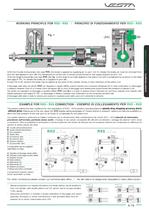
A-79 CILINDRI PNEUMATICI PNEUMATIC CYLINDERS EXAMPLE FOR RXD - RXS CONNECTION / ESEMPIO DI COLLEGAMENTO PER RXD - RXS This system realizes the best conditions for the exploitation of RXD - RXS cylinders operating features: speedy stop, stopping accuracy, starts without jerks. Making use of the two valves 5/2 (4-5) besides taking advantages of “closed centres in pressure” system, we have the possibility to allow the inlet pressure of the rear port to be lower, to compensate for the piston-rod. Con questo sistema si realizzano le migliori condizioni per lo sfruttamento delle caratteristiche dei cilindri RXD - RXS: velocità di intervento, precisione nell’arresto, partenze senza scatti. L’impiego di due valvole monostabili (4 e 5) oltre ad ottenere i vantaggi del sistema “centri chiusi in pressione”, offre la possibilità di alimentare la camera posteriore del cilindro da bloccare ad una pressione inferiore per compensare la differenza di sezione di spinta dovuta allo stelo. A Double acting braking device B Simple acting braking device 2 Flow regulators 3 Shuttle valve 4 5/2 solenoid valve 5 5/2 solenoid valve 6 Pressure regulator 7 5/2 pneumatic valve Components can be supplied assembled on base. A Dispositivo di bloccaggio doppio effetto B Dispositivo di bloccaggio semplice effetto 2 Regolatori di flusso 3 Valvola selettrice 4 Elettrovalvola 5/2 5 Elettrovalvola 5/2 6 Riduttore di pressione 7 Valvola pneumatica monostabile I componenti possono essere forniti assemblati su base. For other connections please contact our technical-sales office. / Per altri sistemi di collegamento interpellare il nostro ufficio tecnico. A 7 3 2 2 4 5 6 With the Double Acting brake unit, type RXD, the brake is applied by supplying air to port AA.To release the brake, air must be removed from port AA and applied to port BB.The clamping force of this unit is directly proportioned to the supply pressure at port AA. With the Single Acting brake unit, type RXS (see fig. 1), the brake is normally applied to the piston-rod with a campling force as shown in the table (see page A-79). To release the brake, air is supplied to port BB. In both DA & SA versions the brake may be applied at any point of the cylinder stroke, in every direction of the piston rod. Il bloccaggio dello stelo, nel cilindro RXD con dispositivo a doppio effetto, avviene inviando aria compressa all’ingresso AA in modo continuativo. Lo sbloccaggio si effettua mediante l’invio di un impulso d’aria all’ingresso BB. La forza di bloccaggio sarà direttamente proporzionale alla pressione di ingresso in AA. Nei cilindri con dispositivo di bloccaggio a semplice effetto RXS (vedi fig.1 ), lo stelo in assenza d’aria è bloccato con una forza costante come indicato nella tabella esplicativa (vedi pagina A-79). Lo sbloccaggio si effettua mediante invio continuativo di aria compressa all’orifizio BB. Il bloccaggio dello stelo, in tutte le versioni, può avvenire in qualsiasi punto della corsa ed in entrambe le direzioni. RXD .. / ... RXS .. / ... B 3 2 2 4 5 6 WORKING PRINCIPLE FOR RXD - RXS / PRINCIPIO DI FUNZIONAMENTO PER RXD - RXS BB Fig. 1 (AA) - Special production: on request, the piston-rod brake device, can be jointed to twin rod cylinder with double piston-rod “AX series” and to torque actuator “CRX series”. - Esecuzioni particolari: a richiesta il gruppo dispositivo di bloccaggio può essere applicato, all’origine, ai cilindri antirotazione a steli gemellati Vesta serie AX passanti ed ai cilindri rotanti Vesta serie CRX.
Open the catalog to page 1All VESTA catalogs and technical brochures
 MICROREGULATORS
2 Pages
 Atex Valves
5 Pages
 CZ Cartridge cylinders
1 Page
 Modular line M38
6 Pages


- Proximity switch
- Directional control valve
- Direct-operated solenoid valve
- Double-acting cylinder
- Single-stage pressure regulator
- Pneumatic gripper
- Membrane regulator
- Hydraulic directional control valve
- Single-acting cylinder
- 2-jaw gripper
- Pneumatic directional control valve
- Compact cylinder
- 3-way solenoid valve
- Multi-channel manifold
- Electric cylinder
- Electrically-operated hydraulic directional control valve