
- Catalogs
- Ventilex BV
- sand dryer

sand dryer

sand dryer
Catalog excerpts
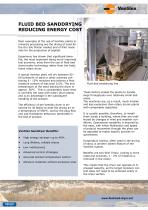
FLUID BED SANDDRYING REDUCING ENERGY COST Main examples of the use of Ventilex plants in minerals processing are the drying of sand for the Dry Silo Mortar market and of filler materials for the production of asphalt. Experience has shown that significant benefits, the most important being much improved fuel economy, arise from the use of fluid-bed dryer/cooler technology rather than the traditional rotary drum. A typical Ventilex plant will dry between 50 60 tonnes/hr of sand or other minerals containing 6 - 15% moisture and achieve a final moisture content of less than 0.5%. The end temperature of the sand leaving the dryer is approx. 50°C. This is considerably lower than is normally the case with rotary drum plants and is an advantage in the subsequent handling of the product. The efficiency of the Ventilex dryer is enhanced by its ability to heat the drying air to a temperature of 550°C. and by the plug-flow and sub-fluidisation behaviour generated in the bed of product. Ventilex Sanddryer Benefits: High energy savings—up to 40% Long lifetime, reliable dryers Low maintenance Advanced control strategies Accurate product temperature control Abrasive materials without excessive wear Fluid bed sanddrying line These factors enable the plants to handle large throughputs over relatively small bed areas. The machines are, as a result, much smaller and less expensive than rotary drums plants with comparable capacities. It is usually possible, therefore, to install them inside a building, where they are unaffected by changes in wind and weather conditions. Operational versatility is ensured by the ease, with which fluidisation and speed of product movement through the plant can be adjusted to match specific process requirements. Evaporative cooling, often used in the drying of sand, is another salient feature of the Ventilex system. Benefits are two-fold: firstly, cooling is more rapid and secondly, 1 - 2% of moisture is removed in the cooler. This means that the dryer can operate at increased capacity, as the target moisture content does not need to be achieved solely in the dryer section.
Open the catalog to page 1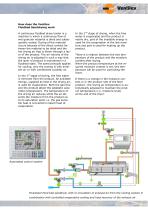
How does the Ventilex Fluidbed Sanddrying work A continuous fluidbed dryer/cooler is a machine in which a continuous flow of wet granular material is dried and subsequently cooled. Drying of the material occurs because of the direct contact between the material to be dried and the hot drying air that is blown through a layer of the product. The air velocity of the drying air is adjusted in such a way that the layer of product is maintained in a fluidised state. The same principle applies for cooling, only the cooling is with ambient air or with conditioned (cooled) air. In the 1st stage of drying,...
Open the catalog to page 2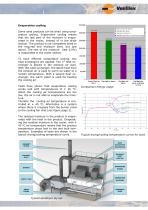
Evaporative cooling Some sand products can be dried using evaporative cooling. Evaporative cooling means that the last part of the moisture is evaporated in the cooler, instead of in the dryer section. The product is not completely dried to the required end moisture level, but just above. The rest of the moisture (last 0,5%) is evaporated in the cooler section. To have efficient evaporative cooling, two heat exchangers are applied. The 1st heat exchanger is placed in the exhaust air duct. With this heat exchanger, the latent heat from the exhaust air is used to warm up water to a certain temperature....
Open the catalog to page 3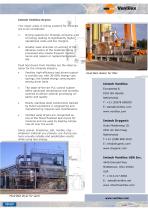
Imtech Ventilex Dryers Two major areas in drying systems for minerals are to be considered: 1. Drying systems for minerals consume a lot of energy leading to significantly higher operational costs and low margins. Greater wear-and-tear on account of the abrasive nature of the materials being processed also means frequent maintenance and repairs or replacement expenses. Fluid bed dryers from Ventilex are the ideal solution for the minerals industry. Ventilex high-efficiency bed dryers typicalFluid Bed Pressure filler Continuous High Heater forsterilizer / Autoclave ly provide you with 30-60% energy...
Open the catalog to page 4All Ventilex BV catalogs and technical brochures
 sugar dryer
4 Pages
 salt dryer
4 Pages
 Gypsum dryer
4 Pages
 fertilizer dryer
4 Pages
 dry scrubber
4 Pages
 DDGS dryer
4 Pages
 Fluid bed
16 Pages
 POLYKATH SYSTEM
2 Pages
 Sugar Drying Equipment
4 Pages
 Breadcrumb production lines
5 Pages
 Fluid Bed Roasting
4 Pages
 Sludge dryers
5 Pages
 Steriliser
7 Pages
 Almond / Nuts pasteurizer
2 Pages
 Belt dryer
4 Pages
 Imtech Drying Technology
12 Pages




- Continuous drying system
- Air dehumidifier
- Air blast drying system
- Hot air dryer
- Refrigerant dehumidifier
- Batch drying system
- Pasteurizer
- Heat sterilizer
- Centrifugal drying system
- Dryer for the chemical industry
- Pasteurizer for the food industry
- Dewatering system with belt conveyor
- Dryer for the pharmaceutical industry
- Process sterilizer
- Fluidized bed dryer
- Rotary drum dryer
- Steam sterilizer
- Sterilizer for the food industry
- Cooler dryer