
- Catalogs
- Ventilex BV
- Gypsum dryer

Gypsum dryer

Gypsum dryer
Gypsum must be cracked or calcined before use. It is commonly used in gypsum board, plaster, fertilizers, cement, and various personal care products. Gypsum exists in several chemical states, including di-hydrate, hemi-hydrate, gamma-anhydrate, and beta-anhydrate, each with specific applications.
Sources and Production
Gypsum is found naturally in quarries worldwide and can also be produced synthetically as a byproduct of phosphate production and flue-gas desulfurization. Synthetic gypsum can often replace natural gypsum in various applications.
Ventilex Gypsum Processing Equipment
Ventilex offers advanced gypsum processing equipment with benefits such as high energy savings (up to 40%), long-lasting and reliable dryers, low maintenance, and precise temperature control. The equipment uses fluid-bed dryer/cooler technology, which is more fuel-efficient than traditional rotary drums.
Calcination Process
Calcination involves heating gypsum to different temperatures to produce various forms: hemi-hydrate at slightly above 150 degrees, gamma anhydrate at slightly above 180 degrees, and beta anhydrate at above 250 degrees. The process is similar for natural, synthetic, and recycled gypsum, with additional cleaning steps for recycled materials.
Ventilex Fluid Bed Dryer/Calciner
The Ventilex system includes drying, calcination, and cooling stages. It uses a fluid bed dryer where gypsum is fluidized by an upward gas flow, achieving a final moisture content of less than 0.5%. The system recirculates process air for energy efficiency.
Advantages of Ventilex Systems
Ventilex systems offer significant energy savings (30-60%), reduced maintenance due to robust construction, and advanced control systems for optimal processing. These systems are recognized globally for their efficiency and reliability in gypsum processing.
Catalog excerpts
GYPSUM PROCESSING EQUIPMENT Gypsum is a soft sulfate mineral composed of calcium sulfate dihydrate, with the chemical formula CaSO4-2H2O. In nature it can be found in gypsum quarries. Well known is the burned gypsum called ‘Plaster of Paris’, mined from the quarries in the Montmartre district of Paris. Commercial quantities of gypsum are found in Brazil, Pakistan, Jamaica, Iran (world's second largest producer), Thailand, Spain (the main producer in Europe), Germany, Italy, England, Ireland, Canada and the United States. The largest gypsum quarry in the world is located in Milford Station, Nova Scotia, Canada. Several small mines also exist in places such as Kalannie in Western Australia, where gypsum is sold to private buyers for changing the pH levels of soil for agricultural purposes Gypsum also occurs as a byproduct in the production of phosphate and is recovered via flue-gas desulfurization at some coal-fired power plants. This synthetic gypsum can be used interchangeably with natural gypsum in some applications. The purity of the last two forms can be considered as highly pure (> 95%). Ventilex gypsum processing equipment Benefits: High energy savings—up to 40% Long lifetime, reliable dryers Advanced control strategies Accurate product temperature control Abrasive materials without excessive wear Raw gypsum has to be cracked (or calcinated) before it can be used. Common uses of gypsum are for example: Gypsum board Plaster ingredient (surgical splints, casting moulds, modeling) Fertilizer and soil conditioner Filler in the food industry A component of cement used to prevent flash setting of concrete In foot creams, shampoos and many other hair products Impression plasters in dentistry Gypsum is known in the following chemical states: di-hydrate, CaSO4 - 2H2O, the set gypsum or the natural gypsum crystals in quarries; hemi-hydrate, 2 CaSO4 - H2O or CaSO4 ½H2O, calcium sulfate hemi-hydrate or di -calcium sulfate mono-hydraat, gypsum plaster powder that upon the addition of water absorbs water of crystallisation, and thus is hard again and forms the dihydrate; gamma-anhydraat, CaSO4, the waterpoor variant that can be used as drying agent; bèta-anhydraat, CaSO4, the anhydrous variant that is used as a filler.
Open the catalog to page 1
Production of plaster from natural gypsum High-quality gypsum rock is extracted at quarries or mines. Large rocks are crushed into small pieces in a grinding mill. At some plants, the crushed rock undergoes a surface drying process before being grinded. The mill reduces small rocks to a very fine, chalk-like powder called land plaster. This land plaster contains about 21 percent of chemically bound water that has to be removed by means of calcination or burning the plaster. Depending on the intended use of the plaster different calcination process steps can now follow.. For the production of...
Open the catalog to page 2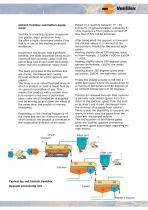
Imtech Ventilex calcination equipment Ventilex is a leading supplier of gypsum and plaster dryer production lines. We offer a highly developed product line that is in use at the leading producers worldwide. Experience has shown that significant benefits, the most important being much improved fuel economy, arise from the use of fluid-bed dryer/cooler technology rather than the traditional rotary drum. The basic principles of the Ventilex line are drying, calcination and cooling through ambient air of the gypsum and plaster. The dryer is a so called fluid bed dryer in which a product or solid...
Open the catalog to page 3
Imtech Ventilex Gypsum Processing equipment Two major areas of interest in drying systems for minerals are to be considered: 1. Drying systems for minerals consume a lot of energy leading to significantly higher operational costs and low margins. 2. Greater wear-and-tear on account of the abrasive nature of the materials being processed also means frequent maintenance and repairs or replacement expenses. Fluid bed dryers from Ventilex are the ideal solution for the minerals industry because they are developed to dispel the aforementioned issues: Ventilex high-efficiency bed dryers typically provide...
Open the catalog to page 4All Ventilex BV catalogs and technical brochures
 sugar dryer
4 Pages
 sand dryer
4 Pages
 salt dryer
4 Pages
 fertilizer dryer
4 Pages
 dry scrubber
4 Pages
 DDGS dryer
4 Pages
 Fluid bed
16 Pages
 POLYKATH SYSTEM
2 Pages
 Sugar Drying Equipment
4 Pages
 Breadcrumb production lines
5 Pages
 Fluid Bed Roasting
4 Pages
 Sludge dryers
5 Pages
 Steriliser
7 Pages
 Almond / Nuts pasteurizer
2 Pages
 Belt dryer
4 Pages
 Imtech Drying Technology
12 Pages




- Continuous drying system
- Air dehumidifier
- Air blast drying system
- Hot air dryer
- Refrigerant dehumidifier
- Batch drying system
- Pasteurizer
- Heat sterilizer
- Centrifugal drying system
- Dryer for the chemical industry
- Pasteurizer for the food industry
- Dewatering system with belt conveyor
- Dryer for the pharmaceutical industry
- Process sterilizer
- Fluidized bed dryer
- Rotary drum dryer
- Steam sterilizer
- Sterilizer for the food industry
- Cooler dryer