
- Catalogs
- Ventilatorenfabrik Oelde
- Centrifugal fans in cement works

Centrifugal fans in cement works

Centrifugal fans in cement works
In industrial processes, particularly in cement and lime manufacturing, dust-laden gases are conveyed, leading to deposits in fans and ducts. These deposits reduce duct cross-section, increase flow velocity, and resistance, ultimately throttling the fan's flow volume. This can cause blockages and damage due to vibrations from unbalanced fan impellers.
Influence of Deposits
- Solid Particle Properties: Deposits are often caused by clay and alkali chlorides in the dust, leading to hard caking on fan blades.
- Particle Size Composition: Large concentrations of alkali chlorides in the gas flow influence deposit formation.
- Temperature: Caking increases at low temperatures (below dew point) and above 400°C.
- Dust Load: High dust loads from worn cyclones or improperly sealed valves increase caking and wear.
- Moisture Content: High moisture content increases caking, especially when temperatures fall below the dew point.
- Angle of Repose: A low natural angle of repose and impeller blade angles over 42° help avoid deposits.
- Flow Velocity: Higher velocities increase deposit formation due to impact forces.
- Aerodynamics: Poor flow to the impeller increases caking and reduces efficiency.
Avoidance or Reduction of Deposits
General measures include maintaining steady operation, material quality, and temperature, ensuring proper functioning of separators and valves, and avoiding temperature drops below the dew point. If these measures fail, further investigation and countermeasures are necessary.
Cleaning Methods
- Compressed Air Cleaning: Fixed nozzles use compressed air to clean lightly adhering deposits.
- Cleaning with Sand or Gravel: Coarse materials are used to remove firmly fixed deposits, though care must be taken to avoid roughening the impeller surface.
- Cleaning with Sound Waves: Vibrations at specific frequencies remove caking.
- Manual Cleaning: Sandblasting is used for thorough cleaning when the fan is stationary.
Conclusion
Effective management of deposits in centrifugal fans involves a combination of operational adjustments and cleaning techniques. Regular monitoring and maintenance are crucial to prevent damage and ensure efficient operation.
Catalog excerpts

Innovations from Venti Oelde Centrifugal fans in cement works – Avoidance and elimination of deposits
Open the catalog to page 1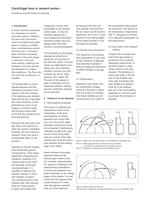
Centrifugal fans in cement works – Avoidance and elimination of deposits 1. Introduction In many industrial processes it is necessary to convey dust-laden gases. Caking in the fans and in the ducts used for handling dust-laden gases is always a problem when manufacturing cement and lime and in numerous other industrial processes. Deposits in the ducts cause a reduction in the duct cross-section, leading to an increase in the flow velocity and therefore to a higher flow resistance. The flow volume of the fan is reduced, i.e. throttled. The throttle effect is considerable because the flow resistance...
Open the catalog to page 2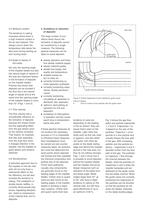
2.5 Moisture content The tendency to caking increases where there is a high moisture content in the air and material. This always occurs when the temperature falls below the dew point during starting up and running down. 2.6 Angle of repose of the solids Not only the opening angle of the impeller blades but also the natural angle of repose of the dust are important factors in the formation of deposits on the impeller blades. Practice has shown that deposits can be avoided if the dust has a low natural angle of repose and at the same time the opening angle of the impeller blades is more than 42°...
Open the catalog to page 3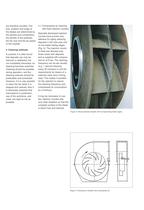
are therefore avoided. The size, position and angle of the blades are determined by the particle size composition, the density of the particles, the fan size and the tip speed of the impeller. 4. Cleaning methods In practice it is often found that deposits can only be reduced or displaced, but not completely prevented, so cleaning becomes essential. Cleaning should be possible during operation, and the cleaning intervals should be predictable and scheduled. However, if it is only possible to clean the fan when it is stopped and opened, then it is absolutely essential that interruptions in production,...
Open the catalog to page 4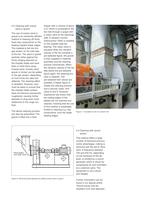
hopper with a volume of about 2 m3 which is connected to the fan inlet through a spigot with The use of coarse sand or a rotary valve at the discharge gravel is an extremely efficient side. A vibration monitor method of cleaning off firmly (Vibrocontrol 1000) is installed fixed clay components on the on the impeller-side fan leading impeller blade edges. bearing. The rotary valve is The material is fed into the actuated when the vibration gas stream on the inlet side velocity of the fan exceeds a of the fan. The sand or gravel pre-selected figure; the gravel particles strike against the is then...
Open the catalog to page 5
4.4 Cleaning with fan opened and stationary Sandblasting is a widely used method, aimed specifically at removing firmly fixed and loose deposits (Fig. 8). When the impeller has been fixed in the required position, it is cleaned with a compressed air lance and blasting media (foundry sand or coarse sand). An experienced team of two will, for example, take about two hours to clean the system fan after a cyclone preheater. Figure 8: Cleaning the trailing edges of the impeller blades with compressed air lance and blasting media while stationary Industrial fans Dust collection and process air cleaning...
Open the catalog to page 6All Ventilatorenfabrik Oelde catalogs and technical brochures
 Air with method
16 Pages
 Industrial Centrifugal Fans
18 Pages
 Large and special fans
28 Pages
 Industrial filters
16 Pages
 High-pressure fans
10 Pages
 Exhaust, filter and convey
28 Pages








- Drying system
- Solids separator
- Air circulation fan
- Centrifugal classifier
- Dust collector
- Continuous drying system
- Single shaft shredder machine
- Cooling fan
- Air blast drying system
- Recycling plant
- Filter dust collector
- Particle separator
- Hot air dryer
- Cardboard shredder
- Cartridge dust collector
- Dryer for the chemical industry
- Dewatering system with belt conveyor
- Drying fan