

VT67EDC

VT67EDC
Overview
This document provides detailed technical specifications, operating characteristics, and installation guidelines for the VT67EDC and T67EDCS series high-performance vane pumps. These pumps are designed for hydraulic applications requiring precise volumetric displacement and high reliability.
1. Product Identification and Configuration
- Model Codes: VT67EDC or T67EDCS with various suffixes indicating displacement, flange type, shaft type, seal class, and modifications.
- Volumetric Displacement: Multiple options ranging from 10.8 cm³/rev (0.66 in³/rev) to 269.8 cm³/rev (16.40 in³/rev) depending on cam ring and pump section (P1, P2, P3).
- Mounting Flanges: ISO 4-bolt 3019-2 and SAE 4-bolt J518 flanges are available, with specific codes for each.
- Shaft Types: Keyed (SAE D&E), splined, and keyed G45N-ISO 3019-2 options are provided.
- Seal Classes and Fluid Compatibility: Options for mineral oil (S1), mineral oil and fire-resistant fluids (S5), and fire-resistant fluids only (S4).
2. Volumetric Displacement and Cam Ring Options
The pumps offer a wide range of volumetric displacements tailored by cam ring selection for each port (P1, P2, P3). Displacement values are provided in both cm³/rev and in³/rev, allowing for precise flow rate control.
3. Operating Parameters and Limitations
- Pressure Ratings: Maximum operating pressures vary by model and cam ring, with typical maximum internal pressures ranging from 90 bar (1300 psi) to 275 bar (4000 psi). Specific notes caution against using certain small displacement models at very high pressures due to excessive internal leakage.
- Speed Limits: Maximum rotational speeds range from 1800 to 2500 rpm depending on displacement and model.
- Axial and Radial Loads: Maximum permissible axial load is 2000 N (449 lbs). Radial load limits are provided with corresponding shaft codes.
- Viscosity and Temperature: Typical operating viscosity is 24 cSt; inlet pressure minimum is 0.9 bar absolute.
4. Performance Characteristics
- Flow and Power: Flow rates and input power are specified at 1800 rpm and 140 bar (2000 psi), with detailed tables showing volumetric displacement, flow in liters per minute (lpm) and gallons per minute (gpm), and power consumption in kW and hp.
- Internal Leakage: Internal leakage values are given as typical flow losses in lpm and gpm at various pressures and speeds. A critical recommendation is to avoid operating pumps for more than 5 seconds if internal leakage exceeds 50% of theoretical flow.
- Hydromechanical Power Loss: Power loss data is provided for each pump section under different operating conditions.
- Noise Levels: Noise emission levels are specified in dB(A) for triple pump configurations at various pressures and speeds, with typical values ranging from 65 to 85 dB(A).
5. Installation and Mounting
- Shaft and Mounting Details: Detailed shaft codes and dimensions are provided, including keyed and splined shaft options with precise measurements in inches and millimeters.
- Mounting Torque: Recommended mounting torque values are specified for different shaft types, ranging from 47 ft-lbs (64 Nm) to 222 ft-lbs (301 Nm).
- Flange and Bolt Patterns: Alternate mounting flange options with bolt hole sizes and pitch diameters are detailed for compatibility with various hydraulic systems.
6. Recommendations and Warnings
- Do not operate the pump at speeds or viscosities that cause internal leakage to exceed 50% of theoretical flow for more than 5 seconds.
- Certain small displacement models (e.g., 003) are not recommended for use at very high pressures (275 bar) and speeds (1500 rpm) due to excessive leakage.
- Ensure correct selection of seal class based on fluid type to maintain pump integrity and performance.
7. Summary Tables and Data Highlights
- Volumetric displacement options span from 10.8 cm³/rev to 269.8 cm³/rev, enabling flow customization.
- Maximum operating pressures up to 275 bar (4000 psi) with speed limits up to 2500 rpm.
- Power consumption and flow rates are provided for standard operating conditions (1800 rpm, 140 bar).
- Noise levels and hydromechanical losses are quantified to assist in system design and compliance.
Conclusion
The VT67EDC and T67EDCS vane pumps offer versatile configurations for hydraulic systems requiring precise flow control, high pressure capability, and reliable operation. Proper selection of displacement, shaft type, mounting flange, and seal class is critical. Adherence to operating limits and installation guidelines ensures optimal performance and longevity.
Catalog excerpts
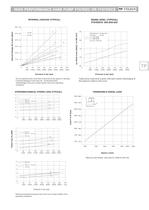
HIGH PERFORMANCE VANE PUMP VT67EDC OR VT67EDCS NOISE LEVEL (TYPICAL) VT67EDCS- 062-B35-022 INTERNAL LEAKAGE (TYPICAL) 85 P1 10 cSt (7.5) 30 Lp. Noise level {db(A)} 1m ISO 4412 Internal leakage Qs in lpm (Gpm) (9.0) 34 24 cSt (6.0) 24 P3 P2 (4.5) 18 P1 (3.0) 12 P2 (1.5) P3 6 0 Inlet pressure 0.9 bar abs Viscosity 32 cSt n = 1200 RPM n = 1800 RPM Lw= Lp + 8 db (A) 80 75 70 35 (500) 70 (1000) 105 (1500) 140 (2000) 175 (2500) 210 (3000) 240 275 (3500) (4000) 0 35 (500) 70 (1000) Pressure in bar (psi) 140 (2000) 170 (2500) 210 (3000) 240 (3500) Triple pump noise level is given with each section discharging...
Open the catalog to page 2All Veljan Hydrair Limited catalogs and technical brochures
 Hydraulic Filters
46 Pages
 VT7QDCC
3 Pages
 VR5V06 Series
8 Pages
 VR5U08 Series
8 Pages
 VR4R series
8 Pages
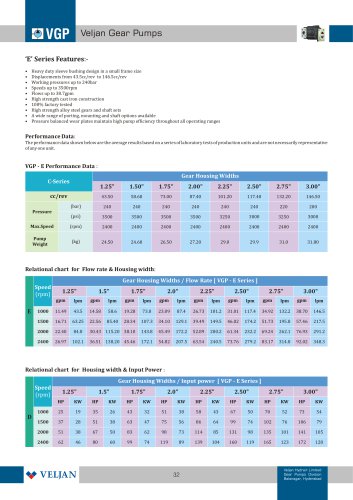 E Series
7 Pages
 Gear Pump - D Series
7 Pages
 Hydraulic Filters Catalogue
46 Pages
 Gear Pump - C Series
7 Pages
 Gear Pump - B Series
6 Pages
 V4DO1
V4DO113 Pages
 V4DO2
V4DO214 Pages
 V4DO6
V4DO616 Pages
 VR4V
VR4V8 Pages
 VT7QDCB
3 Pages
 VT6CC
VT6CC2 Pages
 VT7DSW
2 Pages
 VTXB
VTXB3 Pages
 VJ
VJ13 Pages
 VCC
VCC6 Pages
 VSD
VSD6 Pages
 VIC
VIC7 Pages
 ILV 750
7 Pages
 ILV 725
7 Pages
 ILV 720
9 Pages
 ILV 714
9 Pages
 Hydraulic Cylinders
23 Pages
 VVV01
VVV012 Pages
 System Saver - Single Vane Pump
17 Pages
 VT67DDCS
3 Pages
 VT67DCC
3 Pages
 VT67EC
2 Pages
 VT67BB
2 Pages
 VT6CB
VT6CB3 Pages
 VT6BB
VT6BB4 Pages
 VTXBB
VTXBB4 Pages
 VD4S06
14 Pages
 VD4S03
12 Pages
 VDRV7 - VDV7 06 ? 08
6 Pages
 VR5S06
8 Pages
 VR4S03
8 Pages
 VR4U10
9 Pages
 VR5V12
8 Pages
 VRIEO2
5 Pages
 VT7EE/VT7EES
2 Pages
 VT6EDCR
3 Pages
 VT6DCCR
3 Pages
 VT6CRM
2 Pages
 VT6CR
VT6CR2 Pages
 J9V045
15 Pages
 J9V009
7 Pages
 VM4E
VM4E2 Pages
 VM4D
VM4D2 Pages
 VM4C
VM4C2 Pages
 VM3B
VM3B2 Pages
 System Saver
17 Pages


Archived catalogs
 VELJAN HYDRAULIC PRODUCTS
11 Pages
- Valve
- Cylinder
- Regulating valve
- Flange valve
- Liquid filter
- Flap valve
- Check valve
- Directional control valve
- Hydraulic pump
- Double-acting cylinder
- Filter with cartridge
- Hydraulic cylinder
- Hydraulic valve
- Hydraulic directional control valve
- Spool hydraulic directional control valve
- Relief valve
- Compact cylinder
- Hydraulic filter
- In-line filter
- Ball check valve