


- Products
- Catalogs
- News & Trends
- Exhibitions
High Temperature Source

High Temperature Source
The Veeco High Temperature Source is designed for thermal evaporation of materials at temperatures up to 2000°C. It is compact and efficient, minimizing thermal load and power consumption, which extends the lifespan of heater filaments. The source is constructed with refractory tungsten and tantalum for clean operation in ultra-high vacuum (UHV) environments.
Specifications
The source is available in various sizes: 6cc, 10cc, 24cc, 26cc SUMO, and 78cc, each suited for different substrate sizes and deposition needs. Crucibles are made from refractory metals or ceramics, with the choice depending on the evaporant material.
Performance and Benefits
Key advantages include optimized heater filaments for uniform heating and oxidation-resistant construction. The source is suitable for a range of applications, including the growth of LaAlO3, doping in Si MBE, and deposition of high Tc superconducting thin films.
Product Specifications
The source operates with low vapor pressure materials in the 1300-2000°C range. It features single or dual tungsten wire filaments, a Type C thermocouple, and optional water-cooling. Power supply recommendations and additional options like integral source shutters are provided.
Selection Guide
The document provides a guide for selecting the appropriate source size for various systems, including Veeco, Riber, VG Semicon, and others.
Crucibles and Liners
Crucibles and liners are available in materials such as tungsten, PBN, PG, Al2O3, BeO, and Ta, with specific part numbers listed for each size.
Contact Information
For more information, Veeco can be contacted at their St. Paul, MN location.
Catalog excerpts

High Temperature Source 24cc High Termperature Source • For temperatures up to 2000°C in UHV • Sources available for multi-wafer 4” systems • Oxidation-resistant source construction • User replaceable heat shielding and filaments • More than 425 sources in the field Description The Veeco High Temperature Source provides thermal evaporation of charge materials at temperatures up to 2000°C. This compact MBE source operates efficiently to achieve high temperatures without excessive thermal load on the system. Low power requirements also enhance the lifetime of the heater filaments. The hot zone is constructed exclusively of refractory tungsten and tantalum to ensure clean operation in UHV, even at the highest operating temperatures. The tungsten heater filaments, as well as the heat shielding at the orifice, are field replaceable. Insulating ceramics such as PBN are restricted to cooler regions of the source to prevent outgassing during operation. High Temperature Sources are available in a number of sizes based on the capacity and performance required: • 6cc and 10cc straight-wall. Best suited for use with small (2”) substrates and partial wafers. • 24cc conical. Charge capacity and flux uniformity suitable for deposition on 3” and larger substrates. • 26cc SUMO. As with all SUMO crucibles, this source offers the largest available capacity, excellent flux uniformity, long-term flux stability, and efficient source operation for deposition on 3” and larger substrates. • 78cc conical. Largest capacity for deposition on multi-4” or single-8” systems. Crucibles are available in refractory metal and ceramic materials. The appropriate choice will vary with the desired evaporant material. Reactive materials are often evaporated from a metal crucible combined with a ceramic liner. The SUMO design is not available in all crucible materials due to manufacturing constraints. Power consumption for an empty 10cc High Temperature Source. Actual results are usually lower because the crucible acts as a heat shield for the filament.
Open the catalog to page 1
Performance and Benefits Advantages of the Veeco design include: • Optimized Heater Filament. Uniform heating over the length of the crucible produces a more consistent flux over the lifetime of the source charge. The heater filament has proven to be very durable. • Oxidation-Resistant Construction. For reliability even during oxide deposition, the use of tantalum is avoided in the hottest regions of the source. Demonstrated applications include: Cross-sectional HRTEM image of 10Å of amorphous LaAlO3 on (001) Si showing no interfacial layer between the LaAlO3 film and silicon.1 • La for LaAlO3...
Open the catalog to page 2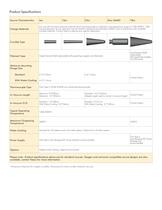
Product Specifications Source Characteristics Charge Materials For use with low vapor pressure materials which are evaporated or sublimed in the temperature range of 1300-2000°C. With some evaporants, source operation may be limited to temperatures well below 2000°C due to interactions with available crucible materials. Contact Veeco to discuss your specific application Crucible Type Filament Type Single filament (field replaceable self-supporting tungsten wire filaments) Dual filament (field replaceable self-supporting tungsten wire filaments) Minimum Mounting Flange Size Standard With Water-Cooling...
Open the catalog to page 3
Selection Guide Typical Source Commonly Used Indicated By “X” Veeco sources are also available for use on systems from Eiko, Anelva, Ulvac, SVTA, and DCA, as well as custom chambers. Contact Veeco for details. Part Number Liner Material Crucible/liner materials may be available. Contact your Veeco Sales Representative to discuss your specific application. * Only available in standard graphite. Solutions for a nanoscale world.™ Compound Semiconductor • MBE Operations 4900 Constellation Drive, St. Paul, MN 55127 USA Phone: (651) 482-0800, Fax: (651) 482-0600 www.veeco.com/mbe © 2009 Veeco Instruments...
Open the catalog to page 4All VEECO catalogs and technical brochures
 Quest OMS
2 Pages
 SPECTOR-HT
2 Pages
 Apex Gas Mixing Solution
2 Pages
 Ammonia Resistant Components
2 Pages
 GENxplor R&D MBE System
2 Pages
 5cc Dual Dopant Source
2 Pages
 GENxplor™
2 Pages
 K465i
K465i2 Pages
 The WaferStorm® Platform
2 Pages
 The WaferEtch® Platform
2 Pages
 PROPEL Power GaN
2 Pages
 TurboDisc® K475i™ As/P
2 Pages
 TurboDisc GaN
1 Page
 Low Temperature SUMO Source
4 Pages
 Valved Cracker for Sulfur
4 Pages
 Valved Cracker for Selenium
4 Pages
 Single Filament Source
3 Pages
 Valved Cracker for Arsenic
4 Pages
 Solutions for Carbon Doping
2 Pages
 Phosphorus Recovery System
2 Pages
 Gas Source Delivery System
2 Pages


- Laser engraving machine
- PVD deposition machine
- Thin-film deposition machine
- Valve positioner
- Rotary valve positioner
- Thermal evaporation deposition machine
- Delivery system
- CVD deposition machine
- Ion beam-assisted deposition machine
- Deposition machine with rotating cathodes
- Electric valve positioner
- Optoelectronic deposition machine
- Lithography system
- MBE system
- MOCVD deposition machine
- Motorized valve positioner
- Ion sputtering source