
- Catalogs
- VDM Metals
- Power Plants Flue Gas Desulfu– rization

Power Plants Flue Gas Desulfu– rization

Power Plants Flue Gas Desulfu– rization
VDM Metals, established in 1930, specializes in high-performance metallic materials, including nickel, cobalt, and zirconium alloys, as well as special stainless steels. These materials are engineered to endure extreme mechanical, thermal, and corrosive conditions, making them vital for various industrial applications.
FGD is a common process in Europe for reducing pollutants from coal-fired power plants. VDM Metals has developed material concepts specifically for FGD systems, ensuring economic efficiency and durability. High-alloyed nickel materials have been successfully used in power plants for over two decades without failure.
VDM Metals provides extensive support in material selection and welding for challenging environments. They perform rigorous testing to ensure mechanical properties, corrosion resistance, and longevity, aiding in the successful planning and construction of FGD plants.
Technologies like lime scrubbing and seawater scrubbing are used to remove sulfur dioxide and other pollutants from exhaust gases. Lime scrubbing produces gypsum for construction, while seawater scrubbing requires careful discharge management to avoid environmental harm.
Material selection is critical for FGD systems due to varying corrosion levels. VDM Metals' nickel alloys resist various corrosion types, including general, pitting, crevice, intergranular, and stress corrosion cracking, ensuring system availability and longevity.
VDM Metals employs tests like Critical Pitting Temperature (CPT) and Critical Crevice Temperature (CCT) to assess the corrosion resistance of their materials, aiding in the preliminary selection of materials based on alloy composition and resistance to localized corrosion.
The document analyzes different VDM alloys, including VDM® Alloy 59, VDM® Alloy C-276, VDM® Alloy 625, VDM® Alloy 31/31 Plus, VDM® Alloy 926, and VDM® Alloy 2120 MoN, discussing each alloy's composition and resistance to various corrosive environments.
- Electrostatic Precipitators (ESP): These systems separate dust particles from flue gas and are prone to corrosion due to acidic conditions. Alloys like VDM® Alloy 31/31 Plus and VDM® Alloy 59 are recommended.
- Heat Recovery Systems: Used in fossil-fired power stations to improve efficiency and reduce CO2 emissions. Alloys like VDM® Alloy 59 and VDM® Alloy 2120 MoN are recommended for their high corrosion resistance.
- Flue Gas Desulfurization (FGD) Systems: These systems use a limestone gypsum process to remove sulfur dioxide from flue gas. The document recommends various alloys for different sections of the FGD system based on corrosion conditions.
The document details the performance of various alloys in different corrosive environments, emphasizing their suitability for demanding applications like flue gas desulfurization and heat exchangers.
The document concludes by summarizing the alloys' specifications and their applications in various industrial processes, highlighting the importance of selecting the right material for specific conditions to ensure longevity and cost-effectiveness.
Catalog excerpts
Power Plants Flue Gas Desulfu– rization
Open the catalog to page 1
Tough demands are our business Founded in 1930, VDM Metals developed into a world market leader for high-performing metallic materials. The quality of our products and services is the result of long-term experience, our integrated production chain and a sales network that spans the globe. VDM serves the most demanding industries and is backed by a strong R&D and Application Engineering force. VDM Metals produces high-performance nickel, cobalt and zirconium alloys as well as special stainless steels for the use in extreme conditions. Our materials are made to last, resisting heavy mechanical...
Open the catalog to page 3
The concept of flue gas desulfurization The principles of the FGD technology have been proven in power plants and waste incineration plants for decades. When air pollution and acid precipitation became an issue, strict regulations for air purification came into force in many Western countries. VDM Metals decided early-on to do its part to overcome these challenges with the development of new alloys designed for use in FGD plants and helped its customers comply with the new regulations with meaningful systems. With a growing world population looking to achieve ever higher living standards, global...
Open the catalog to page 5
Corrosion in flue gas desulfurization systems The materials used in FGD plants are required first and foremost to be resistant to the, in some cases, extremely corrosive conditions. The severity of these conditions is determined by the composition of the fuel and the scrubbing process employed. For an exact assessment of the corrosive conditions, it is necessary to know all operating parameters like fuel and flue gas composition, operating temperature and the products formed during the cleaning process. The mixture of flue gas and scrubbing suspension, which are intensively brought into contact...
Open the catalog to page 6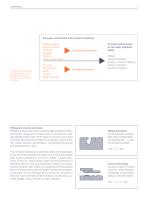
Flue-gas constituents and process conditions, and corrosion phenomena caused on low-alloy stainless steels Flue-gas constituents and process conditions Corrosion phenomena on low-alloy stainless steels Pitting Crevice Corrosion Stress-corrosion cracking Erosion corrosion Contact corrosion Sulphur dioxide Sulphur trioxide Chlorides Fluorides Nitrates Heavy metal oxides pH value Temperature Solids Oxygen Water treatment Pitting and crevice corrosion Pitting and crevice corrosion caused by high chloride contents and low pH values are the main types of corrosion in a flue gas desulfurization plant....
Open the catalog to page 7
Intergranular Corrosion Preferential attack of precipitations containing grain boundaries, e.g. stainless steels (too high C, not stabilized) f (medium, annealing, welding, T) Intergranular corrosion Intergranular corrosion or attack is a form of corrosion which occurs in or adjacent to the grain boundaries of a metal. Some Nickel alloys and stainless steels may become susceptible to intergranular corrosion as a consequence of their carbon and tungsten content after heat treatment. VDM® Alloy 31, Alloy 31 Plus, Alloy 59 and Alloy 2120 now are much more resistant to intergranular corrosion than...
Open the catalog to page 8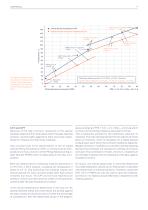
C ritical Crevice Corrosion Temperature CCT Critical Pitting Temperature CPT VDM® Alloy 31 / 31 Plus 1.4562 30 The higher the PRE number of an alloy the higher are the Critical Crevice Corrosion Temperature (CCT) and the Critical Pitting Temperature (CPT) - tainless Steels tested in 10 % FeCl3 x 6 H2O - Solution S - ickel-alloys tested in 7 % H2SO4, 3 % HCl, 1 % CuCl2, 1 % FeCl3. N CCT and CPT Because of the high corrosion resistance of the special stainless steels and the nickel alloys used in flue gas cleaning systems, several highly aggressive tests have been established to compare and rank...
Open the catalog to page 9
Strong materials for demanding applications
Open the catalog to page 10
In a typical FGD system, the wet scrubber process is based on an aqueous slurry of lime (CaO) and limestone (CaCO3). Passing through the slurry, sulfur dioxide (SO2) is removed from the flue gas, via a complex series of chemical reactions, to produce calcium sulphate (gypsum) and sulphite salts. This is known as the limestone gypsum process. In any FGD plant, the different sectors are exposed to a variety of aggressive media and altering temperatures. The material concepts developed by VDM Metals take these challenges into account and adapt to individual solutions regarding the appropriate alloys...
Open the catalog to page 11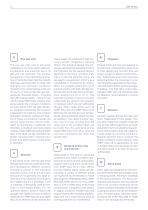
The raw gas inlet area is extremely vulnerable to corrosion due to rebounding absorber and quencher slurry, fly ash and rust particles. The extreme fluctuations in the operating parameters of the boiler mean that the metallic materials used here have to cope with changing wet corrosion conditions caused by the condensating acids and the slurry as well as high raw gas temperatures. Stainless steels – including the 6 Mo special steels – cannot cope with this at all. Particularly in lignite-fired power plants, the corrosion conditions are even worse in the raw gas inlet areas, because of extremely...
Open the catalog to page 12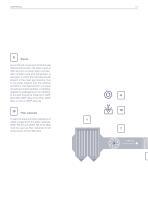
As it is the last component of the flue gas desulfurization plant, the stack is also at high risk from corrosion due to condensate formation and also penetration of rainwater, in which the chlorides are still present in the clean gas dissolve. Due to the great heights and the weather conditions, the head section of a stack should have metal cladding. A cladding, realized by wallpapering or roll-cladding, at this part should be made from VDM ® Alloy 926, VDM ® Alloy 31/31 Plus, VDM ® Alloy C-276 or VDM ® Alloy 59. Filler materials To reach an equal corrosion resistance of welds compared to the...
Open the catalog to page 13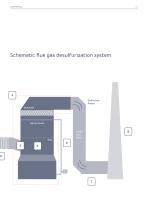
Schematic flue gas esulfurization system d 4 Deflection Plates Demister Spray levels
Open the catalog to page 14
Typical chemical composition, in % VDM® Alloy 926 VDM® Alloy 31 VDM Alloy 31 Plus® VDM® Alloy C-276 VDM® Alloy 59 VDM® Alloy 2120 MoN VDM® Alloy 926 DIN EN 1.4529, UNS N08926 VDM® Alloy 926 is an austenitic iron-nickel-chromium-molybdenum-copper-nitrogen alloy with an increased molybdenum content of about 6.5 % and an addition of about 0.2 % nitrogen for substantially improved resistance to pitting, crevice corrosion and chloride-induced stress-corrosion cracking. The material is firmly established for seawater and product piping systems, for flue-gas desulfurization installations in fossil-fueled...
Open the catalog to page 16All VDM Metals catalogs and technical brochures
 Additive Manufacturing Powder
12 Pages
 Automotive Industry
18 Pages
 Flue Gas Desulfu– rization
28 Pages
 Materials for the future
28 Pages
 Materials for Future
28 Pages
 Service Center
16 Pages


