
- Catalogs
- VDM Metals
- Automotive Industry

Automotive Industry

Automotive Industry
Catalog excerpts

Tough demands are our business Founded in 1930, VDM Metals developed into a world market leader for high-performing metallic materials covering the widest product and service portfolio in the industry. The quality of our products and services bases on our integrated production chain in Germany and the United States and a sales network that spans the globe servicing the most demanding industries and backed by a strong R&D and Application Engineering force. VDM Metals produces high-performance alloys for the use in extreme conditions. Our materials are made to last, resisting heavy mechanical and...
Open the catalog to page 3
High-quality materials for tomorrow’s mobility The challenge of mobility Hardly any other technological development has changed everyday lives more than the automobile. Mobility forms the basis of our modern lifestyle and economic activity – it is the factor with the greatest influence on how we live within a globalized world. The issues of climate protection, environmental friendliness and resource saving are the key driving force for technological development in the automotive industry. The increasing need for mobility – coupled with a shortage of resources and ever stricter requirements for...
Open the catalog to page 5
Strong materials … In today’s automotive industry the trend is towards ever more powerful engines with smaller engine displacement. It is the stated goal of downsizing to reduce fuel consumption while lowering the emission of pollutants at the same time. The design of these usually turbocharged engines results in higher exhaust temperatures, which entails greater requirements for the design of the components and the materials used. As a result, the service life of the engines depends on both the design as well as the materials used. Here VDM Metals has recourse to a wide variety of materials...
Open the catalog to page 6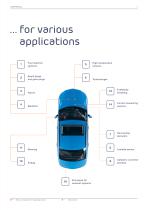
Fuel injection systems High-temperature sensors Spark plugs and glow plugs E-Mobility shielding Current measuring sensors Decoupling elements Lambda sensor Catalytic converter systems Motor compartment / passenger cabin End pipes for exhaust systems Vehicle floor
Open the catalog to page 7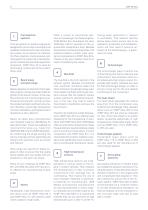
Fuel injection systems The fuel systems in modern engines are designed for as low fuel consumption as possible combined with improved emission values. As an injector for instance, the Piezo injection nozzle ensures optimal injection for lower fuel consumption. As the material has specified expansion properties, VDM ® Alloy 36 is used for the housing construction of the ceramic Piezo stick. Spark plugs and glow plugs Spark plugs play an important role in gasoline engines, as they are responsible for ignition of the fuel-air mixture. In this way, they influence not only the engine’s performance...
Open the catalog to page 8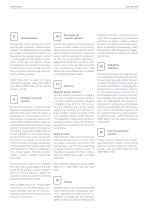
Lambda sensor The lambda sensor serves to control exhaust gas in gasoline, diesel and gas engines. The lambda sensor represents an oxygen concentration sensor for measuring the residual oxygen content in exhaust gas for the mixture composition. In this way, the injection volume is prepared for an optimal composition of the fuel-air mixture in order to ensure the most efficient exhaust gas treatment by the catalytic system. VDM® Alloy 601 is used for highly stressed protective tube, while VDM® Alloy 625 or VDM® Alloy 718 is used for contact springs. The exhaust catalytic system has the task of...
Open the catalog to page 9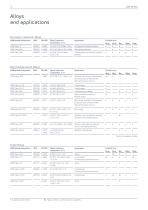
VDM Metals designation UNS DIN EN Typical chemical Application Product form composition, in % Strip Wire Bar Billet Plate VDM® Alloy 31 N08031 1.4562 Fe-31Ni-27Cr-6.5Mo-1.2Cu End pipes for exhaust systems • • • • • VDM® Alloy 625 N06625 2.4856 Ni-21.5Cr-9Mo-4.5Fe-3.5Nb Decoupling elements • • • • • VDM® Alloy 926 N08926 1.4529 Fe-25Ni-20.5Cr-6.5Mo- Turbocharger, end pipes for exhaust • • • • • DIN EN Typical chemical composition, in % 1.4888 Fe-37.5Ni-21Cr-1.6Si-0.1La High-temperature alloys VDM Metals designation UNS Manifold, glow plugs, turbocharger, protective tube lambda sensor, high-temperature...
Open the catalog to page 10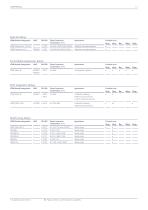
VDM Metals designation UNS DIN EN Typical chemical Application Special alloys Product form Strip Wire Bar Billet Plate VDM® Aluchrom 4 18 Y HF - 1.4737 Fe-18Cr-4.3Al-0.05Y-0.05Hf Catalytic converter systems • VDM® Aluchrom Y Hf K92500 1.4767 Fe-20Cr-6Al-0.05Y-0.05Hf Catalytic converter systems • VDM Metals designation UNS DIN EN Typical chemical Application Controlled expansion alloys Product form Strip Wire Bar Billet Plate VDM® Alloy 36 K93603, 1.3912 Fe-36Ni Fuel injection systems • • • • • Soft magnetic alloys_ VDM Metals designation UNS DIN EN Typical chemical composition, in % VDM® MAG...
Open the catalog to page 11
Integrated production Projects and production in the automotive industry are characterized by high standards in terms of product safety, reliability and longevity, requiring partners with know-how and expertise. VDM Metals has more than 80 years of experience in designing and producing materials of the highest quality standards. The company operates production sites in Germany and the United States, covering the majority of important production steps – from melting to hot forming to cold forming. Melting and casting VDM Metals’ nickel alloys and special stainless steels are melted in an electric...
Open the catalog to page 12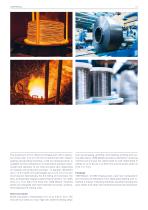
The production of hot-rolled and forged bars with a diameter of less than 4.72 in (120 mm) is performed with modern peeling and grinding machines. A 60-ton drawing bench is available for the manufacture of cold-drawn precision bars. Length and diameter of our rods and bars vary, depending on material and production process – in general, diameters up to 12.8 in (325 mm) and lengths up to 472 in (12 m) can be produced. Alternatively, the hot rolling of round bars, flat bars, and specialty shapes is performed on either a 14 in (355 mm) or a 10 in (254 mm) hand mill. VDM Metals’ finishing plants...
Open the catalog to page 13
Comprehensive Customer Support Customer relationships with VDM Metals mean access to a variety of first class services – services that really make the difference. Technical customer support From selecting the right materials to any request on specifi cations, properties and fabrication characteristics – VDM’s Application Engineering team will be more than happy to provide you with prompt answers and support, relying on their technical and metallurgical background and experience in all fabrication matters of VDM’s materials. Material and corrosion tests Quality is a top priority at VDM Metals....
Open the catalog to page 15All VDM Metals catalogs and technical brochures
 Additive Manufacturing Powder
12 Pages
 Flue Gas Desulfu– rization
28 Pages
 Materials for the future
28 Pages
 Materials for Future
28 Pages
 Service Center
16 Pages


