1. Catalogs
  2. variscite
  3. VARISCITE LTD. VAR-SOM-MX8M-NANO V1.x Datasheet NXP i.MX 8M NanoTM - based System-on-Module
video corpo

VARISCITE LTD. VAR-SOM-MX8M-NANO V1.x Datasheet NXP i.MX 8M NanoTM - based System-on-Module

VARISCITE LTD. VAR-SOM-MX8M-NANO V1.x Datasheet NXP i.MX 8M NanoTM - based System-on-Module
1 / 96 PagesView full catalog

VARISCITE LTD. VAR-SOM-MX8M-NANO V1.x Datasheet NXP i.MX 8M NanoTM - based System-on-Module

Product catalog summary
Overview: The VAR-SOM-MX8M-NANO is a System-on-Module (SoM) designed by Variscite Ltd., based on the NXP i.MX 8M Nano processor. It is intended for embedded systems requiring high performance and low power consumption, supporting Linux and RTOS like FreeRTOS.
Document Revision History: The document has been updated multiple times since January 2020, with changes in power requirements, interface configurations, and component specifications.
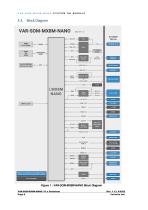
Main Hardware Components: The module includes the NXP i.MX 8M Nano processor, memory options, audio codec (WM8904), Wi-Fi and Bluetooth connectivity, a power management IC (PMIC), Ethernet transceiver, and controllers for display, touch panel, and CAN-FD.
Hardware Configuration: Details on hardware configuration options, including external connectors and pin-out configurations for board-to-board and Wi-Fi & BT connectors, are provided.
Interfaces: The SoM supports multiple interfaces such as display, camera, Ethernet, Wi-Fi & BT, MMC/SD/SDIO, USB, audio, UART, SPI, NAND, I2C, CAN, touch panel, PWM, timers, clocks, GPIO, and JTAG.
Electrical Specifications: Includes absolute maximum ratings, operating conditions, power consumption, and peripheral voltage levels.
Environmental and Mechanical Specifications: Provides details on environmental conditions, mechanical drawings, carrier board mounting, standoffs, and dimensions of the SoM.
Legal and Warranty Information: The document includes legal notices and warranty terms, emphasizing the proprietary nature of the content and limitations of liability.
Feature Summary: The module includes up to 2GB DDR4 RAM, up to 64GB eMMC or 512MB NAND flash, dual-channel LVDS display interface, MIPI DSI, Ethernet, Wi-Fi, Bluetooth, CAN-FD, MIPI-CSI camera interface, and multiple audio interfaces. It operates on a single 3.3V power supply and is suitable for industrial temperature ranges from -40 to 85°C.
ARM Cortex-A53 and Cortex-M7 Platforms: The Cortex-A53 platform features quad symmetric processors with 32KB L1 caches, a 512KB L2 cache, and a target frequency of 1.5GHz. The Cortex-M7 platform includes a low-power microcontroller with IoT features, 32KB L1 caches, and a target frequency of 750MHz.
System Bus and Interconnect: Includes a network interconnect, quality of service controller, performance monitor, and debug monitor for efficient system management.
Clocking and Resets: The clock control module provides centralized clock generation and control, while the system reset controller manages reset generation and distribution.
Interrupts and DMA: The system supports 128 shared peripheral interrupts and includes three Smart DMA engines for flexible peripheral management.
On-Chip and External Memory: The on-chip memory includes 256KB Boot ROM and 288KB RAM. The module supports various external memory interfaces.
Memory Interface: Supports a 16-bit DRAM interface with DDR4-2400, 8-bit NAND FLASH with BCH ECC up to 62-bit, and ONFi3.2 compliance. It also includes eMMC 5.1 FLASH, SPI NOR FLASH, and FlexSPI FLASH with XIP support.
Timers: Includes various timers such as local generic timers for each Cortex-A53 CPU, a global system counter, a local system timer for Cortex-M7, six general-purpose timer modules, three watchdog timer modules, and four PWM modules.
Graphics Processing Unit (GPU): Features 2D/3D acceleration, two shaders, and support for OpenGL ES 1.1, 2.0, 3.0, OpenCL, and Vulkan.
Display/Camera Interfaces: Supports LCDIF Display Controller with up to 1080p60 display, MIPI CSI and DSI interfaces, and ISI for image processing.
Audio: Includes S/PDIF input/output, five SAI modules supporting various audio interfaces, and an ASRC module for processing up to 32 audio channels.
Connectivity Interfaces: Features USB 2.0 OTG, three uSDHC interfaces, a Gigabit Ethernet controller, four UART modules, four I2C modules, and three SPI modules.
Security: Includes RDC, Arm TrustZone, OCRAM secure region protection, High Assurance Boot, CAAM, and Secure Non-Volatile Storage.
Multicore Support: Features RDC for resource isolation, a messaging unit, hardware semaphore, and shared bus topology.
GPIO and Pin Multiplexing: Includes GPIO modules with interrupt capability and an IOMUXC for centralized pad control.
Power Management: Features a temperature sensor, flexible power domain partitioning, and internal power switches.
System Debug: Includes ARM CoreSight debug architecture, TPIU, ETF, and support for JTAG interfaces.
Memory: Available with up to 2GB DDR4 memory and non-volatile storage options up to 64GB MLC eMMC or NAND.
Audio (WM8904): Features a high-performance stereo CODEC with low power consumption, stereo digital microphone input, and dynamic range control.
Wi-Fi + BT: Supports dual or single-band Wi-Fi and Bluetooth with various certifications and operating temperature range.
PMIC: Features ROHM PN:BD71847AMWV PMIC for power regulation, programmable via I2C.
Ethernet Transceiver: Options include Qualcomm Atheros AR8033 or Analog Devices ADIN1300 with various features for robust operation.
MIPI-DSI to LVDS Bridge: Features TI SN65DIS84 bridge for converting MIPI DSI to LVDS output.
CAN-FD Controller: Features Microchip MCP2518FD CAN FD controller with SPI interface and high data rates.
Touch Panel Controller: Features BB TSC2046 4-wire touch screen controller with low power consumption and SPI interface.
EEPROM: Uses 4Kbit serial EEPROM for storing memory calibration and manufacturing parameters.
Pin Configuration: Lists pin assignments for the VAR-SOM-MX8M-NANO, detailing the function of each pin, including ground (GND), not connected (NC), and various signal sources such as LVDS and audio codecs.
Pin-Mux Table: Includes a comprehensive pin-mux table outlining the alternate functions available for each pin.
Trace Impedance: Specifies impedance values for different signal groups, essential for PCB design and ensuring signal integrity.
Display Interfaces: Supports multiple display interfaces, including MIPI DSI and LVDS, with detailed signal configurations.
Conclusion: This datasheet is a technical guide for engineers and developers working with the VAR-SOM-MX8M-NANO module, providing essential information for configuring and utilizing the module's capabilities effectively.
Contact Information: Variscite Ltd. is located at 4, Hamelacha Street, Lod, P.O.B 1121, Airport City, 70100, Israel. For sales inquiries, contact [email protected], and for technical support, contact [email protected]. The corporate website is www.variscite.com.
See more

Catalog excerpts

VARISCITE LTD. VAR-SOM-MX8M-NANO V1.x Datasheet NXP i.MX 8M NanoTM - based System-on-Module-1

NXP i.MX 8M NanoTM - based System-on-Module

 Open the catalog to page 1
VARISCITE LTD. VAR-SOM-MX8M-NANO V1.x Datasheet NXP i.MX 8M NanoTM - based System-on-Module-2

© 2020 Variscite Ltd. All Rights Reserved. No part of this document may be photocopied, reproduced, stored in a retrieval system, or transmitted, in any form or by any means whether, electronic, mechanical, or otherwise without the prior written permission of Variscite Ltd. No warranty of accuracy is given concerning the contents of the information contained in this publication. To the extent permitted by law no liability (including liability to any person by reason of negligence) will be accepted by Variscite Ltd., its subsidiaries or employees for any direct or indirect loss or damage caused...

 Open the catalog to page 2
VARISCITE LTD. VAR-SOM-MX8M-NANO V1.x Datasheet NXP i.MX 8M NanoTM - based System-on-Module-3

Document Revision History Revision 1.00 Notes Official Release Updated SOM power requirements Table: 55 see Important Note Updated power consumption Table: 56 updated Add power up timing diagram – see section 8.22.3.18.22.3.1 Add SOM_3V3_PER loading requirement note – see “Table 51: Power Pins“ Added Audio Codec note about RC network – see 8.9.1 Update pins 83&85 for usage of UART4 as Symphony Base board debug UART (old pins 54&56) Updated Table 1 eMMC ordering notation Update power consumption Table 56. Updated Table 1 – delete temperature figures CAN-FD changes for SOM version V1.3 and onward:...

 Open the catalog to page 3

VARISCITE LTD. VAR-SOM-MX8M-NANO V1.x Datasheet NXP i.MX 8M NanoTM - based System-on-Module-7

Overview 4.1. General Information The VAR-SOM-MX8M-NANO offers cost-effective integration and affordable performance for smart, connected, power-efficient devices requiring graphics, vision, voice control, intelligent sensing and general-purpose processing. It perfectly fits various embedded products, the growing market of connected and portable devices and segment for connected streaming audio/video devices, scanning/imaging devices and various devices requiring high-performance, low-power processors. The product is based on the NXP i.MX 8M family of multi-purpose processors, featuring a quad...

 Open the catalog to page 7
VARISCITE LTD. VAR-SOM-MX8M-NANO V1.x Datasheet NXP i.MX 8M NanoTM - based System-on-Module-8

NXP i.MX 8M NANO series SOC o i.MX 8M NANO family ARM® Cortex™-A53 Core up to 1.5GHz quad core o 750MHz ARM® Cortex™-M7 o Up to 2GB DDR4 RAM o Up to 8-bit 64GB eMMC or up to 512MB 8-bit NAND flash for boot and storage Display Support o Dual channel LVDS display interface o MIPI DSI Networking o 10/100/1000 Mbit/s Ethernet Interface o Certified dual band Wi-Fi 802.11 ac/a/b/g/n or single band 802.11 b/g/n Bluetooth: 5.2/BLE o CAN-FD Camera o MIPI-CSI – CMOS Serial camera Interface 4 lanes Audio o Analog Stereo line in o Analog headphones out o Digital microphone o 6x Digital audio (SAI, SPDIF,...

 Open the catalog to page 8
VARISCITE LTD. VAR-SOM-MX8M-NANO V1.x Datasheet NXP i.MX 8M NanoTM - based System-on-Module-9

4Kb I2C EEPROM (Internal Use Only) DSI-LVDS Bridge ENET RGMII Ethernet PHY Ethernet/RGMII NVCC_ENET Audio CODEC Buffer + Level Shift WiFi + BT Single/Dual Band Digital Audio Pin2pin with additional VAR-SOM products. Please check pin-list document for details Figure 1 : VAR-SOM-MX8M-NANO Block Diagram VAR-SOM-MX8M-NANO_V1.x Datasheet Page 9

 Open the catalog to page 9
VARISCITE LTD. VAR-SOM-MX8M-NANO V1.x Datasheet NXP i.MX 8M NanoTM - based System-on-Module-10

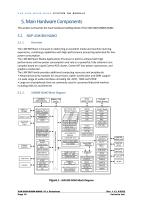
Main Hardware Components This section summarizes the main hardware building blocks of the VAR-SOM-MX8M-NANO. 5.1. NXP i.MX 8M NANO Overview The i.MX 8M Nano is focused on delivering an excellent media and machine learning experience, combining capabilities with high-performance processing optimized for lowpower consumption. The i.MX 8M Nano Media Applications Processor is built to achieve both high performance and low power consumption and rely on a powerful, fully coherent core complex based on a quad Cortex-A53 cluster, Cortex-M7 low-power coprocessor, and graphics accelerator. The i.MX 8M...

 Open the catalog to page 10
VARISCITE LTD. VAR-SOM-MX8M-NANO V1.x Datasheet NXP i.MX 8M NanoTM - based System-on-Module-11

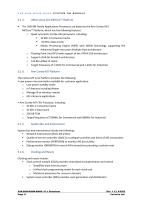
The i.MX 8M Family Applications Processors are based on the Arm Cortex-A53 MPCore™ Platform, which has the following features: o Quad symmetric Cortex-A53 processors, including: ▪ 32 KB L1 Instruction Cache ▪ 32 KB L1 Data Cache ▪ Media Processing Engine (MPE) with NEON technology supporting the Advanced Single Instruction Multiple Data architecture o Floating Point Unit (FPU) with support of the VFPv4-D16 architecture o Support of 64-bit Armv8-A architecture o 512 KB unified L2 cache o Target frequency of 1.5GHz for Commercial and 1.4Ghz for Industrial. Arm Cortex-M7 Platform The Cortex-M7 Core...

 Open the catalog to page 11
VARISCITE LTD. VAR-SOM-MX8M-NANO V1.x Datasheet NXP i.MX 8M NanoTM - based System-on-Module-12

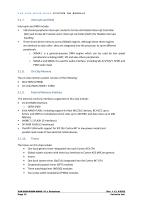
Interrupts and DMA Interrupts and DMA include: • 128 shared peripheral interrupts routed to Cortex-A53 Global Interrupt Controller (GIC) and Cortex-M7 nested vector interrupt controller (NVIC) for flexible interrupt handling • Three Smart direct memory access (SDMA) engines. Although these three engines are identical to each other, they are integrated into the processor to serve different peripherals. o SDMA-1 is a general-purpose DMA engine which can be used by low speed peripherals including UART, SPI and also others peripherals. o SDMA-2 and SMDA-3 is used for audio interface, including SAI-2/3/5/6/7,...

 Open the catalog to page 12
VARISCITE LTD. VAR-SOM-MX8M-NANO V1.x Datasheet NXP i.MX 8M NanoTM - based System-on-Module-13

Graphics Processing Unit (GPU) The chip incorporates the following Graphics Processing Unit (GPU) features: • • • • • 2D/3D acceleration 2 shader Supports OpenGL ES 1.1, 2.0, 3.0 Supports OpenCL Supports Vulkan Display/Camera Interfaces The chip has the following display support: • LCDIF Display Controller: o Supports up to 2 layers of overlay o Support up to 1080p60 display through MIPI DSI MIPI Interface: o 4-lane MIPI CSI interface o 4-lane MIPI DSI interface o Supports 4 cameras using MIPI-CSI2 Virtual Channel support (ISI module) ISI (Image Sensor Interface): o The ISI is a simple camera...

 Open the catalog to page 13
VARISCITE LTD. VAR-SOM-MX8M-NANO V1.x Datasheet NXP i.MX 8M NanoTM - based System-on-Module-14

General Connectivity Interfaces The chip contains a rich set of general connectivity interfaces, including: • One USB 2.0 OTG controller with integrated PHY interface o Spread spectrum clock support • Three Ultra Secure Digital Host Controller (uSDHC) interfaces o MMC 5.1 compliance with HS400 DDR signaling to support up to 400 MB/sec o SD/SDIO 3.01 compliance with 200 MHZ SDR signaling to support up to 100 MB/sec o Support for SDXC (extended capacity) • One Gigabit Ethernet controller with support for EEE, Ethernet AVB and IEEE1588 • Four universal asynchronous receiver/transmitter (UART) modules...

 Open the catalog to page 14
VARISCITE LTD. VAR-SOM-MX8M-NANO V1.x Datasheet NXP i.MX 8M NanoTM - based System-on-Module-15

General-purpose input/output (GPIO) modules with interrupt capability Input/output multiplexing controller (IOMUXC) to provide centralized pad control Power Management The power management unit consists of: • Temperature sensor with programmable trip points • Flexible power domain partitioning with internal power switches to support efficient power management System Debug The system debug features are: • ARM CoreSight debug and trace architecture • Trace Port Interface Unit (TPIU) to support off-chip real-time trace • Embedded Trace FIFO (ETF) with 4 KB internal storage to provide trace buffering...

 Open the catalog to page 15
*Prices are pre-tax. They exclude delivery charges and customs duties and do not include additional charges for installation or activation options. Prices are indicative only and may vary by country, with changes to the cost of raw materials and exchange rates.