- Catalogs
- Valvan Baling Systems NV
- FIBERSORT

FIBERSORT
FIBERSORT
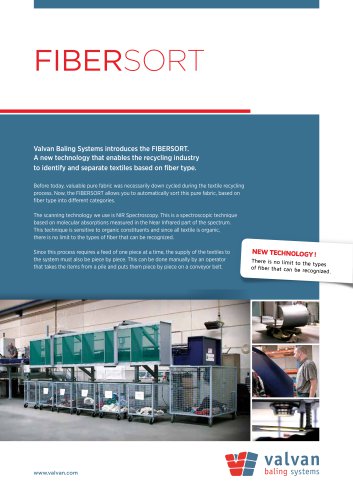
Valvan Baling Systems introduces the FIBERSORT, a groundbreaking technology for the recycling industry that identifies and separates textiles based on fiber type. This innovation allows for the automatic sorting of pure fabrics, preventing the need for downcycling during the recycling process.
The FIBERSORT utilizes NIR Spectroscopy, a technique that measures molecular absorptions in the Near Infrared spectrum. This method is highly sensitive to organic materials, making it capable of recognizing all types of textile fibers without limitation.
The system requires textiles to be fed one piece at a time, which can be done manually by an operator placing items on a conveyor belt. The current capacity is one piece per second, with potential for increased throughput through further optimization.
After scanning, the textile's spectrum is analyzed against a comprehensive database to determine fiber types such as cotton, wool, acrylic, polyester, and blends. The textiles are then sorted into unlimited categories using pressurized air.
The FIBERSORT can be integrated into larger textile sorting facilities. Valvan Baling Systems offers expertise in designing custom sorting facilities, utilizing pressurized air technology and high-speed voice-operated sorting.
Valvan Baling Systems invites interested parties to visit their premises to view the test stand and discuss the capabilities of the FIBERSORT. Updates on the technology are available at www.fibersort.com.
Catalog excerpts

fibersort Valvan Baling Systems introduces the FIBERSORT. A new technology that enables the recycling industry to identify and separate textiles based on fiber type. Before today, valuable pure fabric was necessarily down cycled during the textile recycling process. Now, the FIBERSORT allows you to automatically sort this pure fabric, based on fiber type into different categories. The scanning technology we use is NIR Spectroscopy. This is a spectroscopic technique based on molecular absorptions measured in the Near Infrared part of the spectrum. This technique is sensitive to organic constituents and since all textile is organic, there is no limit to the types of fiber that can be recognized. Since this process requires a feed of one piece at a time, the supply of the textiles to the system must also be piece by piece. This can be done manually by an operator that takes the items from a pile and puts them piece by piece on a conveyor belt. There is no limit to the types of fiber that can be rec ognized.
Open the catalog to page 1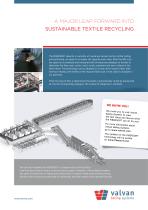
a major leap forward into sustainable textile recycling The FIBERSORT capacity is currently at 1 piece per second, but by further testing and optimizing, we expect to increase the capacity even more. After the NIR scan, the spectrum is analyzed and compared with an extensive database of textiles to determine the fiber type: cotton, wool, acrylic, polyester and even a blend of the these fibers. The technology can be adapted to include other organic fibers after extensive testing with textiles of the required fiber type. A test stand is available in our premises. When the type of fiber is determined,...
Open the catalog to page 2All Valvan Baling Systems NV catalogs and technical brochures
 Valvan Baling Systems NV
13 Pages
 Carcrusher
1 Page