

SMB Extrusion Melt Blender
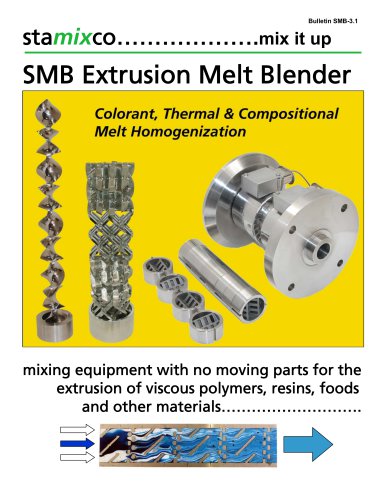
SMB Extrusion Melt Blender
StaMixCo produces three types of static mixers for extrusion services, each offering distinct benefits. The Static Mixer Melt Blender is positioned before the extruder die to address irregularities from the extruder screw, enhancing polymer melt homogeneity and optimizing die face conditions for superior product quality.
The static mixer addresses radial temperature, viscosity, and composition gradients, integrating stagnant polymer into the main stream. This leads to reduced color additives, consistent extrudate thickness, streak-free products, enhanced quality with regrind material, uniform foam cell distribution, and quick color change-over.
Static mixers are applicable in sheet extrusion, blow molding, blown film, rod and tubing, foam sheet, wire and cable, profile, coatings, co-extrusion, cereals, and other food products.
StaMixCo provides various static mixer designs for different applications, comparing models SMB-R, SMB-GX, and SMB-H. The document details their geometric structures, construction, surface finish, mixing performance, self-cleaning capabilities, pressure drop, shear rate, strength, and compactness.
The static mixer aims to produce a homogeneous polymer melt at the die face, enhancing extrusion operations and product quality by reducing temperature and viscosity gradients.
Static mixers achieve mixing in laminar flow by creating radial flow movement, eliminating stagnant boundary layers, reducing degradation, and improving color changeover times.
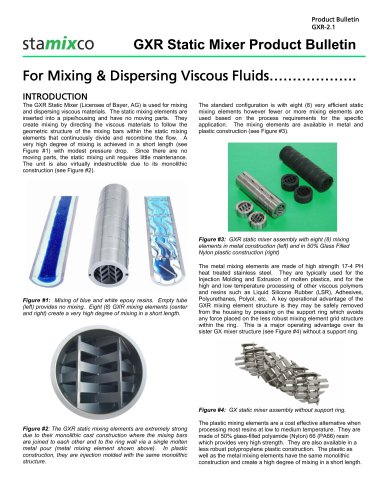
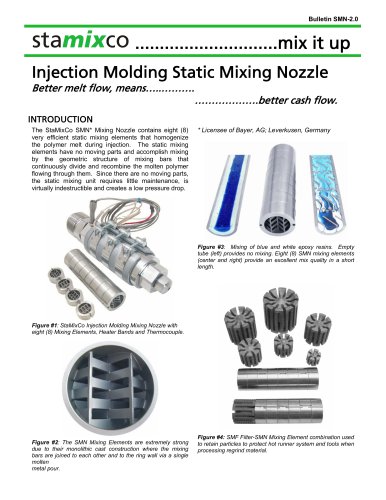
The SMB-R mixer features eight efficient mixing elements for polymer melt homogenization. Its robust monolithic cast construction suits most installations, with adjustable mixing elements based on application needs.
The SMB-R Melt Blender's size depends on pressure drop, mixing degree, polymer flow rate, and viscosity. Standard mixers have eight elements, made of high-strength stainless steel, and are disassemblable for cleaning.
The document outlines specifications for static mixers in polymer extrusion, including dimensions and model numbers for SMB-R, SMB-GX, and SMB-H mixers, highlighting their design features and applications.
The SMB-R and SMB-GX mixers are designed for high-performance mixing, with the SMB-GX featuring a crossing-bar structure for efficient mixing in a short length. Guidelines on the number of mixing elements required for different homogenization levels are provided, with Coefficient of Variation (CoV) values indicating mixing efficiency.
Tables provide key dimensions and sizing parameters for mixing elements, including bore size, length, and support ring dimensions. Figures illustrate the design and arrangement of mixing elements within the mixers.
Mixers are constructed from high-strength materials like 17-4 PH stainless steel and 316L S/S. The document describes traditional and advanced manufacturing techniques, including machining from solid rods for improved surface finish and strength.
The document advises on selecting the appropriate mixer size based on factors like pressure drop, polymer flow rate, and viscosity. It emphasizes the importance of obtaining polymer rheology information for precise design calculations and offers coordination with resin suppliers for technical data if needed.
Contact details for StaMixCo LLC and StaMixCo Technology Ltd. are provided for further inquiries and support.
Catalog excerpts
Colorant, Thermal & Compositional Melt Homogenization
Open the catalog to page 1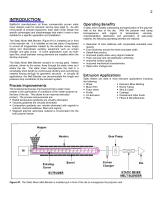
Extrusion Blow Molding Rod & Tubing Wire & Cable Coatings Cereals and other foods Fibers & Monofilaments INTRODUCTION StaMixCo manufacturers all three commercially proven static mixer designs used for extrusion service (see page 3). As with most pieces of process equipment, each static mixer design has specific advantages and disadvantages that make it more or less suitable for a specific application and installation. The Static Mixer Melt Blender (Figure #1) is installed just in front of the extruder die. It is installed as the last piece of equipment to correct all irregularities created by...
Open the catalog to page 2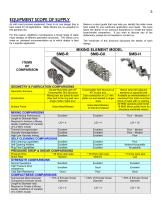
As with most process equipment, there is no one design that is best suited for all applications. Static Mixers are no exception to this general rule. For this reason, StaMixCo manufactures a broad range of static mixer designs of different geometric structures. This allows us to make an unbiased recommendation as to which design is best for a specific application. Below is a short guide that may help you identify the static mixer best suited for your particular application and needs. We have taken the liberty of our previous experience to create the below broad-stroke comparison. If you wish...
Open the catalog to page 3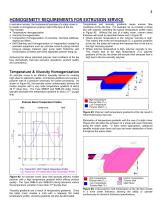
HOMOGENEITY REQUIREMENTS FOR EXTRUSION SERVICE In extrusion service, the fundamental purpose of a static mixer is to create a homogeneous polymer melt at the face of the die. This includes: y Temperature Homogenization. y Viscosity Homogenization. y Composition Homogenization of colorants, chemical additives, regrind and fillers. y Self-Cleaning and Homogenization of irregularities created by upstream equipment such as: extruder screw & piping colorant hang-up release material; gear pump teeth footprints; and incorporation of flaked wall-creep degraded polymer hang-up. Achieving the above optimized...
Open the catalog to page 4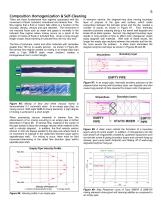
Composition Homogenization & Self-Cleaning There are three fundamental flow regimes associated with the movement of fluids: turbulent, transitional and laminar flow. The flow regime that a fluid in motion falls within is a function of the viscosity, density, velocity and pipe diameter. The movement of low viscosity fluids such as water and gases is normally in the turbulent flow regime where mixing occurs as a result of the pattern of motion of fluids in turbulent flow. Given a long enough length of pipe, fluids traveling in turbulent flow will mix very well. The flow of polymers, resins and...
Open the catalog to page 5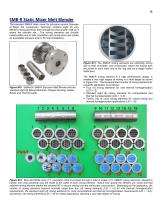
SMB-R Static Mixer Melt Blender The standard SMB-R static mixer for extrusion service (licensee of Bayer AG, Leverkusen, Germany) contains eight (8) very efficient mixing elements that homogenize the polymer melt as it enters the extruder die. The mixing elements are virtually indestructible due to their monolithic cast construction and create an acceptable pressure drop to fit most installations. Figure #11: The SMB-R mixing elements are extremely strong due to their monolithic cast construction where the mixing bars are joined to each other and to the ring wall via a single molten metal pour....
Open the catalog to page 6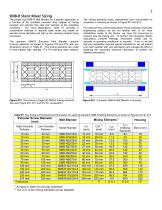
The proper size SMB-R Melt Blender for a specific application is a function of the available pressure drop; degree of mixing required and polymer flow rate and viscosity at the operating conditions. For most applications, Table #1 provides a conservative estimate of required static mixer size based on extruder screw diameter and high or low viscosity polymer being processed. The standard SMB-R Extrusion Melt Blender contains 8-mixing elements as shown in Figures #13 and #14 with key dimensions shown in Table #1. The mixing elements are made of heat treated high strength 17-4 PH stainless steel...
Open the catalog to page 7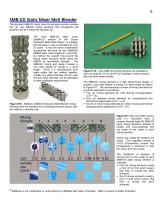
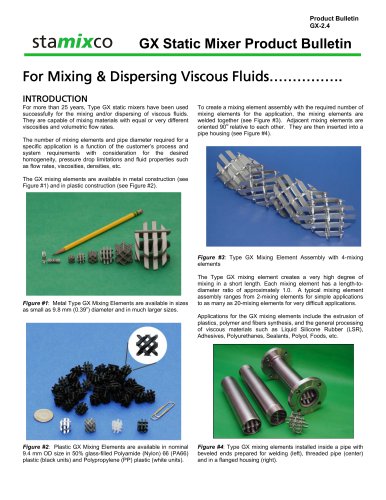
SMB-GX Static Mixer Melt Blender The standard SMB-GX static mixer for extrusion service contains four (4) very efficient mixing elements that homogenize the polymer melt as it enters the extruder die. The Type SMB-GX static mixer (StaMixCo version of the Sulzer Chemtech SMX Static Mixer)*, is a design that has been in use on extruders for over 25 years. It has the same fundamental crossing-bar structure as the StaMixCo SMB-R static mixer (Figure #11 and #12), but without the support ring around the mixing blade structure which gives the SMB-R its remarkable strength. The SMB-GX mixing grid design...
Open the catalog to page 8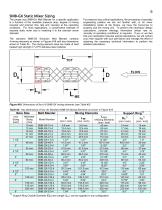
The proper size SMB-GX Melt Blender for a specific application is a function of the available pressure drop; degree of mixing required and polymer flow rate and viscosity at the operating conditions. For most applications, a conservative estimate of required static mixer size is matching it to the extruder screw diameter. For pressure drop critical applications; the processing of specialty engineering plastics we are not familiar with; or for mixer installations inside of die blocks, we have the know-how to properly size the mixing unit. To perform the necessary design calculations, polymer rheology...
Open the catalog to page 9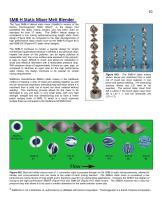
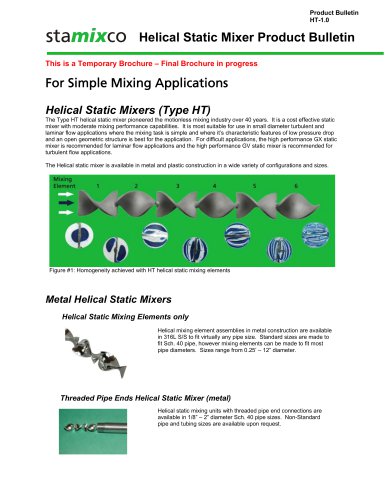
SMB-H Static Mixer Melt Blender The Type SMB-H Helical static mixer (StaMixCo version of the Kenics Thermogenizer Static Mixer)*, is the design that pioneered the static mixing industry and has been used on extruders for over 37 years. The SMB-H helical design is considered a low mixing performance-long length static mixer design (Figure #20) as compared to the later developments of high performance static mixers such as the SMB-R (Figure #12) and SMB-GX (Figure #17) static mixer designs. The SMB-H continues to remain a popular design for simple low-demand applications because it exhibits a low...
Open the catalog to page 10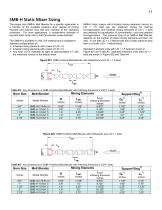
The proper size SMB-H Melt Blender for a specific application is a function of the available pressure drop; degree of mixing required and polymer flow rate and viscosity at the operating conditions. For most applications, a conservative estimate of required static mixer size is half the extruder screw diameter. The SMB-H is available in 316L S/S material and is available in standard configurations of: • 6-helical mixing elements with a twist of L/D=1.5 • 9-helical mixing elements with a twist of L/D=1.0 • Any twist L/D is available as tight as approximately 0.7 with the machined version of the...
Open the catalog to page 11All Val-Mix catalogs and technical brochures
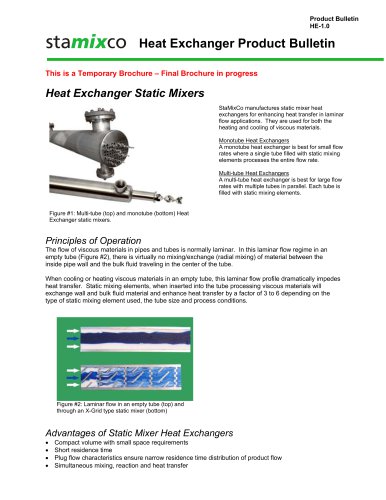 Heat Exchanger Product Bulletin
2 Pages
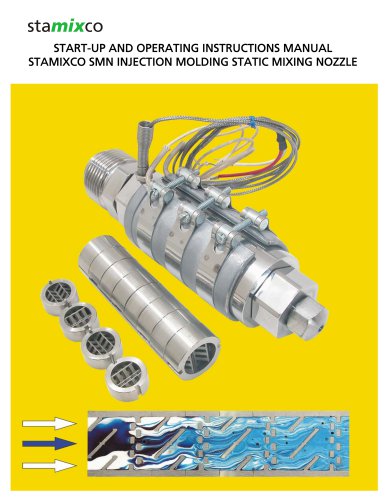
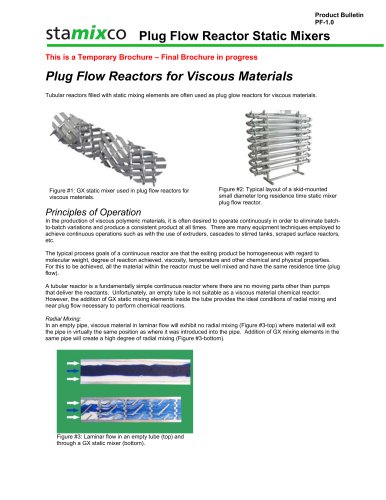
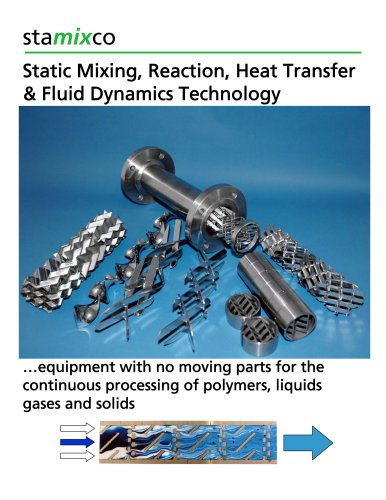
- Liquid homogenizer
- Homogenizer for the chemical industry
- In-line mixer
- Construction blender
- Compact homogenizer
- Kneader for the plastics industry
- Process reactor
- Water treatment mixer
- Continuous reactor
- Chemical reactor
- Helical blender
- Batch reactor
- Polymer agitator
- Tubular reactor
- Polymerization reactor
- Mixing nozzle
- Homogeneous reactor
- Melt filter