

GXR Static Mixer Product Bulletin
GXR Static Mixer Product Bulletin
The GXR Static Mixer, licensed by Bayer AG, is designed for mixing and dispersing viscous materials. It features static mixing elements inserted into a pipe or housing, which have no moving parts. These elements create mixing by directing materials through a geometric structure that divides and recombines the flow, achieving high mixing efficiency with minimal pressure drop. The unit is durable due to its monolithic construction, requiring little maintenance.
Specifications and Construction
The standard configuration includes eight static mixing elements, but the number can be adjusted based on application needs. Mixing elements are available in metal and plastic, with metal elements made from high-strength 17-4 PH stainless steel, suitable for high-temperature applications. Plastic elements, made from 50% glass-filled Nylon 66, offer a cost-effective alternative for low to medium temperature processes.
Mixing Performance
The GXR static mixer efficiently mixes fluids of varying viscosities and flow ratios to achieve the desired homogeneity. The design considers flow rate, viscosity, pressure drop, and required homogeneity. Tables provided in the document help determine the number of mixing elements needed based on specific conditions.
Key Dimensions
Dimensions for metal and plastic mixing elements are detailed in tables, specifying internal and external diameters, length, and bore size for various models.
Housings for Mixing Elements
Housings vary based on customer requirements, including material, design pressure, temperature, and end-connections. StaMixCo offers assistance in housing design and can supply housings to specifications.
Sizing and Availability
To determine the appropriate GXR mixer size, users should provide specifications regarding flow rate, material properties, and operating conditions. Mixing elements are in stock for next-day shipment, while housings are available within 1-5 weeks post-approval.
Contact Information
StaMixCo LLC provides contact details for North & South America and Europe, Asia-Pacific, Africa, including phone numbers, fax, email, and website.
Catalog excerpts
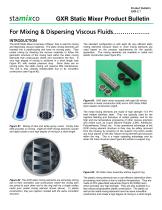
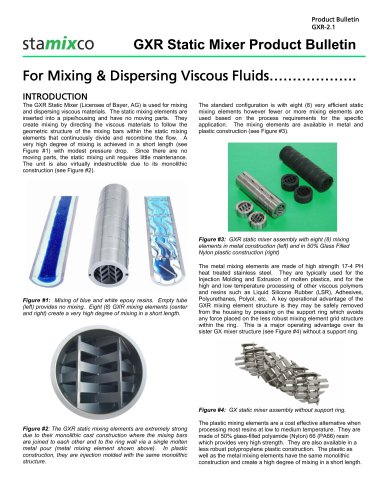
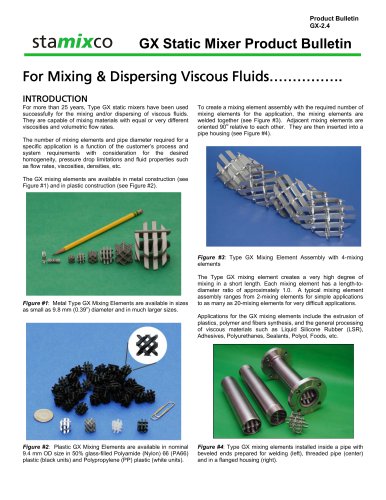
GXR Static Mixer Product Bulletin For Mixing & Dispersing Viscous Fluids………………. INTRODUCTION The GXR Static Mixer (Licensee of Bayer, AG) is used for mixing and dispersing viscous materials. The static mixing elements are inserted into a pipe/housing and have no moving parts. They create mixing by directing the viscous materials to follow the geometric structure of the mixing bars within the static mixing elements that continuously divide and recombine the flow. A very high degree of mixing is achieved in a short length (see Figure #1) with modest pressure drop. Since there are no moving parts, the static mixing unit requires little maintenance. The unit is also virtually indestructible due to its monolithic construction (see Figure #2). The standard configuration is with eight (8) very efficient static mixing elements however fewer or more mixing elements are used based on the process requirements for the specific application. The mixing elements are available in metal and plastic construction (see Figure #3). Figure #3: GXR static mixer assembly with eight (8) mixing elements in metal construction (left) and in 50% Glass Filled Nylon plastic construction (right) Figure #1: Mixing of blue and white epoxy resins. Empty tube (left) provides no mixing. Eight (8) GXR mixing elements (center and right) create a very high degree of mixing in a short length. The metal mixing elements are made of high strength 17-4 PH heat treated stainless steel. They are typically used for the Injection Molding and Extrusion of molten plastics, and for the high and low temperature processing of other viscous polymers and resins such as Liquid Silicone Rubber (LSR), Adhesives, Polyurethanes, Polyol, etc. A key operational advantage of the GXR mixing element structure is they may be safely removed from the housing by pressing on the support ring which avoids any force placed on the less robust mixing element grid structure within the ring. This is a major operating advantage over its sister GX mixer structure (see Figure #4) without a support ring. Figure #4: GX static mixer assembly without support ring. Figure #2: The GXR static mixing elements are extremely strong due to their monolithic cast construction where the mixing bars are joined to each other and to the ring wall via a single molten metal pour (metal mixing element shown above). In plastic construction, they are injection molded with the same monolithic structure. The plastic mixing elements are a cost effective alternative when processing most resins at low to medium temperature. They are made of 50% glass-filled polyamide (Nylon) 66 (PA66) resin which provides very high strength. They are also available in a less robust polypropylene plastic construction. The plastic as well as the metal mixing elements have the same monolithic construction and create a high degree of mixing in a shor
Open the catalog to page 1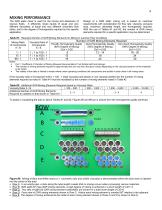
The GXR static mixer is used for the mixing and dispersion of viscous fluids. It efficiently mixes liquids of equal and very different viscosities, of equal and very different volumetric flow ratios, and to the degree of homogeneity required by the specific application. Design of a GXR static mixing unit is based on customer requirements with consideration for flow rate, viscosity, pressure drop, maximum allowable length, and homogeneity required. With the use of Tables #1 and #2, the number of GXR mixing elements required for a specific application may be determined. Table #1: Required Number...
Open the catalog to page 2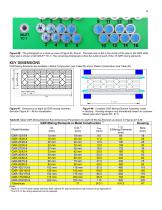
Figure #6: This photograph is a close-up view of Figure #5, Row E. The blue resin is fed in the center of the pipe to the GXR static mixer and is shown at left (INLET TO 1). The remaining photographs show the outlet of each of the 16 GXR mixing elements. GXR Mixing Elements are available in Metal Construction (see Table #3) and in Plastic Construction (see Table #4) Figure #7: Dimensions of eight (8) GXR mixing elements. Figure #8: Complete GXR Mixing Element Assembly inside See also Figure #1 - #6 for visualization. a Housing. Housing designs vary dramatically based on customer Needs (see also...
Open the catalog to page 3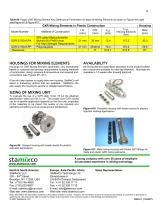
Table #4: Plastic GXR Mixing Element Key Dimensional Parameters for eight (8) Mixing Elements as shown in Figures #3 (right side)Figure #7 & Figure #11.__ Housings for GXR Mixing Element assemblies vary dramatically based on customer and process requirements including materials of construction, design pressure & temperature and required end-connections (see Figures #8 - #11). If the end user desires to supply their own housing, StaMixCo will assist in presenting options that are available. StaMixCo can also supply the housing to general or detailed specifications. To evaluate the use of a GXR...
Open the catalog to page 4All Val-Mix catalogs and technical brochures
 Heat Exchanger Product Bulletin
2 Pages
 SMB Extrusion Melt Blender
12 Pages
- Liquid homogenizer
- Homogenizer for the chemical industry
- In-line mixer
- Construction blender
- Compact homogenizer
- Kneader for the plastics industry
- Process reactor
- Water treatment mixer
- Continuous reactor
- Chemical reactor
- Helical blender
- Batch reactor
- Polymer agitator
- Tubular reactor
- Polymerization reactor
- Mixing nozzle
- Homogeneous reactor
- Melt filter