
- Catalogs
- VACUUBRAND
- Practical guide for vacuum in the laboratory


- Company
- Products
- Catalogs
- News & Trends
- Exhibitions
Practical guide for vacuum in the laboratory
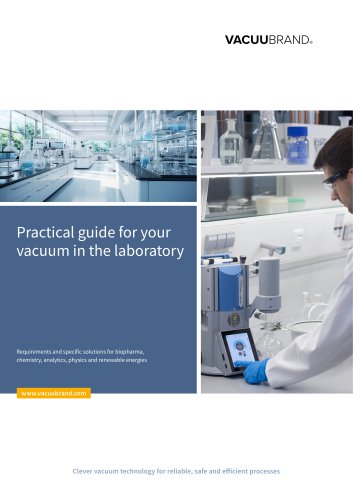
Practical guide for vacuum in the laboratory
This guide from VACUUBRAND highlights the significance of vacuum technology in laboratory settings, particularly in fields like biopharma, chemistry, analytics, physics, and renewable energies. It underscores the role of vacuum in enhancing process reliability, safety, and efficiency.
Vacuum technology is essential for laboratory applications such as filtration, evaporation, distillation, and drying. It accelerates processes by creating low-pressure environments, facilitating faster transitions from liquid to gaseous states, and reducing the heat energy required for vaporization.
The selection of vacuum technology depends on the specific laboratory application, substances used, and required precision. Key considerations include boiling points, corrosion risks, and solvent quantities. Different applications demand varying vacuum levels, from rough to ultra-high vacuum, each requiring specific pump technologies.
Vacuum pumps are characterized by their ultimate vacuum and pumping speed. The ultimate vacuum indicates the lowest achievable pressure, while pumping speed affects how quickly a pump can evacuate a volume. The performance of a pump is also influenced by its ability to maintain process pressure and compensate for system leaks.
Pumps used in chemical processes must be corrosion-resistant, often achieved through chemically resistant plastics. VACUUBRAND pumps are designed to handle common solvents safely, with features like ATEX approval for use in potentially explosive environments.
The guide details various pump technologies, including diaphragm pumps, rotary vane pumps, and screw pumps, each suited for different vacuum ranges and applications. Diaphragm pumps are noted for their chemical resistance and dry operation, while rotary vane pumps offer deeper vacuums but require oil and are less chemically resistant. Screw pumps provide oil-free operation and low maintenance, ideal for chemically sensitive applications.
Selecting the appropriate pump involves considering the specific vacuum requirements of the application, the chemical compatibility of the pump materials, and the desired balance between ultimate vacuum and pumping speed. VACUUBRAND offers a range of pumps tailored to meet diverse laboratory needs.
- Air-cooled and versatile use with regeneration mode for quick drying cycles.
- Rotatable inlet allows for vertical or horizontal orientation.
- Chemically resistant materials throughout the flow path with cantilevered spindles.
- 100% oil-free flow path.
- Condensation inside pumps can impair function and cause damage, especially in diaphragm and rotary vane pumps.
- Gas ballast allows air or inert gas into the pump to reduce gas condensation.
- Recommended to run the pump with gas ballast open before switching off to remove condensate.
- Rotary vane pumps should warm up with the valve closed to reduce condensate formation.
- Cold traps may be necessary for rotary vane pumps to collect corrosive chemicals.
- Modern diaphragm pumps have condensate separators and emission condensers to protect the pump and environment.
- VACUU·PURE® screw pump design eliminates the need for gas ballast and cold traps.
- Capacitive sensors are used for rough vacuum measurement, offering high accuracy and chemical resistance.
- Pirani sensors are used for fine vacuum measurement, with extended range but gas type dependence.
- Vacuum control can be manual, via valve switching, or through rotational speed control for precision and energy savings.
- Local networks with decentralized vacuum pumps are recommended over centralized systems to reduce costs and risks.
- VACUU·LAN® system offers modular and expandable vacuum supply solutions with high chemical resistance.
- Selection depends on media used, volume, precision required, and specific application needs.
- The Vacuum Pump Selection Guide assists in finding the optimal pump for laboratory applications.
- VACUUBRAND is part of the Brand group, specializing in vacuum technology and laboratory equipment.
- Committed to innovation, quality, and customer service, with products engineered and manufactured in Germany.
Catalog excerpts
Practical guide for your vacuum in the laboratory Requirements and specific solutions for biopharma, chemistry, analytics, physics and renewable energies Clever vacuum technology for reliable, safe and efficient processes
Open the catalog to page 1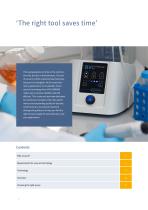
‘The right tool saves time’ This saying applies not only on the construction site, but also in the laboratory. The role of vacuum is often underestimated precisely because it is intangible. Yet for many laboratory applications it is invaluable. Clever vacuum technology from VACUUBRAND makes your processes reliable, safe and efficient. This is why we have been dedicated to continuous innovation, first-class performance and outstanding quality for decades. In this brochure, we present important distinguishing features to help you find the right vacuum supply for your laboratory and your applications....
Open the catalog to page 2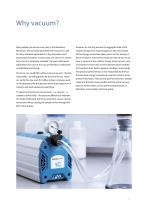
Many people use vacuum every day in the laboratory. However, on a drying process the aggregate state of the But what is the actual purpose behind it? Vacuum is used sample changes from liquid to gaseous. We could simply for many standard applications in the preparation and let the drying process take place, just as we dry laundry in processing of samples. In most cases, the vacuum is not the the air. However, remove this would also take far too much focus, but it is absolutely essential. The most well-known time, a vacuum is also used for drying. Under vacuum, less applications for vacuum are...
Open the catalog to page 3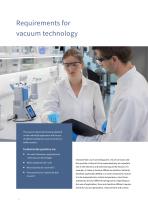
Requirements for vacuum technology The vacuum requirements always depend on the individual application and the use of different substances such as solvents or buffer systems. Fundamental questions are: For which laboratory application do I need vacuum technology? What volumes do I work with? How precisely do I need to be able Characteristics such as boiling point, risk of corrosion and the quantity of solvent to be evaporated play an important role in the selection and dimensioning of the devices. For example, it makes a decisive difference whether methanol, dimethyl sulphoxide (DMSO) or a multi-component...
Open the catalog to page 4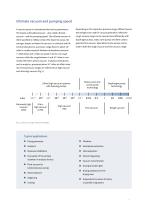
Ultimate vacuum and pumping speed A vacuum pump is characterized by two key parameters: Depending on the respective pressure range, different pump The lowest achievable pressure – also called ultimate technologies are used for vacuum generation. While the vacuum – and the pumping speed. The ultimate vacuum is rough vacuum range can be covered most efficiently with often specified in millibar (mbar).The lower the value, the diaphragm pumps, rotary vane pumps are often used to stronger, deeper or better the vacuum. In chemical and life generate fine vacuum. Specialized screw pumps can be science...
Open the catalog to page 5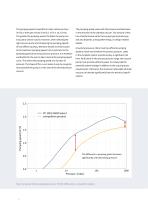
The pumping speed is specified in cubic metres per hour The pumping speed varies with the pressure and decreases [m3/h] or litres per minute [l/min] (1 m3/h ≙ 16,7 l/min). in the direction of the ultimate vacuum. The amount of this The greater the pumping speed, the faster the pump can loss of performance varies from pump type to pump type evacuate a certain volume. However, when selecting the and also depends, among other things, on design-related right vacuum pump and comparing the pumping speeds of two different pumps, attention should not only be paid to the maximum pumping speed, but in...
Open the catalog to page 6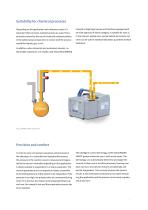
Suitability for chemical processes Depending on the application and substances used, it is chemistry diaphragm pumps are therefore equipped with important that corrosion-resistant pumps are used. This is an ATEX approval of device category 3 (suitable for zone 2) primarily ensured by the use of chemically resistant plastics in the internal, wetted area, so that almost all common sol- in the wetted area (components in contact with the process vents can be used in standard laboratory quantities without media like liquids, gas, or air). In addition, when chemicals are mentioned, solvents, i.e. flammable...
Open the catalog to page 7
There are a variety of technical solutions for the requirements described above. However, the performance and robustness of a pump are also heavily dependent on design details and the quality of the materials used. Further distinguishing features result from the accessories used. There are significant quality differences, particularly in the area of control technology. The following section provides an overview of the most important technical features and their functions. Dry compressing diaphragm pumps down to approx. 1 mbar In a diaphragm pump, one or more diaphragms are moved The assembly...
Open the catalog to page 8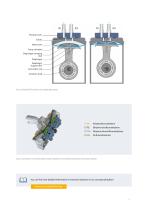
Housing cover Valves Head cover Pump chamber Diaphragm clamping disk Diaphragm Diaphragm support disk Connection rod Excentric shaft Fig. 4: Schematic illustration of a diaphragm pump Ethylene tetrafluoroethylene ECTFE: Ethylene chlorotrifluoroethylene FFKM: Fig. 5: Consistent use of chemically resistant plastics for all wetted materials in the pump chamber You can find more detailed information on chemical resistance in our corresponding flyer! Chemistry compatibility flyer
Open the catalog to page 9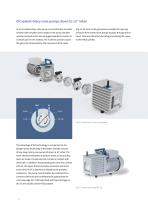
Oil sealed rotary vane pumps down to 10-3 mbar In an oil-sealed rotary vane pump, an eccentrically mounted (Fig. 6). As soon as the gas pressure exceeds the opening cylinder with movable vanes rotates in the pump chamber pressure of the outlet valve, the gas escapes through the ex- cylinder and pushes the incoming gas towards the outlet. At haust. Oil is used here for lubricating and sealing the vanes a certain point in the rotation, the eccentric position causes the gas to be compressed by the movement of the vanes Fig. 6: Structure of a rotary vane pump The advantage of this technology in comparison...
Open the catalog to page 10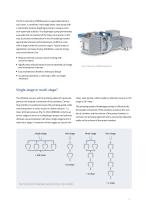
The RC 6 chemistry-HYBRID pump is a good alternative in such cases. It combines a two-stage rotary vane pump with a chemically resistant diaphragm pump to create a corrosion-optimized solution. The diaphragm pump permanently evacuates the oil chamber of the rotary vane pump. In this way, it prevents condensation in the oil-sealed part under appropriate pressure and temperature conditions, even with a large number of corrosive vapors. Typical areas of application are freeze drying, distillation, vacuum drying ovens and Schlenk Line. ■ Reduced internal corrosion when working with corrosive vapors...
Open the catalog to page 11All VACUUBRAND catalogs and technical brochures
 Chemistry diaphragm pumps
12 Pages
 Vacuum in physics
12 Pages
 Chemistry Compatibility
2 Pages


- Piping
- Manual valve
- Stainless valve
- Control valve
- Ball valve
- Electrically operated valve
- VACUUBRAND vacuum generator
- On/off valve
- Lever valve
- VACUUBRAND single-stage vacuum pump
- 2-way solenoid valve
- Gas valve
- Direct-operated solenoid valve
- Neoprene® hose
- Butterfly valve
- Lift valve
- VACUUBRAND lubricated vacuum generator
- VACUUBRAND lubricated vacuum pump