


NivoGuide® NG 3000 / NG 8000 - Whitepaper

NivoGuide® NG 3000 / NG 8000 - Whitepaper
Radar technology, short for "radio detection and ranging," utilizes electromagnetic waves for location and distance measurement. It is extensively used in industries such as food and beverage, oil and gas, chemical, water and wastewater, and cement production for determining fill levels.
Time Domain Reflectometry (TDR), also known as Guided Wave Radar (GWR), is a widely used method for level measurement in both bulk solids and liquids. TDR sensors are known for their adaptability and reliability in challenging conditions like temperature and pressure changes, dust, and surface movements.
TDR sensors function by emitting an electromagnetic pulse along a probe. The pulse reflects back upon hitting the material surface, and the sensor calculates the fill level based on the pulse's transit time. The pulse speed is affected by the medium's dielectric constant, but TDR sensors are designed to manage variations in temperature, pressure, and medium properties.
TDR sensors are less impacted by process-related interferences such as dust, build-up, and low dielectric constant values. They are suitable for high-pressure and high-temperature applications and can effectively measure interface layers.
TDR sensors tackle issues like dust, build-up, low DK values, bulk cones, and high tensile forces. They are engineered to minimize signal loss and endure mechanical stresses, making them ideal for high silos and demanding environments.
In liquid applications, TDR sensors manage challenges such as steam, condensate, wave movements, and limited space. The coaxial version of TDR sensors is particularly effective in providing accurate measurements under these conditions.
TDR sensors are effective for level measurement in environments with steam over a liquid. They use low-frequency microwave pulses that maintain signal strength in vaporous atmospheres, ensuring reliable level determination. Steam compensation is used in high-pressure/high-temperature applications to address measuring inaccuracies.
TDR sensors feature insulated rods and process connections for clean signal coupling, even with condensate. A conical insulation shape prevents condensation and aids drainage. In narrow spaces, a coaxial tube can be used to eliminate external interference and allow precise measurements.
When selecting TDR sensors, consider the chemical resistance of sealing and insulation materials, suitability for food contact, and safety for toxic or volatile substances. High-quality materials like FFKM or PEEK are recommended for durability.
TDR sensors are ideal for measuring interface layers, such as oil on water, due to their ability to penetrate substances with low DK values. They use software algorithms to evaluate reflected signals from both upper and lower layers, allowing accurate determination of total fill level and layer thickness.
TDR sensors are available for extreme conditions, with robust materials and solutions for low-noise and low-loss signal coupling. Steam compensation is crucial in steam boilers to correct measurement errors caused by steam's effect on signal propagation.
TDR sensors maintain high accuracy under varying conditions, but steam combined with high temperatures and pressures can significantly affect accuracy. Steam compensation can correct these inaccuracies, achieving measurement accuracies of +/- 3 mm even under extreme conditions.
TDR sensors are versatile and reliable for level determination across various applications and industries. Their user-friendliness, quick commissioning, and diagnostic functions contribute to their widespread use and effectiveness even under challenging process conditions.
Catalog excerpts

SOLUTIONS FOR TRICKY LEVEL MEASUREMENT CHALLENGES When it gets tricky! WHITE PAPER M ULTITALENT TDR IN S OLIDS & LIQUIDS Nikolas Oppenberger Product Management
Open the catalog to page 1
Solutions for tricky level measurement applications – TDR Sensor: All-rounder for bulk solids & liquids WHITE PAPER What is radar? Radar is the abbreviation for "radio detection and ranging" which means "radio-based location and distance measurement". This technology is based on electromagnetic waves. A radar device emits a concentrated electromagnetic wave, which is reflected by objects as an echo and then evaluated by the device according to various criteria. Depending on the application, the following information can be obtained from the reflected waves: the angle or the direction...
Open the catalog to page 2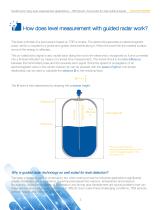
Solutions for tricky level measurement applications – TDR Sensor: All-rounder for bulk solids & liquids WHITE PAPER How does level measurement with guided radar work? The basic principle of a level sensor based on TDR is simple. The electronics generate an electromagnetic pulse, which is coupled to a probe and guided downwards along it. When the wave hits the material surface, some of the energy is reflected. This so-called echo signal is also routed back along the rod to the electronics, recognized by it and converted into a fill level indication by means of a transit time measurement. The transit...
Open the catalog to page 3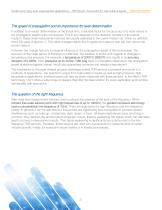
Solutions for tricky level measurement applications – TDR Sensor: All-rounder for bulk solids & liquids WHITE PAPER The speed of propagation and its importance for level determination In addition to an exact determination of the transit time, a decisive factor for the accuracy of a radar sensor is the propagation speed of the microwaves. This in turn depends on the dielectric constant of the carrier medium. Radar level measurement devices are usually calibrated in the carrier medium air, which by definition has a DK value of approx. 1. This value changes slightly due to gases and vapours that...
Open the catalog to page 4
Solutions for tricky level measurement applications - TDR Sensor: All-rounder for bulk solids & liquids WHITE PAPER Solutions for tricky level measurement applications - TDR Sensor: All-rounder for bulk solids & liquids WHITE PAPER How do TDR sensors master the challenges of bulk solids applications? There are many challenges in the bulk goods sector. High, narrow silos and large measuring distances, pouring cones, build-up, dust, materials with low DK values and high mechanical tensile forces pose particular challenges for measuring technology. TDR sensors prove to be true all-round talents....
Open the catalog to page 5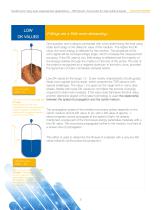
Solutions for tricky level measurement applications - TDR Sensor: All-rounder for bulk solids & liquids WHITE PAPER Solutions for tricky level measurement applications - TDR Sensor: All-rounder for bulk solids & liquids WHITE PAPER The echo curve for media with low DK value. Characteristic are the lower amplitude of the echo signal and a signal propagation through the medium with a negative downturn at the end of the probe. If things are a Httfe more demanding... One question one is always confronted with when determining the level using radar technology is the dielectric value of the medium....
Open the catalog to page 6
Solutions for tricky level measurement applications – TDR Sensor: All-rounder for bulk solids & liquids WHITE PAPER If something gets lost… If you compare the echo curves of an empty and a full container, there is a second difference in addition to the amplitude of the level echo. The signal of the probe end appears farther away with a container filled with material than with empty containers. This shows the dependence on the speed of propagation and the carrier medium. While the microwave can always spread out in the free space in the empty container to the end of the probe, it must penetrate...
Open the catalog to page 7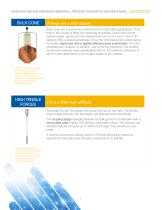
Solutions for tricky level measurement applications – TDR Sensor: All-rounder for bulk solids & liquids BULK CONE WHITE PAPER If things are a little steeper... Bulk cones are a well-known phenomenon in bulk solids applications. They form in the course of filling and emptying processes. Due to the conical surface shape, signal loss and measurement errors can occur. Here TDR sensors offer a decisive advantage. Since the microwaves are guided along the probe, signal loss due to signals reflecting away is eliminated. This also simplifies echo analysis. In addition, due to the low frequency, the emitted...
Open the catalog to page 8
Solutions for tricky level measurement applications – TDR Sensor: All-rounder for bulk solids & liquids HIGH SILOS WHITE PAPER If it's a little higher... If it's a little higher... With a maximum rope length of 75m, TDR sensors are ideal for use in high silos. Since the emitted microwave pulses are less strongly attenuated due to their low frequency (1 GHz), they deliver a sufficiently large measuring signal even over large measuring distances. With a maximum rope length of up to 75 meters, TDR sensors are also suitable for use in high silos
Open the catalog to page 9
Solutions for tricky level measurement applications – TDR Sensor: All-rounder for bulk solids & liquids WHITE PAPER Exemplary application of the TDR in SOLIDS NG 3000 in high storage silo for cement www.uwt.de/tdr-cement-application Special Challenges: dust-intensive process environment material prone to build-up high process compatibili
Open the catalog to page 10
Solutions for tricky level measurement applications – TDR Sensor: All-rounder for bulk solids & liquids WHITE PAPER How do TDR sensors master the challenges in the liquid area? Due to its flexibility, the TDR technology is predestined to be used in liquid applications. Similar to the bulk goods area, measurement technology is also confronted with a variety of challenges, the characteristics of which however differ from those of the solids. Steam, condensate, agitators or heating coils, distinctive separating layers, wave movements, volatile substances or limited space due to smaller container...
Open the catalog to page 11All UWT GmbH catalogs and technical brochures
 Brochure Chemical Industry
21 Pages
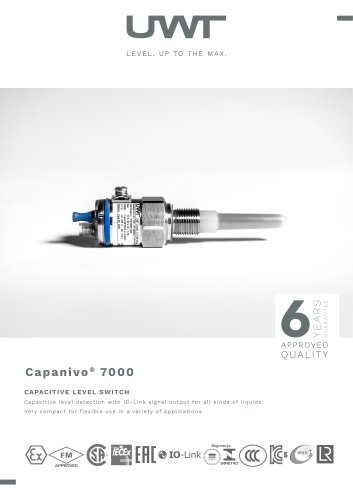 Capanivo® 7000
2 Pages
 SOLUTIONS FOR THE FOOD INDUSTRY
21 Pages
 Product-Overview UWT
36 Pages
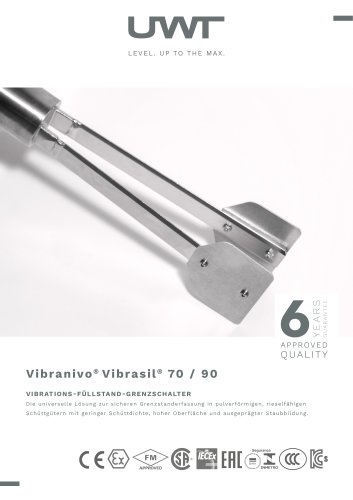 Vibrasil 70/90
2 Pages
 DK value
8 Pages
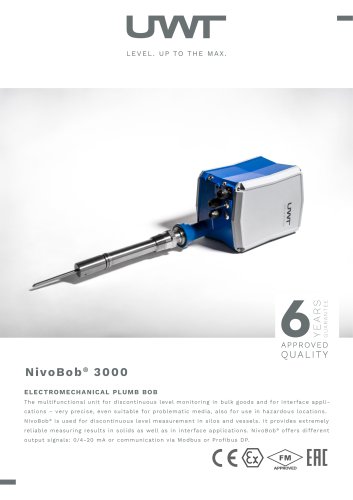 NivoBob® NB 3000
2 Pages
 Product Matrix
2 Pages
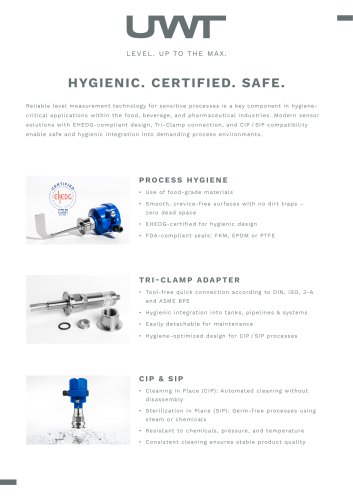 Hygiene-Flyer-EHEDG
2 Pages
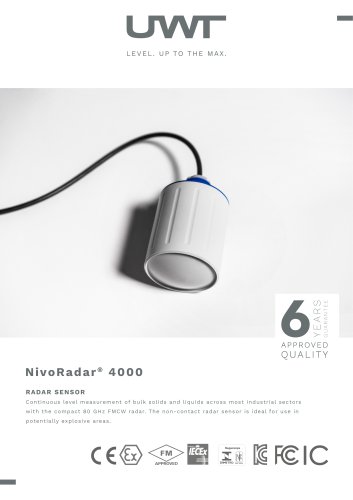 NivoRadar® NR 4000
2 Pages
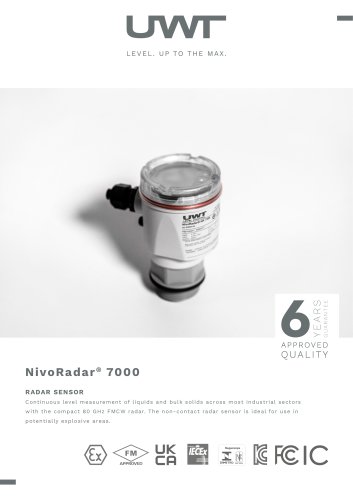 NivoRadar® NR 7000
2 Pages
 NivoRadar® NR 3000
2 Pages
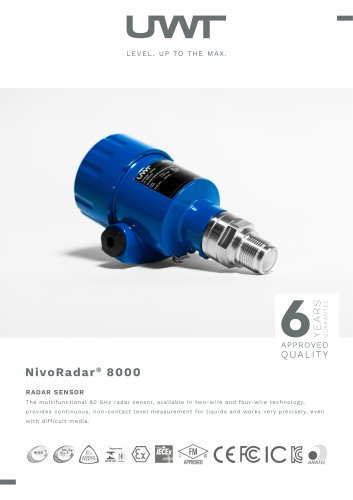 NivoRadar® NR 8000
2 Pages
 Capanivo® CN 4000
22 Pages
 Capanivo® CN 7000
50 Pages
 Capanivo® CN 8000
42 Pages
 Mononivo® 4000
25 Pages
 NivoBob® 3000
41 Pages
 NivoCapa® 8000
27 Pages
 NivoBob® 4000
31 Pages
 NivoGuide® NG 8000
84 Pages
 NivoTec® NT 4700
7 Pages
 NivoTec® NT 4500
20 Pages
 RFnivo® 3000
44 Pages
 RFnivo® 8000
39 Pages
 Rotonivo® 4000
21 Pages
 Radar Flyer New 2024
2 Pages
 Vibranivo® VN 4000
25 Pages
 Solids - Liquids at a glance
2 Pages
 Vibranivo® VN 7000
2 Pages
 Capanivo® CN 7000
2 Pages
 NivoCapa® NC 8000
2 Pages
 Vibranivo® VN 4000
2 Pages
 RFnivo® 8000
2 Pages
 Rotonivo® RN 4000
2 Pages
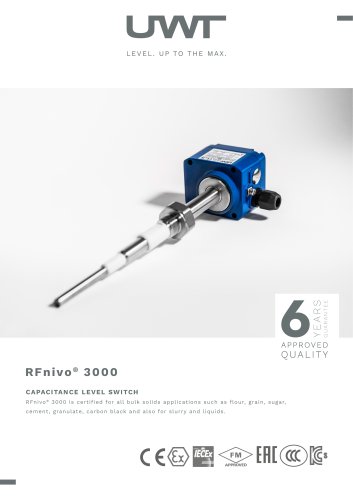 RFnivo® 3000
2 Pages
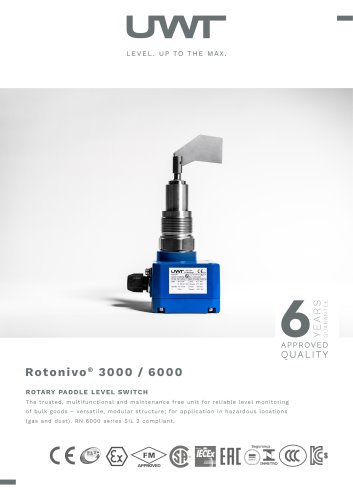 Rotonivo® RN 3000 / 6000
2 Pages
 NivoGuide® NG 3000
2 Pages
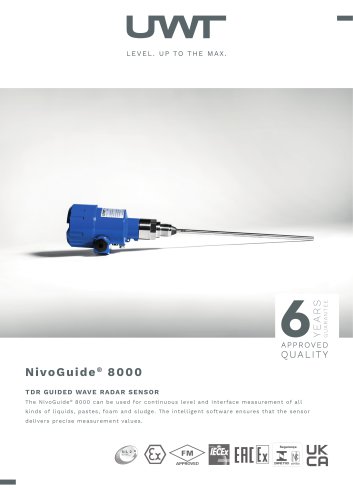 NivoGuide® NG 8000
2 Pages
 NivoBob® NB 4000
2 Pages
 Mononivo® MN 4000
2 Pages
 Capanivo® CN 4000
2 Pages
 Capanivo® CN 8000
2 Pages


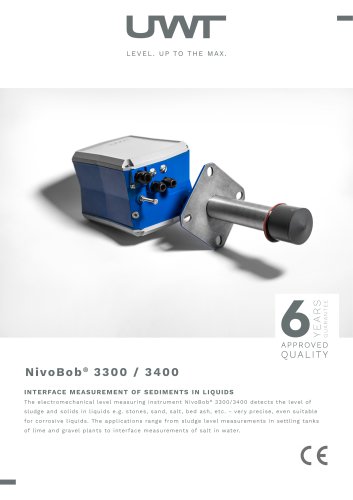

- UWT level switch
- UWT liquid level switch
- UWT liquid level sensor
- Warning light
- UWT analog level sensor
- LED beacon light
- DC beacon light
- UWT stainless steel level switch
- Level transmitter
- Liquid level transmitter
- UWT digital output level sensor
- AC warning light
- UWT threaded level switch
- UWT storage tank level sensor
- Analog level transmitter
- Liquids level gauge
- Tank level limit switch
- Steady warning light
- Plastic level switch