


- Products
- Catalogs
- News & Trends
- Exhibitions
Safety Gloves

Safety Gloves
- Dry Areas: Gloves like uvex phynomic lite are breathable and suitable for precision work, assembly, and inspection.
- Damp and Oily Areas: Gloves such as uvex phynomic XG and uvex unilite 6605 offer excellent grip and durability in oily conditions.
- Heavy Duty/Construction: uvex synexo M100 and uvex profi ergo are designed for robust tasks, providing good grip and protection against impacts.
- Ergonomic Design: Many gloves feature a "second skin" fit, enhancing comfort and dexterity.
- Material Composition: Common materials include polyamide, elastane, and nitrile rubber, chosen for their flexibility, durability, and protective qualities.
- Protective Coatings: Various coatings like aqua-polymer and NBR foam are used to enhance grip and resistance to moisture and oils.
- Gloves are dermatologically approved and certified according to OEKO-TEX® Standard 100, ensuring they are free from harmful substances.
- Special attention is given to skin safety, with products designed to prevent irritation and allergic reactions.
- Select gloves based on specific workplace conditions and tasks to ensure optimal protection and performance.
- Consider the ergonomic fit and breathability of gloves to reduce fatigue and enhance comfort during prolonged use.
- uvex athletic D5 XP: High cut protection (Level D), suitable for dry and slightly oily conditions, used in industries like automotive and metalworking.
- uvex phynomic C5: Lightweight with good cut protection (Level C), ideal for precision work and assembly.
- uvex synexo impact 1: Designed for heavy-duty work with impact protection, suitable for the oil and gas industry.
- uvex C500 series: Offers high cut protection with Bamboo TwinFlex® technology, suitable for various industries including metal and automotive.
Catalog excerpts

Safety Gloves
Open the catalog to page 1
Manufacturing and technology expertise uvex centre of expertise for safety gloves in Luneburg, Germany Development expertise, state-of-the-art robot-controlled manufacturing technology and stringent quality control ensure the first-class quality of our safety gloves. By manufacturing in Germany, uvex pursues efficient, resource-preserving production processes and ensures that the path from manufacturer to end user is as short as possible. Development/production Fully integrated development processes across all stages: • own yarn/liner manufacturing • own compounding (blending) • specially developed...
Open the catalog to page 2
Extensive know-how is part of our service Service expertise We know exactly what you want. Our expertise is available for you at all times which forms the basis of our on-site r isk-hazard analysis service: Our hand protection specialists work with you to determine which safety gloves are best suited to your individual requirements. Seminars, laboratory analyses and online tools round off our service portfolio. Consultation / training / application technology • on-site consultation from uvex product specialists • practical hand protection seminars (uvex academy) • plant and laboratory tours for...
Open the catalog to page 3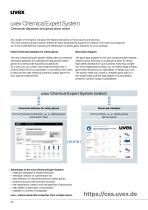
uvex Chemical Expert System Chemicals database and glove plans online As a leader of innovation, we place the highest demands on the products and services. The uvex Chemical Expert System (CES) has been developed by experts for experts. This online tool supports you in the comprehensive analysis and optimisation of safety glove solutions for your business. Online chemicals database for safety gloves Glove plan designer The uvex Chemical Expert System (CES) offers an extensive c hemicals database for selecting the appropriate safety gloves for working with hazardous substances. As a user, you...
Open the catalog to page 4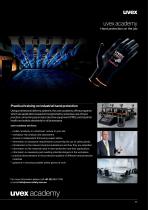
Hand protection on the job Practical training on industrial hand protection Using professional delivery systems, the uvex academy offers programs which are application-based and supported by extensive use of best practice concerning personal protective equipment (PPE) and industrial health and safety standards for all businesses. uvex academy services: • mobile “academy in a briefcase” comes to your site • workplace risk analysis and assessment • access to independent third-party expert advice • information on standards requirements concerning the use of safety gloves • introduction to the relevant...
Open the catalog to page 5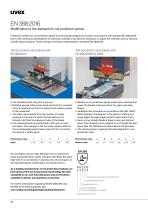
EN 388:2016 Modification to the standard for cut protection gloves Protection classes for cut protection gloves were previously assigned in Europe in accordance with standard EN 388:2003. Due to the continuous development of technical materials it has become necessary to adjust the methods used to test and classify these products. These changes have been implemented in standard EN 388:2016. ► Cut resistance test using the coup test ► Rotating circular knife moves back and forth at a constant force (5 newtons) on the test material and rotates counter to the movement ► The index value results from...
Open the catalog to page 6
EN ISO 374-1:2016 Modification to the Standard for chemical safety gloves Chemical safety gloves must meet the requirements of European standard EN ISO 374-1. This standard has undergone fundamental changes in terms of certification. Part 1 (Terminology and performance requirements for chemical risks) contains important modifications: ► Expansion of test chemicals from 12 to 18 ► Omission of beaker glass for “water-resistant safety glove with low protection against chemical risks” ► Standardisation of types of gloves into type A, B or C ► Modification to labelling on the product: Pictogram of...
Open the catalog to page 7
Safety Gloves Mechanical Risks Precision work uvex phynomic range uvex synexo range uvex unilite range uvex profi ergo uvex unilite range Heavy duty uvex rubiflex uvex synexo range uvex unipur range uvex phynomic range uvex unidur range uvex athletic lite uvex athletic all-round
Open the catalog to page 8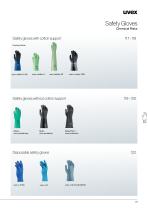
Safety Gloves Chemical Risks Safety gloves with cotton support Coating: Nitrile Safety gloves without cotton support Nitrile – uvex profastrong Butyl – uvex profabutyl Butyl/Viton® – uvex profaviton Disposable safety gloves uvex u-fit lite uvex u-fit uvex u-fit strong N2000
Open the catalog to page 9
The uvex Glove Navigator The fast way to find the right safety gloves There are many factors which must be taken into consideration when selecting the appropriate safety gloves. To help you make the right choice, uvex has developed clear guidelines that nclude helpful symbols for selecting safety i gloves for specific areas of application. 1. Identify and classify risk potential What is the main risk for users in the workplace? The symbols provide initial guidance to help you choose the right category for the appropriate safety gloves. Mechanical protection Working with chemicals Cut protection...
Open the catalog to page 10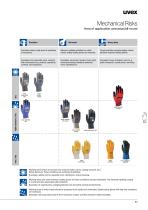
Mechanical Risks Area of application: precision/all-round Heavy duty General, multiple activities for which r obust, stable safety gloves are required. Tough activities requiring highly robust, abrasion resistant safety gloves. Examples: fine assembly work, working with small parts (e. g. screws), operating controls, and inspection. Activities where a high level of sensitivity is necessary. Examples: servicing, transport work, light metal rocessing, standard assembly p work, maintenance. Examples: heavy transport work (e. g. pallet ransport), construction, servicing. t uvex phynomic lite uvex...
Open the catalog to page 11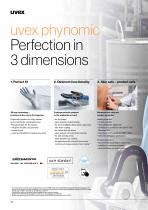
uvex uvex phynomic Perfection in 3 dimensions 2. Optimum functionality3. Skin safe - product safe 3D ergo technology -precision all the way to the fingertips Ergonomic solution for every wearer: up to 8 perfectly coordinated sizes The advantages for the wearer: • the glove fits like a second skin • natural touch • maximum flexibility for fatigue-free work Coatings perfectly adapted to the application at hand • for dry areas: aqua-polymer waterproofing • for dry and slightly damp areas: aqua-polymer foam coating • for humid and oily areas: aqua-polymer xtra grip foam coating • for wet and oily...
Open the catalog to page 12All UVEX catalogs and technical brochures
 uvex safety gloves 2023
74 Pages
 uvex complete catalogue 2023
438 Pages
 uvex main catalogue 2022
416 Pages
 Safety Footwear
2 Pages
 Breathing Protection
28 Pages
 Safety Helmets
38 Pages
 Hearing Protection
26 Pages
 Safety Eyewear
66 Pages
 catalogue-2019-2020
457 Pages
 Extra-soft earmuffs
8 Pages
 SelectToGo
6 Pages
 uvex u-sonic
4 Pages
 uvex i-works
3 Pages
 uvex sportstyle
4 Pages
 uvex 2 Pushing the limits
4 Pages
 HexArmor
36 Pages
 uvex safety solutions
36 Pages
 catalog uvex
8 Pages
 uvex_Safety_Catalogue_2019
414 Pages
 Prescription Safety Eyewear
28 Pages
 Disposable Protection Clothing
16 Pages
 Protective clothing Workwear
12 Pages
 uvex silv-Air
20 Pages
 uvex PPE Catalogue
341 Pages
 Safety Footwear
60 Pages
 Individual PPE
55 Pages
 Safety gloves
52 Pages
 Disposable protective clothing
14 Pages
 Safety Eyewear
50 Pages


Archived catalogs
 Safety Helmets
18 Pages
- Shoes
- Fabric clothing
- UVEX mechanical protection glove
- UVEX polyester clothing
- Anti-slip safety shoes
- Cotton clothing
- Electrical protection safety shoes
- UVEX work glove
- UVEX industrial glove
- Anti-static safety shoes
- UVEX 10 glove
- UVEX 9 glove
- Work jacket
- UVEX EN 388 glove
- UVEX 8 glove
- Chemical protection safety gloves
- Handling protection gloves
- UVEX plastic glove
- UVEX anti-cut glove
- Work pants