
- Catalogs
- UVB TECHNIK s.r.o.
- Brochure SZ

- Products
- Catalogs
- News & Trends
- Exhibitions
Brochure SZ

Brochure SZ
The document discusses the challenges of removing oils and emulsions from steel strips in cold rolling mills. These contaminants can affect the quality of the final product, becoming apparent after processes like annealing and galvanizing. Traditional methods of cleaning, such as using textile rags or high-pressure air, have limitations and can lead to further contamination or inefficiency.
Current Cleaning Methods
Existing methods include rag squeegees, high-pressure air blowing, and scraping rolls. Each has drawbacks such as inefficiency, potential for additional contamination, and dependency on various parameters like strip speed and thickness.
UVB TECHNIK's Wiping Equipment
UVB TECHNIK has developed a new wiping equipment that uses interchangeable wiping slats in floating frames, allowing for better adaptation to the strip's movement. This design reduces wear and minimizes surface damage. The equipment uses pneumatic cylinders for adjustable pressure and includes pressurized air jets to enhance drying.
Wiping Slats
The wiping slats are crucial for removing residuals from the strip. They come in different profiles and materials (NBR, PVC, TPU), each suited for specific conditions like temperature and strip speed. TPU is highlighted for its effectiveness due to its hardness and thermal resistance.
Technical Parameters
The equipment can handle strips up to 2000 mm wide, with no speed restrictions, and temperatures up to 150°C. It offers several advantages, including improved strip quality, higher rolling speeds, and ecological benefits.
Ecological Advantages
The equipment reduces waste and consumption of oils and emulsions, eliminates dangerous fumes during annealing, and supports recycling of plastic materials used in slats.
Conclusion
Thermal polyurethane is identified as the most effective material for wiping slats, offering ideal hardness and resistance. The combination of TPU and the described equipment provides an optimal solution for cleaning impurities and residuals from rolled strips.
This project received financial support from the Czech Ministry of Industry and Trade.
Catalog excerpts
WIPING OF OILS AND EMULSION FROM STEEL STRIP IN COLD ROLLING MILLS INTRODUCTION In the cold rolling process, the surface of the rolled strip is contaminated by cooling oil or emulsion and other pollutants that could considerably influence the final quality of the strip. Unfortunately, this will usually become visible only after subsequent operations such as annealing, galvanising, phosphate or powder coating, etc. Rolled strip is coiled at the exit end into coils containing all these gathered impurities and cooling emulsion and thus losing valuable rolling emulsion which could probably be used again – provided we have a means to remove it before coiling. For a high quality of rolled material it is necessary that besides the final geometrical shape and thickness tolerance of the strip, the surface be clean. Present cleaning methods used Removal of cooling emulsions or oils from the rolled strip in rolling mills is presently done with the help of rag squeegees or sewn textile parts which quickly absorb oils and/or emulsions, rendering inefficient in a very short time. In addition, the release of textile fibre usually contributes to the soiling of the strip and subsequent strip quality problems after the final operations (for example, the well known scratch marks on the surface!). A further disadvantage is the lost of pulling power of the coiler due to increased friction between the “rag squeegee scraper” and the rolled strip. Another method is wiping (blowing off) by high air pressure blowing directly onto the strip. This method cleans the strip surface impurities only partially and due to the high air consumption is not widely used. Yet another method uses “scraping rolls”. Here the final result is dependent on the surfaces of rolled strip and scraping rolls, which could lead to impurities stuck on the roll’s surface further damaging the strip. Speed of rolling, strip flatness and strip thickness are also very important parameters that must be taken into consideration. More recently devised methods use differently shaped plastic squeegees in combination with suction of emulsion, which appear to be more effective. However, their fastening devices prevent flexibility and its adaptation to the running strip, rendering this method prone to fast abrasion of the plastic slats and insufficient wiping action. Wiping equipment of UVB TECHNIK Company Company UVB TECHNIK devised new equipment incorporating all the positive features mentioned above. For the strip cleaning / wiping action they use two pairs of opposite, interchangeable “wiping slats” fastened in sliding holders. These are subsequently held in “floating frames” enabling the adaption of the positioning, elevation and inclination of the slats to the movement of the rolled strip, reducing the “holding” (press down power), thus increasing the working life of slats and minimising the surface damage. For the adherence of the slats to the moving strip, a pair of side pneumatic cylinders is used with continuous, step-less regulation of the closing force. This method makes it possible to set up the residual quantity of the cooling emulsion on the strip. Furthermore, careful adjustment of the “hold-down pressure” increases the slats´ working life without impairing the efficiency of the rolled strip wiping function. An important part of the whole mechanism is pressurized air blow, via jets positioned between the wiping slats. This also speeds up the drying of the rolled strip. The principle of “pressurized air blow off” is based on the creation of air overpressure between the first and second “wiper slats” restricting oil or emulsion penetration where there is lower adhesion of wiping slats to the whole strip cross-section, thus enabling correct emulsion / oil removal even at lower slats adhesion. First slat (in the direction of moving strip) provides rough wiping of the cooling liquid and the second secures clean wipe and closes the space for supplied air overpressure (see Fig. 1). UVB TECHNIK s. r. o. Hlučín, Ostravská 79A , CZ 748 01 Hlučín , tel.:+420 595044444, fax:+420595044700, e-mail: [email protected], www.uvbtechnik.cz
Open the catalog to page 1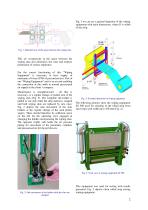
Fig. 3 we can see a general depiction of the wiping equipment with main dimensions, where D is width of the strip. Fig. 1: Detailed view of the space between the wiping slats This air overpressure in the space between the wiping slats also minimizes slat wear and restricts penetration of surface impurities. For the correct functioning of this “Wiping Equipment” is necessary to have supply of minimum of 6 bars (PN6 of pressurized air). Part of our “Wiping Equipment” unit is an air unit enabling the connection of this outfit to normal pressurized air supply in the client’s company. Maintenance...
Open the catalog to page 2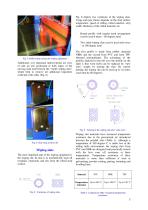
Fig. 8 depicts two variations of the wiping slats. Usage and type choice depends on the strip surface temperature, speed of rolling, rolled material, strip width, thickness of the rolled material, etc. - Fig. 5: Rolled strip exiting the wiping equipment Additional, very important improvements are rows of side air jets positioned at both edges of the moving strip and between the “trailer wiping slats” which help to remove all additional impurities collected at the sides (Fig. 6) Round profile with regular teeth arrangement (can be used 6 times – 60 degrees turn) Two sided wiping slats (can be...
Open the catalog to page 3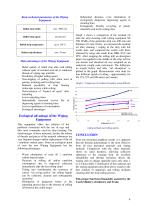
Basic technical parameters of the Wiping Equipment Rolled strip width Rolled strip speed Rolled strip temperature Rolled strip thickness Main advantages of the Wiping Equipment - Better quality of rolled strip after cold rolling without spots of residual used oil or emulsion, threads of wiping rags and felts Possibility of higher rolling speed Non-slipping of pulling rolls when used in parting, trimming and levelling lines Reduced possibility of strip floating (telescopic action) while coiling Non-existence of “burned oil spots” after annealing Lower annealing times Substantially increased service...
Open the catalog to page 4All UVB TECHNIK s.r.o. catalogs and technical brochures
 Signal Conditioner
3 Pages
 Transducers
2 Pages
 Brochure MPP
5 Pages

- Measuring device
- Measuring machine
- Inspection system
- Thickness gauge
- Digital gauge
- Displacement transducer
- Linear displacement sensor
- Automatic measurement system
- Camera inspection system
- Analog displacement transducer
- Non-contact displacement sensor
- In-line inspection system
- Compact displacement sensor
- Length gauge
- Rugged displacement sensor
- LVDT displacement sensor
- Thickness measuring system
- Stationary thickness gauge
- Automatic calibration thickness gauge