
- Catalogs
- ULTRAWAVES Wasser- & Umwelttechnologien GmbH
- Biogas Plants


Biogas Plants

Biogas Plants
Ultrawaves' ultrasound systems are utilized in agricultural biogas plants to enhance the anaerobic degradation of biomass materials such as renewable raw materials, maize, and slurry. This technology can either increase biogas production without changing substrate supply or reduce biomass input without loss in biogas output.
Technical Challenges and Ultrasound Solutions
Anaerobic fermentation is a mature technology where biomass is decomposed by bacteria at around 37°C, producing methane-rich biogas. The process is slow due to the difficulty bacteria face in breaking down solid biomass. Ultrasound technology addresses this by enhancing the hydrolysis step, breaking down cell structures, stimulating microorganisms, and releasing enzymes, thus accelerating degradation.
Intensification of Fermentation
Ultrasound intensifies fermentation by increasing enzyme release and stimulating microorganisms. It enhances the interface between liquid and solid phases, facilitating enzymatic action. This results in more efficient digestion, increased biogas production, and improved methane content. Ultrasound also reduces the viscosity of fermenter content, lowering energy consumption for agitators and pumps.
Design and Integration
Ultrasound systems are compact and easy to integrate into existing biogas plants. Typically, a partial flow of fermented biomass is sonicated and returned to the fermenter, requiring minimal space and connections.
Practical Results: Bordesholmerland Biogas Plant Case Study
The Bordesholmerland biogas plant in Germany serves as a practical example. With ultrasound technology, substrate supply was reduced by 17% while maintaining biogas production. Methane content increased by 2%, and viscosity reduction led to lower power consumption.
Summary of Advantages
- Intensification of fermentation
- Increased biogas production
- Higher methane content
- Substrate savings
- Reduced viscosity
- Lower power consumption for agitators and pumps
About ULTRAWAVES
Founded in 2001, Ultrawaves GmbH specializes in high-power ultrasound systems for water and environmental engineering, with applications in wastewater treatment and biogas plants. The company collaborates with research facilities and industrial partners globally.
Catalog excerpts
Biogas plants More energy from biomass by ultrasound
Open the catalog to page 1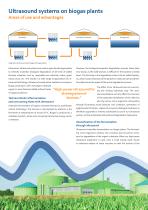
Ultrasound systems on biogas plants Areas of use and advantages secondary fermenter storage tank Integration of ultrasound technology into biogas plants Ultrawaves‘ ultrasound systems are used in agricultural biogas plants However, the biological anaerobic degradation process takes place to intensify anaerobic biological degradation of all kinds of added very slowly, as the solid biomass is difficult for the bacteria to break biomass materials, such as, renewable raw materials, maize, green down. The first step in the degradation chain is the so-called hydroly- waste, slurry, etc. This results...
Open the catalog to page 2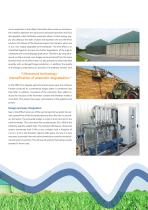
micro-organisms is stimulated. Sonication also causes an increase in the interface between the liquid and solid phase (particles and flocs disintegrate), which facilitates enzymatic attack. Further energy supply also destroys the walls of plant and bacterial cells and therefore results in the release of the dissolved organic cell contents, which are in turn very readily degraded by fermentation. The end effect is an intensified digestion process with further degradation of the organic substrates and increased biogas production. Therefore, by using ultrasound, on the one hand more biogas can be...
Open the catalog to page 3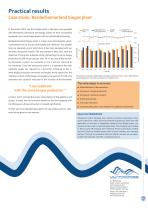
Practical results Case study: Bordesholmerland biogas plant In December 2007, the first biogas plant in Germany was operated with Ultrawaves ultrasound technology. Today we have successfully substrate line 2 with ultrasound biogas line 2 with ultrasound 7000 equipped many more biogas plants with our ultrasound technology. standard ultrasound reactor. The test started in May 2011 with the objective of using less substrate while maintaining the same biogas production (6,150 m³ per day per line). 36 m³ per day of the second- lines are operated, one of which (line 2) has been equipped with our ultrasound...
Open the catalog to page 4All ULTRAWAVES Wasser- & Umwelttechnologien GmbH catalogs and technical brochures
 BIOSONATOR
2 Pages
 WWTP
WWTP6 Pages