

PLA

PLA
Catalog excerpts
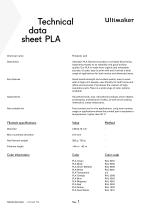
Technical UltiMaker Chemical name Description Polylactic acid Ultimaker PLA filament provides a no-hassle 3D printing experience thanks to its reliability and good surface quality. Our PLA is made from organic and renewable sources. It's safe, easy to print with and it serves a wide range of applications for both novice and advanced users. Good tensile strength and surface quality, easy to work with at high print speeds, user-friendly for both home and office environments, PLA allows the creation of high-resolution parts. There is a wide range of color options available. Household tools, toys, educational projects, show objects, prototyping, architectural models, as well as lost casting methods to create metal parts. Food contact and in-vivo applications. Long term outdoor usage or applications where the printed part is exposed to temperatures higher than 50 °C. Filament specifications Diameter Max roundness deviation Net filament weight Filament length Value Method Color information Color code PLA Transparent PLA Orange PLA Blue PLA Magenta PLA Red PLA Yellow PLA Pearl White Technical data sheet — Ultimaker PLA
Open the catalog to page 1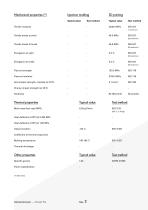
Tensile modulus Tensile stress at yield Tensile stress at break Injection molding 3D printing Typical value Test method Typical value Izod impact strength, notched (at 23°C) - - 5.1 kJ/m2 Charpy impact strength (at 23°C) - - - Test method ISO 527 (1 mm/min) ISO 527 (50 mm/min) ISO 527 (50 mm/min) ISO 527 (50 mm/min) ISO 527 (50 mm/min) ISO 178 ISO 178 ISO 180 Durometer Thermal properties Melt mass-flow rate (MFR) Heat deflection (HDT) at 0.455 MPa Heat deflection (HDT) at 1.82 MPa Glass transition Coefficient of thermal expansion Melting temperature Thermal shrinkage...
Open the catalog to page 2
Notes Properties reported here are average of a typical batch. The 3D printed test specimens were printed in the XY plane, using the normal quality profile in Cura 2.1, an Ultimaker 2+, a 0.4mm nozzle, 90% infill, 210 ˚C nozzle temperature and 60 ˚C build plate temperature. The values are the average of 5 white and 5 black specimens for the tensile, flexural, and impact tests. The Shore hardness D was measured in a 7-mm-thick square printed in the XY plane, using the normal quality profile in Cura 2.5, an Ultimaker 3, a 0.4 mm print core and 100% infill. Ultimaker is constantly working on extending...
Open the catalog to page 3All Ultimaker catalogs and technical brochures
 Nylon
Nylon3 Pages
 Breakaway
2 Pages
 Ultimaker 2+
4 Pages
 Ultimaker 3
4 Pages
- Additive manufacturing machine
- 3D printer filament
- Industrial 3D printer
- Plastic additive manufacturing machine
- Prototyping 3D printing machine
- FDM 3D printer
- Large-format 3D printer
- ABS 3D printer
- 3D printer PLA filament
- PLA 3D printer
- Desktop 3D printer
- CPE filament
- 3D printer CPE filament
- 3D printer polyamide filament
- Polyamide filament
- ABS filament
- 3D printer ABS filament
- 3-axis 3D printer
- Black PLA filament