
- Catalogs
- UE SYSTEMS
- ULTRAPROBE 201 – GREASE CADDY


- Company
- Products
- Catalogs
- News & Trends
- Exhibitions
ULTRAPROBE 201 – GREASE CADDY

ULTRAPROBE 201 – GREASE CADDY
- Prolongs equipment life and prevents over-lubrication.
- Saves on working hours and operational costs.
- Improves maintenance efficiencies.
- Translates high-frequency sounds into audible range for easy monitoring.
- LEDs provide visual indication of ultrasound amplitude.
- Includes a built-in lamp for illuminating dark areas and a swivel base for adjusting to odd angles.
- Comes with heavy-duty headphones for high noise environments and a magnetically mounted transducer for ease of operation.
- Aluminum housing with dimensions of 13.3 x 6.7 x 4.5 cm.
- Operating temperature range: 0°C to 60°C.
- Relative humidity: 10-95% non-condensing at up to 30°C.
- Features a magnetically mounted piezoelectric transducer with a peak response centered around 38 kHz.
- Includes a 10-segment LED bar graph and a bright white LED for test area illumination.
- Power: Rechargeable nickel metal hydride with a time delay power-off feature.
- Weight: 0.45 kg (16 oz).
- Warranty: 1-year standard, extendable to 5 years with registration.
Catalog excerpts

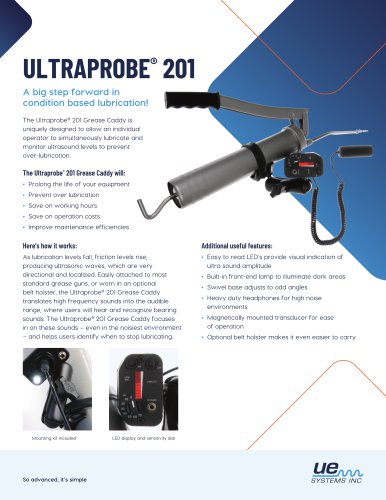
A big step forward in condition based lubrication! The Ultraprobe® 201 Grease Caddy is uniquely designed to allow an individual operator to si ultaneously lubricate and m monitor ultrasound levels to prevent over-lubrication. The Ultraprobe® 201 Grease Caddy will: • Prolong the life of your equipment • Prevent over lubrication • Save on working hours • Save on operation costs • Improve maintenance efficiencies Here's how it works: As lubrication levels fall, friction levels rise, producing ultrasonic waves, which are very directional and localized. Easily attached to most standard grease guns, or worn in an optional belt holster, the Ultraprobe® 201 Grease Caddy translates high frequency sounds into the audible range, where users will hear and recognize bearing sounds. The Ultraprobe® 201 Grease Caddy focuses in on these sounds – even in the noisiest environment – and helps users identify when to stop lubricating. Additional useful features: • Easy to read LED’s provide visual indication of ultra sound amplitude • Built-in front-end lamp to illuminate dark areas • Swivel base adjusts to odd angles • Heavy duty headphones for high noise environments • Magnetically mounted transducer for ease of operation • Optional belt holster makes it even easier to carry
Open the catalog to page 1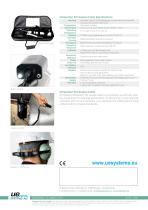
Ultraprobe® 201 Grease Caddy Specifications Housing Construction Dimensions Operating Temperature Relative Humidity Circuity Transducer Frequency Response Indicator Optional carry case Sensitivity Selection Power Power off Low Battery indicator Headset Attachment Weight Warranty Attaches directly to the grease gun, gives visual and audible indication for proper lubrication Aluminum housing 13.3 x 6.7 x 4.5 cm (LWH) (5.25" x 2.65" x 1.25") 0 °C to 60 °C (32 °F to 140 °F) 10-95% non-condensing at up to 30 °C (86 °F) SMD/Solid State heterodyne receiver Magnetically mounted piezoelectric transducer...
Open the catalog to page 2All UE SYSTEMS catalogs and technical brochures








Archived catalogs
 Ultra-Trak 750
2 Pages
 Ultraprobe 9000
2 Pages
 Ultraprobe 2000
2 Pages
 Ultraprobe 100
2 Pages
 Ultraprobe 15,000
4 Pages
 Ultraprobe 10,000
4 Pages
 Ultraprobe 3000
2 Pages
 Ultraprobe Accessories
2 Pages
 Ultrasound Applications
2 Pages
 ULTRAPROBE 15.000 IS
2 Pages
 Remote Access Sensor
2 Pages
 ULTRAPROBE 9000ATEX
2 Pages
 ULTRAPROBE 2000ATEX
2 Pages
 ULTRAPROBE 10.000
4 Pages
 4Cast
4Cast2 Pages
 ULTRAPROBE 15.000
4 Pages
 OnTrak
2 Pages
 UltraView
2 Pages

- Digital imager
- Visible imager
- Industrial camera module
- Management software solution
- Analysis software solution
- Full-color camera system
- Windows software
- Detection camera system
- Industrial software
- Waterproof camera module
- Leak monitor
- Reporting software
- Real-time monitoring module
- Portable camera system
- Greasing system
- Planning software solution
- Gas leak detector
- Continuous monitoring module
- Condition monitoring module
- Digital monitoring module