

Virtual Station

Virtual Station
The document discusses the integration of robots and automated systems in modern car and truck assembly, emphasizing that human involvement remains crucial due to the complexity and variability of the process. Effective assembly relies on fast and reliable product identification to provide operators with necessary information.
Virtual Station Overview
Virtual Station is introduced as a new standard for rapid assignment and agile relocation of identification-driven processes on the assembly line. It aims to reduce the costs and resource demands associated with traditional identification technologies like barcodes and passive RFID.
Core Capabilities
- Software-driven identification allows for rapid process assignment and relocation.
- Eliminates the need for barcode scans and other legacy identification technologies.
- Utilizes trigger events from line encoders, PLCs, or Ubisense precision location sensor networks.
Rapid Reconfiguration
The document highlights the importance of identifying specific products on the line to ensure correct tool usage, part fitting, and task completion. Traditional identification technologies are costly and inflexible, leading to downtime during process changes. Virtual Station offers a malleable solution by removing hardware dependencies and creating software-driven 'virtual zones' that can be easily reconfigured.
Elimination of Fixed Identification Points
By tracking vehicles in real-time within a virtual factory model, Virtual Station eliminates the need for fixed identification points. Vehicles generate identification events upon entering active zones, which are transmitted to control systems like line-side tool controllers or Manufacturing Execution Systems (MES). This flexibility allows for easy reconfiguration and minimal production downtime.
Conclusion
Virtual Station represents a significant advancement in automotive assembly by providing a flexible, cost-effective solution for process identification and reconfiguration, enhancing the efficiency and adaptability of modern manufacturing lines.
Catalog excerpts
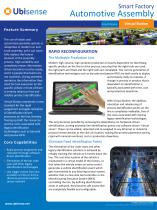
Automotive Assembly Smart Device Virtual Station Feature Summary The use of robots and automated assembly systems is ubiquitous in modern car and truck assembly, yet it can never fully replace the human element of the assembly process. High variability and complexity means information driven decisions must be made, and it is people that build cars, not machines. Giving assembly operators the information they need for task execution on the specific vehicle in front of them is entirely reliant on fast and reliable product identification. The Malleable Production Line Modern high volume, high variation production is heavily dependent on identifying specific product on the line to drive process, ensuring that the right tools are used, the right parts are fitted and the right tasks are completed. The current generation of identification technologies such as barcode and passive RFID are both costly to deploy and similarly costly to relocate. A change in process or product that is dependent on identification is typically associated with time, cost and production downtime. Virtual Station represents a new standard for the rapid assignment and agile relocation of identification‐driven processes on the line, thereby freeing up both the resources and the costs associated with legacy identification technologies such as barcode and passive RFID. With Virtual Station, the addition, relocation and rebalancing of process identification points on the line is completely malleable, free of the costs associated with moving legacy identification technologies. This only becomes possible by removing the dependency on hardware‐driven identification, turning assembly line identification points into software driven “virtual zones”. These can be added, relocated and re‐assigned to any Ethernet or industrial protocol‐driven devices at the click of a button, making the process placement activity rapid with minimal overhead, cost or production downtime. Core Capabilities relocation through software‐ driven identification Elimination of the bar code scan and other legacy identification technologies Use trigger events from line encoders or PLCs or from a Ubisense precision location sensor network The elimination of bar code scans and other legacy identification solutions is achieved by reliably tracking the vehicle as it travels down the line. The real‐time location of the vehicle is maintained in a virtual model of the factory, so that when the vehicle enters an active zone it generates a vehicle identification event which gets transmitted to any listening control system, whether that is a line‐side tool controller or the Manufacturing Execution System (MES) controlling the line. By defining identification zones in software, they become soft assets that are completely flexible and configurable.
Open the catalog to page 1All Ubisense catalogs and technical brochures
 Series 7000 Industrial Tag
2 Pages
 myWorld inside - telecoms
2 Pages
 myWorld - telecoms
2 Pages
 IT Requirements
1 Page
 Operations Centre
2 Pages
 Process Improvement
2 Pages
 Explorer
1 Page
 Smart Factory Offline
2 Pages
 Korean?certified IP Sensors
2 Pages
 RTLS Hardware
2 Pages
 Research Package
2 Pages


