
- Catalogs
- Tyrolit - Schleifmittelwerke Swarovski AG & Co K.G
- INDUSTRIAL SUPPLY

INDUSTRIAL SUPPLY

INDUSTRIAL SUPPLY
TYROLIT, part of the SWAROVSKI Group, is a leading manufacturer of bonded grinding, cutting, sawing, drilling, and dressing tools. The company focuses on environmentally friendly practices and customer-specific solutions through its global network of production centers and sales companies.
TYROLIT is expanding with 28 production centers in 13 countries and a workforce of approximately 4,113, aiming to grow its global sales network.
TYROLIT emphasizes customer relations, innovation, and quality, viewing customers as partners and focusing on strategic solutions. Innovation is driven by employee creativity, and quality is ensured through ISO 9001:2000 certification and adherence to European standards.
TYROLIT prioritizes safety through its membership in the Organisation for the Safety of Abrasives (oSa) and collaboration with safety authorities, aiming to provide high-quality and safe products.
TYROLIT products are categorized into three quality lines: PREMIUM, STANDARD, and BASIC, each offering different performance levels and price points.
Since 2008, TYROLIT has introduced a new product design with simplified markings and a user-friendly brand image to enhance sales and customer experience.
The TYROLIT catalogue is organized into sections for construction-related trade, industrial supply, and construction professionals. The POS system is designed for easy assembly and provides clear product organization.
The document provides detailed specifications for resin-bonded and diamond tools, including labeling, color codes, and material applications. It also includes information on grinding wheel designations and bond types.
The catalogue covers various tools such as straight grinders, angle grinders, petrol cutting saws, and stationary cut-off wheels, with detailed application tables and specifications for each tool type.
Precision tools are categorized by application, including grinding, sharpening, cutting, and dressing, with specific information on grinding wheel types and materials.
The document outlines specifications for tool grinding wheels with superabrasive materials, specifically cup wheels like TYROLIT Amigo or Diago. Key dimensions include external diameter, floor thickness, bore diameter, and others related to the shape and abrasive coating of the wheel.
Dressing is essential to maintain the grinding wheel's performance by compensating for wear and ensuring optimal grinding results. The document details various dressing tools and their applications, such as single-grain and multi-grain dressers, and highlights common errors in dressing.
Tables are provided to help select the appropriate grit size for desired surface roughness and profile radius. Larger grain sizes are noted for easier material removal.
Guidelines for rotational and peripheral speeds based on the grinding wheel's external diameter are provided, along with pictograms for different machines and materials.
Emphasizes the importance of safety in grinding operations, including proper machine and wheel synchronization, storage, and handling of grinding wheels. Safety measures include checking wheels for damage, proper clamping methods, and conducting test runs before use.
Details various clamping methods for grinding wheels, such as using wheel flanges, embedded fixing elements, and support plates. Each method is described with specific requirements to ensure safe and effective clamping.
Before use, grinding wheels must undergo a test run at maximum operating speed. Personal safety measures, including eye protection and protective clothing, are mandatory during grinding tasks.
The document concludes with a summary of key points for safe grinding wheel use, emphasizing machine data adjustment, skilled mounting, and personal safety.
- Ensure wheel flanges are clean, flat, and suitable for clamping the grinding tool. Use intermediate layers between the grinding wheel and flanges as intended.
- Operate machines with proper guards and ensure they are in good condition before use. Conduct a test run for at least one minute at operating speed after each mounting.
- Always wear eye protection during grinding processes. Use protective goggles or a safety mask for off-hand grinding.
- Ensure air supply and protective measures are adequate for the material being processed. Fit suitable extraction systems for dry grinding processes.
- Do not use abrasives exposed to humid conditions or high temperatures before mounting. Avoid using damaged or dropped abrasives.
- Never exceed the maximum permissible operating speed. Avoid using wheel flanges with foreign bodies, and do not overtighten clamping devices.
- Use only one-way adapters once and ensure the machine's protection cover is securely fixed before starting.
- Ensure sufficient air supply and personal safety equipment when working with grinding tools.
- Various grinders (straight, angle, petrol cutting) are available with resin-bonded and diamond dry-cutting saws for different materials like steel, concrete, and abrasive materials.
- Products are categorized into Premium, Standard, and Basic quality lines, each suitable for specific applications and target groups such as construction, shipbuilding, and vehicle repair workshops.
- Application tables provide specifications for materials like steel, stainless steel, aluminum, and stone, indicating the appropriate cut-off wheels for each.
- Cut-off wheels are designed for long service life and maximum cutting ability, with options for fast, convenient, and low-burr cutting.
- Cut-off wheels are available in various dimensions and specifications, suitable for cutting metal sheets, profiles, pipes, and rods.
- Innovative ultra-thin cut-off wheels offer maximum performance, clean cutting areas, and low thermal load on workpieces.
- Color coding systems help identify the right product for specific materials or applications.
- Cutting Tools The document lists several types of cutting tools, including angle grinders and petrol cutting saws. Each tool is specified by type number, shape, dimensions, and classification. The materials these tools can machine range from universal building materials to hard concrete and abrasive materials.
- Grinding Tools This section covers straight grinders and angle grinders, detailing the types of grinding wheels available, their specifications, and the materials they are suitable for. The document emphasizes the long service life and high performance of these tools.
- Material Compatibility Each tool is associated with specific materials it can machine, such as concrete, reinforced steel, asphalt, and more. The document highlights the versatility of these tools in handling various materials.
- Product Quality and Classification Tools are classified into premium, standard, and basic categories, indicating their quality and suitability for different applications. Premium tools offer maximum cutting ability and long service life.
- Innovative Features The document mentions innovative products like ultra-thin and sound-insulated dry cut-off saw blades, which enhance the performance and safety of the tools.
- Designed for grinding, deburring, and shaping operations, particularly effective on spherical curved surfaces.
- Combines advantages of different grinding tools with easy handling.
- Features unique geometry for ergonomic use and cool grinding, minimizing material damage.
- Vibration-free and adaptable to workpieces.
- Various types and dimensions are listed, such as 29RON and 27A/28A, with specific classifications and uses.
- Premium tools are noted for their high performance and versatility in grinding jobs on steel and stainless steel.
- Suitable for universal grinding jobs, including surface and edge grinding and deburring.
- Features self-sharpening ceramic abrasive grit for high-alloyed steels, ensuring longer tool life and consistent surface finish.
- Optimized for surface and edge grinding with long service life and easy cutting ability.
- Available in various specifications for different materials and applications.
- Professional tools for large area grinding, edge grinding, and bevelling, especially in casting houses and steelworks.
- Available with different bore designs for tool fitting.
- Effective in removing rust, paint, and sealants, preparing surfaces for welding and anodizing.
- Characterized by a lack of clogging and smearing, with long life and low heat build-up.
- Allows for fine grinding to polishing with an angle grinder, suitable for vehicles, containers, and airplanes.
- Available in different abrasives and grades of fineness.
1. Type 477724: Shape 50HAG, Dimensions 185x20x8, Specification D30ST, 1 carat.
2. Type 477726: Shape 50HAG, Dimensions 185x30x10, Specification D2ST, 2 carat.
3. Type 477254: Shape 50HAG, Dimensions 250x40x10, Specification D35ST, 3 carat.
4. Type 195112: Shape STSEG, Dimensions 185x5x8, Specification HA_DIA.
Recommended hand-guided dressing tools include Shape 90AR and diamond dressers in Shapes 50HAG and STSEG.
1. Type 15321: Shape 100AKO, Specification S3610, for A+C grinding wheels, Diameter 120-250 mm, Max thickness 40 mm, Grit size 24-80, Hardness H-Q.
2. Type 74497: Shape 100AKO, Specification S3611, for A+C grinding wheels, Diameter 300-600 mm, Max thickness 63 mm, Grit size 16-60, Hardness H-Q.
1. Type 74492: Shape 100ARO, Dimensions 36x21x8, Specification S3610.
2. Type 74493: Shape 100ARO, Dimensions 55x39x12, Specification S3611.
3. Type 75915: Shape 100ARO, Dimensions 55x65x12, Specification S3612.
Type 26571: Shape 100ASB, Dimensions 12x6x75, for dressing and trueing conventional grinding wheels.
Tyrolit has offices in multiple countries including Argentina, Australia, Belgium, Brazil, China, Denmark, Estonia, Germany, Finland, France, India, Indonesia, Italy, Netherlands, Norway, Austria, Poland, Portugal, Sweden, Switzerland, Spain, Thailand, Czech Republic, United Kingdom, Hungary, USA, and UAE. Each entry includes the company name, address, telephone, and fax numbers.
Catalog excerpts

industrial supply A Company of the SWAROVSKI Group
Open the catalog to page 1
— Petrol cutting saws - Resin 59 — Application tables Straight grinder Resin Angle grinder Resin Angle grinder Diamond 75 L Petrol cutting saws - Diamond 83
Open the catalog to page 2
— Rough cleaning discs 99 — Cemented carbide cutters 116 Angle grinder Resin 127 Rough grinding discs 128 — Premium Flap discs 136 — Standard Rough Rough cleaning discs 146 — Standard Flap discs 149 Rough grinding discs 151 — Basic Flap discs 154 Angle grinder Diamond 155 Floorstand grinding wheels -Sharpening and polishing wheels ■External cylindrical grinding -Reciprocating surface grinding -Profile surface grinding ■Surface grinding — Internal cylindrical grinding Hand held grinding — Universal tool grinding — Pedestal / swing
Open the catalog to page 3
restruCtured: prOduCt CatalOgue Dear business partners, We have taken the liberty of making the product catalogue clearer. It is split into the main sections cutting, grinding and precision, where in each section cutting through the subsections/machines used – straight grinders, angle grinders, petrol cutting saws and stationary cut-off wheels grinding through the subsections/machines used – straight grinders, angle grinders and floorstand grinders and precision through the subsections/applications – grinding, sharpening, cutting and dressing you are guided to the individual products. 4
Open the catalog to page 4
tyrOlit is one of the largest manufacturers of bonded grinding, cutting, sawing, drilling and dressing tools in the world. The company is also a provider of tools and machines. A system partner that tailors its complete cutting and grinding solutions in close cooperation with its customers, Tyrolit achieves and provides customer-specific solutions through the hard work of highly-skilled application engineers. A company that is continously investing to ensure that its products are as environmentally friendly as possible in terms of their manufacture, use and disposal. tyrOlit in eXpansiOn TYROLIT,...
Open the catalog to page 5
prinCiples Customer relations We view our customers as partners with the aim of achieving a lasting win-win situation. The success of our customers lies in the quality of our products, our knowledge of application technology and the provision of customer-specific on-site solutions. Close cooperation with our customers leads to remarkable strategic developments and ensures long-term success for both parties. Our global network of production centres, sales companies and our carefully selected local service provision means that we see TYROLIT as a global company for our internationally-active customers...
Open the catalog to page 6
prinCiples QualitY Our strength was, is and remains an unbeatable combination of tradition, innovation and quality. Our quality level is characterised by our constant striving to improve quality, an attribute that is embedded in the strategic orientation of the company. It is this characteristic that guarantees our customers the usual high quality standards they expect of TYROLIT. The TYROLIT quality management system has been certified to ISO 9001:2000 by an external authorised body for the entire production area. Production is carried out in accordance with European Standards: EN12413 for grinding...
Open the catalog to page 7
saFety Brand tyrOlit Our aim was and is to make our products even safer for our users: Through our work as the founder member of the "Organisation for the Safety of Abrasives (oSa)," through close cooperation with the safety authorities, through practical communication with our users all over the world. aiM OF Osa The main aim of oSa is defined in terms of absolute protection for the users of grinding tools. Members undertake to: provide a consistently high level of quality, adopt a rigorous approach towards quality assurance, strive to develop new, improved standards of safety. 8
Open the catalog to page 8
Quality lines The restructuring of the product markings carried out in 2008, the aim of which was to make it easier to select the best product, has proved to be extremely successful. preMiuM ★★★ Quality tools for maximum performance: TYROLIT PREMIUM products are highest performers in the category, offering outstanding life and efficiency for optimum performance standard ★★ Quality tools for daily use: TYROLIT STANDARD products have been designed where high demands and frequent use are placed upon the tool in industrial and trade applications. They offer excellent price to performance ratio, reinforced...
Open the catalog to page 9
tHe neW prOduCt design The investment in the relaunch of our product image, also in 2008 has exceeded our expectations in just the same way as the restructuring of the product markings: Making the image of the TYROLIT brand even more visible and ultimately user-friendly. Since 2008, TYROLIT has presented: a new, simplified product marking broken down by quality levels a new, attractive product image a new, clearly structured POS new ways of promoting sales Aim To standardise, simplify and make the entire appearance of the TYROLIT brand more user-friendly. Benefits Easier to sell 10
Open the catalog to page 10
prOMOting sales tHe CataloGue series BY tYrolit Construction related trade Construction professionals This catalogue contains everything about: Construction related trade This catalogue contains everything about: Construction professionals Industrial Supply This catalogue contains everything about: Industrial Supply 11
Open the catalog to page 11
prOMOting sales tHe Pos It gives the right impression of the brand TYROLIT and ensures a clear organisation of the product in terms of areas of application levels of quality Diameter the POS also has enough space for additional information materials for customers. We’re here for you Assembly If requested, we can take on the planning of your range to meet customer requirements and will be happy to advise you regarding the best selling positions. The POS is easy to assemble using the enclosed assembly diagram and is available in the following versions: 12 Wall system Sales element in the room Counter...
Open the catalog to page 12
General information Explanation of labels 14 Table of recommended speeds 26 Specific information 18 Pictrograms & Safety 27 Dressing – the basics 22 Dos & Don'ts 33
Open the catalog to page 13All Tyrolit - Schleifmittelwerke Swarovski AG & Co K.G catalogs and technical brochures
 Tyrolit Factsheet
6 Pages
 FOCUR SA
4 Pages
 MIRA ULTRA SF
2 Pages
 STARTEC XP-P
2 Pages
 DIAMANT
8 Pages
 COOL CUT
18 Pages
 GENIS CF
2 Pages
 GENIS 2
2 Pages
 andorflex
4 Pages
 Diamond Saw
2 Pages
 flapdisc
2 Pages
 ABRASIVE PRODUCTS CATALOGUE
87 Pages
 saw
saw4 Pages
 Product Innovations 2015
20 Pages
 DIAMOND WET core drills
8 Pages
 Construction trade
148 Pages
 Tyrolit Flap Disc Program
12 Pages
 Skytec pcd-Basic+
12 Pages
 GENIS
GENIS6 Pages
 STARTEC CNC Flyer
22 Pages
 COOL-CUT Flyer
16 Pages
 Ring Saw Blades
6 Pages
 Glass
Glass6 Pages
 Ceramics
6 Pages
 Stone
Stone6 Pages
 Coated
71 Pages
 Construction Professional
114 Pages
 Tile saw TTE250
2 Pages
 Core drilling system DRS160
2 Pages


Archived catalogs
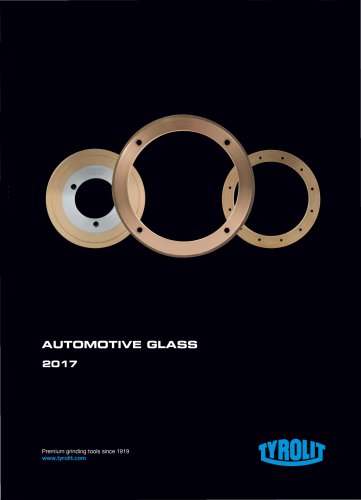 Automative class 2017
24 Pages
 CONSTRUCTION RELATED TRADE
125 Pages
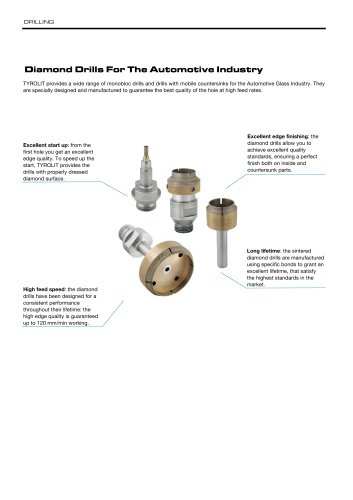
- Milling tool
- Solid milling cutter
- Drilling tool
- Steel milling cutter
- Solid drill bit
- Metal milling cutter
- Clamping milling cutter
- Milling cutter with cylindrical shank
- Surface treatment brush
- Cast iron milling cutter
- Cutting milling cutter
- Washing brush
- Sanding disc
- Metal brush
- Cutting edge milling cutter
- Circular saw blade
- Circular brush
- Metal saw blade
- 2-flute milling cutter