


FIRE PROTECTION General Products Catalog

FIRE PROTECTION General Products Catalog
- Automatic Sprinklers: Standard, extended coverage, storage, rapid response, dry, and special purpose sprinklers.
- System Valves & Devices: Wet, dry, deluge, preaction systems, and general-purpose valves.
- Piping & Electrical Products: Grooved piping, CPVC pipe & fittings, and electrical devices.
- Specialty Systems: Foam and Aquamist® systems.
- K-Factor: Ranges from 5.6 to 25.2
- Thread Size: 1/2" NPT to 1" NPT
- Sprinkler Finish: Natural Brass, Chrome Plated, White Polyester
- Applications: Light hazard, ordinary hazard, high density, and area/density applications
- K-Factor: Ranges from 11.2 to 25.2
- Thread Size: 3/4" NPT to 1" NPT
- Sprinkler Finish: Natural Brass, Chrome Plated
- Applications: High-piled storage, in-rack storage, warehouse, high challenge occupancies
- K Factor: Ranges from 4.2 to 8.0, indicating the flow rate of the sprinklers.
- Thread Size: Available in 1/2" NPT and 3/4" NPT.
- Finishes: Options include natural brass, chrome plated, and white polyester.
- Bulb Type: Available in 3 mm and 5 mm sizes.
- Intermediate Level Sprinklers: Include models TY-B, TY-FRB, TY-L, and TY-FRL, designed for areas where sprinkler guards are not required.
- Rapid Response Sprinklers: Designed for residential applications, meeting NFPA standards, and featuring BlazeMaster® CPVC pipe and fittings.
- Dry Sprinklers: Suitable for areas prone to freezing conditions, available in various lengths and finishes.
- Residential buildings, including single-family homes, apartments, and hotels.
- Areas with specific design requirements, such as beamed or sloped ceilings.
- Unheated warehouses, loading docks, and exterior platforms.
- Sprinkler guards and shields designed to minimize damage and protect against mechanical or physical impacts.
- Concealed and recessed models available for aesthetic considerations.
- Extended coverage options for specific hazard applications.
- ANSUL-A™: A fluorine-free surfactant foam concentrate for Class A combustible materials, compatible with compressed air foam systems (CAFS) at 0.1% to 1.0% concentration. Minimum storage temperature is 20°F (-6.7°C).
- TARGET-7™: Used for vapor mitigation and neutralization of toxic chemicals like chlorine dioxide and titanium tetrachloride, requiring an acidic or caustic agent for neutralization.
- JET-X®: High-expansion foam concentrate for Class A, B, and LNG fires, used with expansion ratios from 200:1 to 1000:1. Requires air aspirating foam discharge devices.
- SILV-EX®: Enhances water effectiveness for Class A fires, proportioned from 0.1% to 1% in various water types, and can be delivered via multiple methods including aircraft.
- 3% Fluoroprotein Foam: Designed for Class B hydrocarbon fuel fires, used with air aspirating discharge devices in fresh, salt, or hard water.
- JET-X® Generators: Water-powered, steel-constructed generators with a maximum output of 24,000 cfm, used for both portable and fixed-system applications without electrical power.
- Utilizes unique nozzles for fire protection, offering an alternative to traditional systems by using higher pressure and lower water flow, reducing costs and water damage.
- Applications include cable trays, clean rooms, computer rooms, and more.
- The MCC Mist Control Center is a pre-assembled unit for easy installation, requiring power, detection circuits, and adequate water supply.
- Fire extinguishment is achieved through evaporation and oxygen displacement, with small water droplets cooling gases and blocking radiant heat.
- Various nozzles and systems are detailed with specifications such as pressure requirements, coverage areas, and approved applications.
- Technical data sheets are referenced for detailed installation and maintenance guidelines.
Catalog excerpts
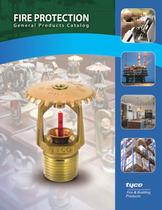
FIRE PROTECTION General Products Catalog Fire & Building Products
Open the catalog to page 1
FIRE PROTECTION General Products Catalog Tyco Fire & Building Products is a leading manufacturer and distrlbutor of water-based fire suppression Systems and components, offering one of the broadest Unes of fire protection System equipment worldwlde, Continually expandlng its capablllties through aggressive rcsearch and product developmcnt, it provides its customers effective fire protection and construction solutions for resldential, commercial, industrial, and lnstitutional buildings. Tyco Fire & Building Products serves a diverse group of specifiers, including architects, engineers, contractors,...
Open the catalog to page 2
STANDARD SPRAY SPRINKLERS 8158895 t\P PLIC StandardSpraySprinklersarecomprisedoftwo responses: standard and quick. Together they offer a wide range of sprinklers from which to choose when designing a standard coverage fire sprinkler System. Theaters ՕLightA Or dinar y Hazard Occupancies Schools 'ffice uծldings anks StandardResponseSprinklersare intended for use in fixe sprinkler Systems designed in accordance with the Installation mies recogntzed by the applicable Listing or Approval agcncy. Thcrc are two types or response clments: bulb and solder. Factones Libraries Sries TY-B bulb type sprinklers...
Open the catalog to page 7
AUTOMATIC SPR STANDARD SPRAY SPRINKLERS Upright, Pendent & Recessed Pendent » Allhazard ► 5 mm bulb Discharges a hemispherical water spray pattern in the area beneath the sprinkler ► Small frame, narrow profile bulb « = 5.6(80,6), k-ao 0150) x/imNPT* WNPT Style TO Օ Style 40 kfactor thread SiZtsojtchen sin escutcheonfinish white coated, chrome Plated, BrassPlated sprinkler finish Natural Brass* Chrome Plated, White Polyester, Lead Coated, Wax Coated, Wax over Lead Coated TY3151,TY3251fTY4151, TY425I,TY4851,TY4951 TFP15뻏 TECH DATA Horizontal, Recessed Horizontal & Vertical Sidewa Lighthazard/Ordinaryhazard KFACTOR K=5.6(80,6)...
Open the catalog to page 8
AUTOMATIC SPRINKLERS STANDARD SPRAY SPRINKLERS TYFRB Horizontal,RecessedHorizontalSidewall&VerticalSidewall Light hazard/Ordirary hazard * facto*___K^*Wգ>_ 3 mm bulb iHREADSitt W NPT___ Օ Designed for use in applications where escutcheonStyle 10 Style 20 aesthetics must beconsidered or where "e^՛tcheonfinishV^KeCoate<l Chrome building construction makes the installation Plated, Brass Plated of standard pendent or upright sprinklers ^nklrh ,mPract,cal Plated. White Polyester Õ Vertical sidewall sprinkler can be installed in Lead Coated either the pendent or upright position along jy'^331.TYiil...
Open the catalog to page 9
AUTOMATIC SPRINKLERS STANDARD SPRAY SPRINKLERS K FACTOR Light hazard / Ordinary hazard Solder type Suited for hotels, nursing homes and hospitals Օ Design allows piping to be confined to corridors, closets or service areas THREAD SIZE 72" NPT SPRINKLER FINISH Natural Brass, chrome Plated, Lead coated, Wax coated, Wax over Lead coated SIN TY3311 TECH DATA TFP120 TY-FRL Upright, Pendent & Recessed Pendent Light hazard/Ordinary hazard light hazard K=2.8 (40,3) Solder type 1 Typically used in hotels, motels, office buildings and other commercial and industrial applications k FACTOR K=2.8 (40,3)...
Open the catalog to page 10
EXTENDED COVERAGE SPRINKLERS «=2^2(362^9)_ MNPTorik>7-R k facto r thwao si7 Natural Brass TY9128 TFP213 sprinki fr finish BN_ TECH DATA Upright AH hazard Օ Solder type Extended coverage area/densծty Deflector design allows maximum coverage area of 14' X 14' (4,3m X 4Jm) Օ For use in high density applications such as*bk) box* retailng, extra hazard and hkjh-piled storage occupantes Minimum operating pressure of 7 ps (0,48 bar) 1/1 Pendent & Recessed Pendent Solder type Օ Extended coverage for hgher density applications Recessed configuration iskieal forretail applications Maximum 196sq.ft/sprinklerspacing...
Open the catalog to page 12
AUTOMATICSPRINKLERS EXTENDED COVERAGE SPRINKLERS Pendent & Recessed Pendent Light hazard Օ 3 mm bulb Covers areasas large as 20" x 20" (6,1 mx&l m) k facto r threadsize escutcheon _K=8.0111S,2) WNPT_ Style 30» Style 40 escutcheon finish White Coated, Chrome Plated Brass Plated sprinkler finish Natural Brass, Chrome _Plated White Polyester sin TY4232 toc h data TFP223 Pendent & Recessed Pendent Օ Light hazard 3 mm bulb Օ Coveraqeup to k factor threaosize K=5-6 180,6) 1 /2" NPT Style 50 escutcheon 20'x20'(6,l mx6,l m) escutcheon finish White Coated Chrome Plated Brass Plated spftinki frfinish...
Open the catalog to page 13
AUTOMATIC SPRINKLERS EXTENDED CQVERAGE SPRINKLERS TY-FRB Horizontal & Recessed Horizontal Sidewall Light hazard Օ 3 mm bulb Two-piece escutcheon converts sidewall sprinklers into low profile sprinkler assemblies with coverage areas up to 16' x 22' (4,9 m x 6,7 m) for K=5.6 and 16' x 24' (4,9 m x 7,3 m) for K=8.0 Օ Provides 3/4" NPT (19,1 mm) of horizontal adjustment from the flush sidewall position k factor K=5.6 (80,6) K=8.0 (115,2) thread size 1/2" NPT Օ 3/4" NPT escutcheon Style 10 Style 20 Style 30 Օ Style 40 escutcheon finish White Coated, Chrome Plated, Brass Plated sprinkler finish Natural...
Open the catalog to page 14
AUTOMATIC SPRINKLERS EXTENDED CQVERAGE SPRINKLERS Concealed Horizontal Extended Coverage Sidewall Light hazard 3 mm bulb Attractive concealed contour Coverage up to 16' x 22' (4,9 m x 6,7 m) Lowest flows & pressures allowed by NFPA 13 1/2" adjustment Push on / thread off option 12" maximum deflector distance from ceiling No "Slots" in cover plate K FACTOR K=8.0 (115,2) thread size 3/4" npt sprinkler finish Bright White, Chrome Plated, Custom sin TY4332 tech data TFP265 Concealed Pendent Light hazard Օ Covers 400 sq. ft. (37,2 m2) using less pressure than a standard 1/2" (12,7 mm) sprinkler at...
Open the catalog to page 15
AUTOMATIC SPRINKLERS STORAGE SPRINKLERS ESFR-1 K FACTOR K=14.0 (201,6) Pendent Early Suppression, Fast Response (ESFR) Օ Solder type Designed for the protection of rack storage Օ Eliminates many of the requirements for in-rack sprinklers Direct attack on burning fuel by improved heavy sprinkler discharge THREAD SIZE 3/4" NPT SPRINKLER FINISH Natural Brass SIN TY6226 TECH DATA TFP318 Patented frame design substantially reduces the frame shadow effects that often produce non-uniformity in spray pattern ULTRA K-17 Upright, Spթcifie Application Control Mode 5 mm bulb Օ Control mode sprinkler...
Open the catalog to page 19All Tyco catalogs and technical brochures
 Fire Protection Systems
16 Pages
Archived catalogs
 Global protection, all togetht
12 Pages
