
- Catalogs
- TUTCO SureHeat
- Collateral aerospace


- Company
- Products
- Catalogs
- News & Trends
- Exhibitions
Collateral aerospace

Collateral aerospace
Tutco SureHeat specializes in high-capacity electric in-line air heaters, crucial for simulating high-temperature and high-pressure conditions in aviation and aerospace industries. These heaters are integral to R&D and testing processes, offering advantages over traditional sheathed heating elements.
Historically, the aviation industry used sheathed tubular electric heaters, which are inefficient for air heating due to high thermal mass and poor heat transfer. These heaters require high operating temperatures, reducing efficiency and element lifespan.
Open-coil heaters offer several benefits: lower operating temperatures for longer element life, higher safe maximum process air temperatures, faster temperature changes, and higher watt density for compact design. These features enhance productivity and flexibility in demanding aerospace conditions.
Open-coil heaters require responsive control systems, achievable with modern power and temperature control technologies. Key components include SCR power controllers, PID loop temperature controllers, and high-limit safety devices, configurable for remote or local access.
Larger open-coil in-line heaters meet the high pressure and flow requirements of the aerospace industry. For instance, Tutco SureHeat heaters can heat air mass flow rates up to 200 lb/min to 1,000°F at pressures up to 300 psi, with compact designs for easy installation.
Key considerations for sizing include specifying the temperature rise and air mass flow through the heater. The formula kW = SCFM x (Delta T)/3000 helps determine heater power. Material selection for pipes and flanges depends on temperature and pressure conditions, ranging from stainless steel to super alloys.
For aviation and aerospace applications, selecting a heater system requires a partner with the right products and experience. Tutco SureHeat offers solutions tailored to the critical demands of these industries.
Catalog excerpts

Tutco SureHeat Your Custom Heat Solutions Partner By Matt Hargreaves General Manager, Tutco SureHeat High-capacity electric in-line air heaters, as an integral part of a compressed air system, are used throughout the aviation and aerospace industries for R&D simulation of the high-temperature and high-pressure conditions produced by an aircraft turbofan compressor. Open-coil electric heaters provide the most optimum heating solution for rig testing as compared with traditional sheathed (‘tubular’) heating elements. The advantages of open-coil technology for high-temperature and high-pressure A turbofan engine compressor stage generates the high-temperature and high-pressure air that directly feeds the engine internal combustion process and indirectly feeds the environmental control systems via high and low ‘bleed’ valve ports in the compressor. Traditional Heater Technology aviation industry Original equipment manufacturers (OEMs) of turbofan engines, ACMs, flow control valves, and other auxiliary equipment need a compact, efficient, and controllable system to provide pressurized hot air to enable their ongoing development efforts for new products. Similarly, FAA-certified repair stations also need this capability to provide pass/fail testing as part of the routine service and repair work on the ACMs, valves and other components necessary to extend the operating life of the aircraft. Historically, the aviation industry used sheathed element type tubular electric heaters for heating the compressed air for tes
Open the catalog to page 1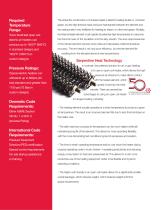
Required Temperature Range: Tutco SureHeat open coil electric air heaters can produce up to 1652°F (900°C) in standard designs and 1922°F (1050°C) in custom designs Pressure Ratings: Typical electric heaters can withstand up to 600psi (40 bar) standard and greater than 1100 psi (75 Bar) in custom designs Domestic Code Requirements: Either ASME Section VIII Div. 1 or B31.3 (process Piping) International Code Requirements: Pressure Equipment Directive (PED) certification Special control requirements On-site startup assistance or training The protective construction of a tubular heater is ideal...
Open the catalog to page 2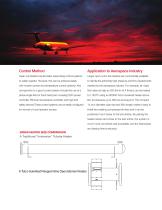
Control Method Open-coil heaters require faster responding control systems to safely operate. However, this can be achieved easily with modern power and temperature control systems. Key components to a good control system include the use of a phase angle-fired or burst-fired (zero crossing) SCR power controller, PID loop temperature controller, and high-limit safety devices.These control systems can be easily configured for remote or local operator access. Application to Aerospace Industry Larger open-coil in-line heaters are commercially available to handle the extremely high pressure and flow...
Open the catalog to page 3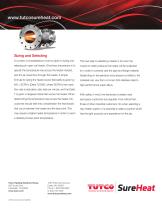
A number of considerations must be given to sizing and selecting an open-coil heater. Of primary importance is to specify the temperature rise across the heater needed, and the air mass flow through the heater. A simple formula for sizing the heater power (kilowatts) is given by: kW = SCFM x (Delta T)/3000, where SCFM is the mass flow rate in standard cubic feet per minute, and the Delta T is given in degrees Fahrenheit across the heater. When determining the temperature rise across the heater, the customer should take into consideration the heat losses that occur between the heater and the test...
Open the catalog to page 4Archived catalogs
 SureHeat Standard Air Heaters
42 Pages
 sureheat
2 Pages
 Custom Process Heat Solutions
16 Pages
 Hot Air Tools
3 Pages
 MC-5A Quick_Start_Guide
3 Pages

- Digital temperature control
- Digital temperature controller
- Automation temperature controller
- PID temperature control
- PID temperature controller
- TUTCO SureHeat gas heater
- Cartridge heater
- IP65 temperature controller
- Circulation heater
- Stainless steel heater
- Duct heater
- TUTCO SureHeat compact heater
- Explosion-proof heater
- TUTCO SureHeat high-temperature heater
- TUTCO SureHeat high-pressure heater
- Custom heater