
- Catalogs
- Tsubakimoto Chain
- Tsubaki Timing Belts and Pulleys PX/Ultra PX


- Company
- Products
- Catalogs
- News & Trends
- Exhibitions
Tsubaki Timing Belts and Pulleys PX/Ultra PX

Tsubaki Timing Belts and Pulleys PX/Ultra PX
This document serves as an instruction manual for the safe use of timing belts and pulleys, emphasizing the importance of thoroughly reading the belt catalog and instructions to ensure correct handling and safety.
- Danger: Imminent risk of death or serious injury due to incorrect handling.
- Warning: Possible risk of death or serious injury.
- Caution: Risk of personal injury or material damage.
Timing belts should not be used as harnesses, tow ropes, or insulators. They must comply with specific laws when in contact with food and should not be used outside indicated specifications.
Belts should be kept free from water, oil, chemicals, and dust to prevent deterioration. Noise may increase during high-speed operations, requiring sound insulation.
Belts should be stored at temperatures between -10℃ to +40℃ in low humidity and away from direct sunlight. Heavy belts require appropriate transportation equipment.
Safety covers should be installed over rotating parts. Proper tension and alignment are crucial to prevent premature breakage. Regular inspections and proper maintenance are necessary.
The warranty covers 18 months after shipment or 12 months after first use, whichever is shorter, excluding issues from improper use, maintenance, or external factors.
The document details various belt types, including PX BELT, ULTRA PX BELT, and SHINAYAKA 530, highlighting features such as high precision, low noise, and high efficiency. Specific types are designed for oil-proof, high-speed, and wet environments.
Includes belt tooth profiles, dimensions, materials, and installation tension recommendations. Transmission capacity tables and pulley specifications are also provided.
PX belts are made from chloroprene rubber with nylon fabric and fiberglass cords, designed for use with PX pulleys and operating within a temperature range of -15℃ to +80℃. They comply with the RoHS Directive but are not conductive, oil-proof, or waterproof.
Various belt lengths and corresponding numbers of teeth are listed for different belt models, with a comprehensive table for PX belts with different pitches.
Reference dimensions for pulleys are provided, including the number of teeth, pitch circle diameter, and flange outer diameter, crucial for selecting compatible pulleys.
The belts are made from chloroprene rubber, nylon fabric, and fiberglass cords, designed for low dust emission and not suitable for oil or water exposure.
Recommended installation tensions and maximum values for different belt widths are outlined, along with weight per meter and width factors for various belt sizes.
The belts comply with the RoHS Directive but are not suitable for conductive, oil-proof, or waterproof applications. Some belts are available as stock items, while others are made to order with short lead times.
Detailed specifications for various types of belts, including PX Belt Water Proof Type and Ultra PX Belt HC Type, are provided. The belts are made from materials such as chloroprene rubber, nylon fabric, and aramid fiber, with some models using high-intensity synthetic rubber and fiberglass.
Tables listing belt lengths, widths, and the number of teeth for different models are included, along with model identification examples.
Reference tables for pulley dimensions are provided, detailing the number of teeth, pitch circle diameter, and flange outer diameter for various pulley models.
Installation tension and recommended maximum values for different belt widths are outlined, along with unit mass and width factors.
Transmission capacity tables are referenced, indicating the power transmission capabilities of the belts. Sections on selection and design guide users on choosing the right belt and pulley combinations for their applications.
Some belt models are available as stock items, while others are made to order with short lead times.
The belts are designed for specific environmental conditions, with temperature ranges and usage limitations clearly stated.
ULTRA PX BELT OIL PROOF TYPE
- Belt Tooth Profile and Dimensions: Detailed specifications for various belt models, including tooth profile and dimensions.
- Model Identification: Example model numbers and their components, such as belt width, pitch length, and type.
- Materials: High-intensity synthetic rubber, wear-resistant fabric, and high-intensity fiberglass cord.
- Specifications and Characteristics: Includes transmission capacity tables, selection and design guidelines, and pulley specifications.
- Installation Tension: Recommended maximum values for different belt widths.
- Environmental Suitability: Oil and water-proof capabilities, with a temperature range of 0℃ to 60℃ in oil environments.
- Belt Tooth Profile and Dimensions: Similar structure to the oil-proof type, with specific model identification and dimensions.
- Materials: High-intensity synthetic rubber, wear-resistant fabric, and a hybrid of carbon fiber and high-intensity fiberglass cord.
- Specifications and Characteristics: Includes pulley specifications and installation tension values.
- Environmental Suitability: Not suitable for oil or water environments, with a temperature range of -15℃ to +80℃.
- RoHS Compliance: All belt types comply with the RoHS directive.
- Custom Orders: Belts are made to order with short lead times, and lot sales items are available upon inquiry.
- Pulley Dimensions: Reference dimensions for various pulley sizes and configurations.
- Tsubaki Belt Clamp: A standard stock product for fixing work to belts, available for immediate shipment.
The document provides detailed specifications for the ULTRA PX BELT HC TYPE, including transmission capacity and torque for various belt widths (15 mm, 40 mm, etc.). It includes tables showing standard transmission capacities and torque values, with width factors for different belt sizes.
- Belt width factors are provided for different sizes, affecting transmission capacity.
- Standard transmission capacity and torque are specified for belts of 15 mm and 40 mm widths.
The document outlines procedures for selecting and designing belt systems, emphasizing the importance of maintaining proper belt tension and pulley balance to ensure optimal performance and longevity.
- Avoid areas that shorten belt life.
- Ensure pulley speeds do not exceed 33 m/s to maintain balance.
The Tsubaki belt tension meter "T-ACE" is highlighted as a tool for accurately measuring belt tension using sound wave technology. It is lightweight, compact, and features a large LCD screen, memory function, and auto power-off.
- Measures tension without contact.
- Displays results in "N" or "Hz".
- Stores up to 10 measuring conditions.
The document provides a comprehensive guide for selecting timing belts and pulleys, including simplified selection tables and correction factors for various conditions such as load, speed increase, and start-stop frequency.
- Load correction factors vary based on application type and operational hours.
- Speed increase and start-stop frequency correction factors are provided to adjust for different operational scenarios.
The document serves as a technical guide for the selection, design, and maintenance of ULTRA PX BELT HC TYPE systems, emphasizing the importance of correct tension and balance for optimal performance.
- Motor output, revolution speed, and shaft diameter.
- Type and revolution speed of the driven machine.
- Center distance, hours of use, and frequency of start-stop per day.
- Speed ratio and use or nonuse of idler.
- Other conditions such as layout restrictions.
- Design power (Pd) is calculated using transmission power (Pk) and various correction factors: load (Ko), idler use (Ki), speed increase (Ks), start-stop frequency (Ka), and operation environment (Ke).
- Formula: Pd = Pk × (Ko + Ki + Ks) × Ka × Ke.
- Select a belt size based on design power and small pulley revolution using simplified selection tables.
- Select belt width and number of teeth for the small pulley from standard transmission capacity tables, ensuring compatibility with shaft diameter and avoiding colored areas in tables.
- Determine the number of teeth for the large pulley based on speed ratio and verify bore diameter.
- Calculate approximate belt length (L') and select the closest belt length from available types.
- Calculate center distance (C) using selected belt length.
- Ensure the number of meshing teeth is 6 or more; if less, apply a correction factor from Table 6.
- Engagement angles for drive and idler pulleys should be 120° or more and 90° or more, respectively.
- Ensure the belt width satisfies the design power or torque requirements using factors for belt width (Kw), meshing correction (Km), and belt length (KL).
- Design torque (Pt) is calculated similarly to design power, using transmission torque (Pm) and correction factors.
- Formula: Pt = Pm × (Ko + Ki + Ks) × Ka × Ke.
- Examples provided for selection based on power and inertial load, detailing the step-by-step process and calculations for determining belt and pulley specifications.
The document provides detailed calculations for determining belt length (L') and center distance (C) for a timing belt system. The approximate belt length is calculated using the formula L = 2C + 1.57(Dp + dp), where Dp and dp are the pitch circle diameters of the large and small pulleys, respectively. The center distance is calculated as C = (B + √(B² - 2(Dp + dp)²))/4, where B is the belt length minus 1.57 times the sum of the pitch diameters.
The document outlines the selection process for timing belts, including the determination of belt size, number of teeth, and belt width. It emphasizes the importance of guide flanges to prevent axial deviation of the belt and provides guidelines for their installation based on the type of transmission (horizontal, vertical, or multiple-shaft).
Idlers are recommended for adjusting installation tension and increasing the number of meshing teeth in cases of large speed ratios. The document specifies criteria for selecting inside and outside idlers, including minimum number of teeth and diameter requirements.
Proper alignment of pulleys is crucial to prevent belt deviation and damage. The document provides allowable ranges for pulley alignment and installation tension to ensure smooth operation and longevity of the belt system. It also includes methods for adjusting the distance between axes and applying installation tension.
The document lists various pulley types, materials, and dimensions, including aluminum pulleys with specific pitch, outside, and hub diameters. It also provides model identification examples and notes on the availability of special models.
The document serves as a comprehensive guide for the selection, design, and installation of timing belt systems, emphasizing the importance of precise calculations and proper alignment to ensure efficient and reliable operation.
Catalog excerpts

Since TSUBAKI’s “Timing Belt Drive” was introduced to the market in 1973, the timing belts and pulleys have ceaselessly been improved and new models developed to meet diversified needs of our valued customers. As an integrated manufacturer of power transmission products, TSUBAKI makes full use of its know-how and high engineering capability to continue to offer products that meet customers’ satisfaction. We believe you will find in this brochure “Timing Belts and Pulleys” that meet your needs.
Open the catalog to page 2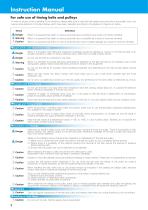
Instruction Manual For safe use of timing belts and pulleys In order to ensure correct handling of the products, please make sure to read the belt catalog and instructions thoroughly upon use paying close attention to the items below, which have been classified according to the degree of influence on safety. Danger Warning Caution When it is assumed that death or serious personal injury is imminent as a result of incorrect handling. When it is assumed that death or serious personal injury is possible as a result of incorrect handling. When it is assumed that there is a risk of personal injury...
Open the catalog to page 4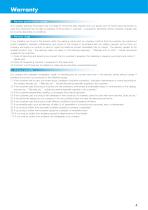
Warranty 1. Warranty period without charge Our company warrants the product free of charge for 18 months after shipment from our factory and 12 months after the product is used first (reckoned from the date of assembly of the product in customer’s equipment), whichever shorter. However, charges may be incurred, depending on conditions. 2. Warranty range If any problems are found in the product within the warranty period and our company confirms that the customer has carried out proper installation, operation, maintenance, and control of the product in accordance with the catalog, manuals, and...
Open the catalog to page 5
Over viewFeatures Precision drive As a mechanism of engaged-drive, timing belts realize precision drive with only little belt elongation. Low noise drive Compared to other power transmission elements such as gears, timing belts offer low-noise and smooth drive. Lube-free Timing belts are lube-free allowing a clean drive without spillage or contamination. High-efficiency rating Timing belts can transmit power efficiently with minimal energy loss. High-speed drive Timing belts can be operated at high-speed compared to other power transmission parts such as gears. ■ Backing :Durable and wear-resistant...
Open the catalog to page 6
PRODUCT Line-Up[ 1 ] PX BELT Compared to the trapezoidal belt, the performance of TSUBAKI PX belt is improved sharply through the adoption of a unique tooth contour. Moreover, there is an abundance of sizes available in the line-up to suit a variety of applications. Features ■ Ideal tooth engagement The unique contour of the teeth enables high torque drive.Transmission capacity is about 1.6 times that of the trapezoidal belt. ■ High jumping torque Large belt teeth provide high jumping torque capabilities. Low-noise drive is made possible by the adoption of a unique dimple on the tooth ends....
Open the catalog to page 7
Features of Ultra PX Belt HC Type High precision Halved operation elongation improves the transmission accuracy, which improves the precision of the equipment and eliminates the need for a belt tension re-adjustment. High strength The transmission capability is twice or more as high as the conventional PX belts. The belt width or the number of teeth of pulley can be reduced, allowing for a space-saving design. Ultra PX Belt HC Type Operation time & belt elongation Twice or more Transmission capability (kW) Belt elongation Minimized operation elongation Ultra PX Belt HC Type Comparison of transmission...
Open the catalog to page 8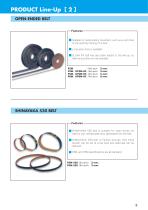
PRODUCT Line-Up[ 2 ] OPEN-ENDED BELT Features ■ Suitable for reciprocating movement, such as a cart drive or the opening/closing of a door. ■ Long-span drive is available. ■ ULTRA PX belt has also been added to the line-up, so high-torque drive is now possible. P2M (Belt pitch P3M、UP3M-HC(Belt pitch P5M、UP5M-HC(Belt pitch P8M、UP8M-HC(Belt pitch SHINAYAKA 530 BELT Features ■ SHINAYAKA 530 belt is suitable for clean drives, as there is very minimal wear dust generated from the belt. ■ SHINAYAKA 530 belt is flexible enough that initial tension can be set at a low level and axial load can...
Open the catalog to page 9
PRODUCT Line-Up[ 3 ] ULTRA PX BELT OIL-PROOF TYPE PATENTED : JP,US,DE,GB,FR,IT Oil-proof type belt developed based on the high-performance belt ultra PX belt HC type Oil-proof rubber is used for the belt. Even in conditions subject to oil splashes, the physical properties of the belt are hardly reduced. The belt can be used in conditions subject to oil splashes. ■ High strength and high precision This belt features equivalent transmission capability to the ultra PX belt HC type. Besides, it features very little operation elongation, allowing high-precision transmission. *Resistance for all...
Open the catalog to page 10
PRODUCT Line-Up[ 4 ] PX BELT WATER PROOF TYPE Belt most suitable for use in wet environment. ■ Most suitable for use in wet environment This belt can be used in wet environment where conventional timing belts cannot be used. It can be used in machines that are washed by water. When this belt is used, the waterproof cover can be simplified. ■ Clean, low noise and high precision This is a timing belt and thus produces less noise than other drive elements and provides cleaner drive. No lubrication is required. ■ PX standard pulleys can be used Since the PX tooth profile is employed, this can be...
Open the catalog to page 11
■ Belt Tooth Profile and Dimensions Rubber belt Pitch length mm ■ Materials Rubber : Chloroprene rubber Fabric : Nylon fabric (Low dust specification) Cord : Fiberglass Pulley : PX Pulley P2M Oil proof, Water proof : No ( Unusable ) Temperature Range : -15‘C~ +80C RoHS Directive : Compliance Conductive property : No ■ Belt Width / Width Factor / Unit Mass / Installation Tension Pulley Specifications
Open the catalog to page 12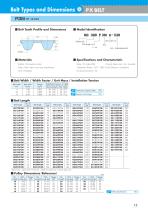
■ Belt Tooth Profile and Dimensions ■ Model Identification ■ Materials Rubber : Chloroprene rubber Fabric : Nylon fabric (Low dust specification) Cord : Fiberglass Pulley : PX Pulley P3M Oil proof, Water proof : No ( Unusable ) Temperature Range : -15‘C~ +80C RoHS Directive : Compliance Conductive property : No ■ Belt Width / Width Factor / Unit Mass / Installation Tension
Open the catalog to page 13All Tsubakimoto Chain catalogs and technical brochures
 TSUBAKI DIRVE CHAINS & SPROCKETS
234 Pages
 TIMING beltand pulleys
72 Pages
 REDUCER FOR SERVO MOTORS TERVO
42 Pages
 TSUBAKI COUPLINGS
120 Pages
 Tsubaki Miter Gear Box
64 Pages
 Drive Chains & Sprockets
219 Pages
 Cam Clutch BR-HT Series
8 Pages
 Tsubaki Couplings
120 Pages
 Tsubaki Lambda Chain Leaflet
6 Pages
 Tsubaki Pin Gear Drive Units
6 Pages
 Tsubaki gear motors 40 W - 5.5 kW
268 Pages
 Titan Series Chain
4 Pages
 TRAXLINE Cables for Motion
88 Pages
 Power-Lock
88 Pages
 SJ3 Sealed Joint Technology
2 Pages
 TKA Series Plastic Cable Carrier
21 Pages
 Tsubaki Smart Tooth
2 Pages
 Tsubaki Cam Clutch Box Series
16 Pages
 Tsubaki Cam Clutch
92 Pages
 Tsubaki Pin Oven Chain
4 Pages
 Top Chain Engineering Manual
76 Pages
 Tsubaki Pin Gear Drive Units
16 Pages
 Tsubaki Cleanveyor
12 Pages
 Tsubaki Gripper Chain
6 Pages
 Tsubaki Top Chain
246 Pages
 Tsubaki Small Size Conveyor Chains
168 Pages
 Tsubaki Palm Oil Mill Chain
2 Pages
 Tsubaki PC Chain Brochure
12 Pages


Archived catalogs
 Tsubaki Custom Made Chain
90 Pages
 ZIP CHAIN ACTUATOR
56 Pages


- Cylinder
- Actuator
- Electric gearmotor
- Linear actuator
- Power transmission belt
- Articulated telesocpic boom lift
- Tsubaki conveyor belt
- Precision gearhead
- Hydraulic cylinder
- Tsubaki right angle gear reducer
- Compact gearhead
- Solid-shaft gearhead
- Flexible coupling
- Hollow-shaft gearhead
- Tsubaki shaft coupling
- Gear train gear reducer
- Lifting system
- Protection relay
- Transmission gearhead
- Compact actuator