
- Catalogs
- Tsubakimoto Chain
- Tsubaki Miter Gear Box


- Company
- Products
- Catalogs
- News & Trends
- Exhibitions
Tsubaki Miter Gear Box

Tsubaki Miter Gear Box
Tsubaki Miter Gear Boxes, introduced in 1966, are known for their versatility and reliability in industrial applications. They are available in various sizes and configurations, constructed from materials like gray cast iron, ductile cast iron, and die-cast aluminum.
Specifications
These gear boxes offer reduction ratios of 1:1 to 3:1, available in 10 sizes with 42 pattern variations, designed for high efficiency and transmission capacity, adhering to AGMA standards.
Features and Functions
The gear boxes can change power transmission direction by 90 degrees, support both left and right input shaft rotation, and can be mounted on floors, ceilings, or walls.
ARA Gear Box Overview
Introduced in 1987, ARA Gear Boxes are compact and corrosion-resistant, suitable for food processing and IT industry machinery, made from die-cast aluminum with reduction ratios of 1:1 and 2:1.
Applications and Benefits
Miter Gear Boxes are used in carton box formers, lifting equipment, and conveyor systems, while ARA Gear Boxes are favored for agitators and food packaging machines.
Technical Data and Options
Includes transmission capacity tables, dimensional drawings, and options for specific applications.
Conclusion
Tsubaki's Miter and ARA Gear Boxes offer high performance and adaptability across various sectors, supported by a wide range of models and configurations.
Gearboxes are grease lubricated, allowing mounting in any direction. Standard floor mounting is available for sizes 6 to 25, with ceiling or wall mounting altering oil gauge and plug positions. A pressure vent is required for sizes 12 and above.
Selection Procedure
Determine the service factor, calculate corrected torque or kW, select the gearbox size, calculate radial load, determine shaft arrangement, and review options for additional requirements.
Selection Requirements
Consider machine, system, layout, operating conditions, ambient atmosphere, and other factors like options and special types.
Service Factors
Service factors vary based on operating hours and load type.
O.H.L. and Load Position Factors
Factors are provided for different transmission types and load positions.
Selection Examples
Examples include general selection and line shaft drive model selection.
Transmission Capacity Tables
Tables provide input kW and cross shaft torque for various reduction ratios and speeds.
This document provides technical specifications for Miter Gear Boxes, specifically models ED10, ED12, and ED16, including transmission capacity, dimensional drawings, and operational notes.
Specifications
Models include ED10, ED12, ED16 with reduction ratios from 1:1 to 3:1, and approximate mass and oil volume details.
Transmission Capacity
Tables provide input power, cross shaft torque, and allowable radial load for various speeds.
Operational Notes
Proportional calculation is required for certain speeds, and forced lubrication may be necessary.
Dimensional Drawings
Includes detailed views of shaft ends and mounting types.
Additional Information
Drawings show cross 2-shaft types and other arrangements.
Detailed specifications for gearboxes including ED16, ED20, and ED25 models, featuring different reduction ratios and universal mounting. Cases are made of aluminum die-cast, and shafts of stainless steel.
Transmission Capacity and Torque
Tables list input power, cross shaft torque, and allowable radial loads for different speeds.
Lubrication and Maintenance
Forced lubrication may be necessary for high speeds, with guidance from Tsubaki representatives.
Dimensional Drawings
Provided for different shaft arrangements.
Selection and Calculation Guidelines
Outlines a selection procedure based on load torque, input speed, and other factors.
Technical Data
Efficiency of gearboxes is highlighted, with special types and options available.
Conclusion
This document serves as a comprehensive guide for selecting, installing, and maintaining gearboxes.
Technical specifications for Miter and ARA Gear Boxes, focusing on backlash, moment of inertia, allowable torque, radial load, no-load loss, and special options.
2. Backlash
Details on mechanical clearance in the rotating direction.
3. Moment of Inertia
Values for lateral shafts in Miter Gear Boxes.
4. Allowable Cross Shaft Torque
Torsional transmission capacity outlined.
5. Allowable Radial Load
Vertical load on the shaft must be checked.
6. No-load Loss
No-load loss rates presented.
7. Detailed Dimensions
Dimensions for brackets and housing cases.
8. Options
Available options for specific usage conditions.
9. Special Types
Special types for specific conditions.
10. Conclusion
Comprehensive guide for selecting and customizing gear boxes.
Case-hardened SCM415 and stainless steel shafts for corrosion resistance.
Case and Bracket Material
Manufactured from SS400 steel.
High-Speed Operation
Customized specifications to prevent heat generation.
High Precision
Low backlash and keyless shafts available.
Special Types
Grease lubrication and special sizes available.
Handling and Installation
Verify specifications and install in appropriate environments.
Lubrication
Specific lubricants recommended.
Operation and Maintenance
Conduct inspections and monitor for issues.
Disassembly and Assembly
Disassembly not recommended; contact manufacturer if necessary.
Parts List
Details on bearings and oil seals.
Catalog excerpts

Miter Gear Box .ARA£ear£mft
Open the catalog to page 1
With more than naif arantury of Tsubaki Miter Gear Boxes are used for for a wide range of applicat Both Miter Gear Boxes special specifications to best meet your needs.
Open the catalog to page 2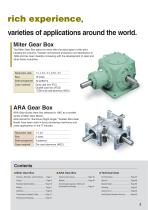
rich experience, varieties of applications around the world, Miter Gear Box The Miter Gear Box takes its name after the spiral gear’s miter-joint. Leading the industry, Tsubaki commenced production and distribution in 1966 and has been steadily increasing with the development of steel and other heavy industries.
Open the catalog to page 3
Tsubaki offers Lifting equipment For table lifting, jack system drive units that combine a gear motor, Miter Gear Boxes, couplings, and jacks are widely used. The system is used in many applications, such as LCD and semiconductor production, servo presses, and stage equipment. Tsubaki offers jack lifting system components to suit customer layout and use conditions (page 58 and 59). Related products Gear Motors Hypoid Motors Croise Motors Echt-Flex Couplings Lini Power Jacks Conveyor lifter While different types of conveyor lifting mechanisms exist, smaller sizes are in demand for the drive section....
Open the catalog to page 4
specifications for any application. Iron process roller conveyor Connecting multiple Miter Gear Boxes to a single drive makes steady conveyor speed with double mechanical synchronization. The synchronous multiple drive sections offer a simple design and better maintenance accessibility. Related products Gear Motors Hypoid Motors Echt-Flex Couplings Croise Motors Pipe forming machine In a pipe forming machine, the drive from multiple gear motors is transmitted via couplings to the jacks for forming. Using gear motors, couplings, Miter Gear Boxes, and jacks enables synchronized operation as well...
Open the catalog to page 5
C O N T E N T S Features, Structure, and Functions ····························· Page 7 Lineup ········································· Page 9 Standard Specifications ············ Page 10 Models ······································ Page 11 Shaft Arrangements, Rotation Details, and Mounting Types
Open the catalog to page 7
Features, Structure, and Functions Features Wide variety of models We offer a wide range of variations from which you can choose the unit best suited to your needs. Tsubaki provides customized models to serve every application need. High quality Tsubaki's precision spiral bevel gear is based on AGMA standards and it ensures advanced functionality, including high efficiency and high transmission capacity. Standardized design A wide range of models are standardized design, and we offer best fitting model to application needs. Structure Horizontal shaft type Housing case Lateral shaft The shaft...
Open the catalog to page 8
* Reversing the gear mounting position (shown in dotted line) changes the direction of the rotation. 1. Changes the direction of power transmission by 90°. 2. Changes the direction of power transmission by 90° and distributes the power horizontally (vertically). Examples of application 4. Using a lateral 2-shaft type, power input from the cross shaft rotates the lateral shafts in the opposite direction.
Open the catalog to page 9
LineupLineup 1. Lateral 1-shaft type • : Standard product A: Semi-standard product Note 1. ADC (Aluminum die-cast), FC (Gray cast iron), FCD (Ductile cast iron) 2. ED2 is available for the following shaft arrangements: 1-1-UD(-O), 1-1-U(-O), 1-1-D(-O), U-D-LR(-O), U-D-R(-O), and U-D-L(-O). 3. FCD types are limited
Open the catalog to page 10
Standard Specifications Gear box Note: ADC (Aluminium die-cast), FC (Gray cast iron), FCD (Ductile cast iron)
Open the catalog to page 11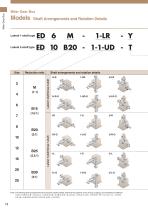
Models Shaft Arrangements and Rotation Details Size Reduction ratio Shaft arrangements and rotation details1-LR 1-UD M (1:1) B15 1-L 1-D U-L 1-L-O 1-D-O Note: The following shaft arrangements have the same rotation details. Note that the positions of the oil plug, oil gauge, and nameplate are different. U-LR = U-LR-O, U-R = U-L-O, U-L = U-R-O, D-LR = D-LR-O, D-R = D-L-O, D-L = D-R-O, 1-1-LR = 1-1-LR-O, 1-1-R = 1-1-L-O, 1-1-L = 1-1-R-O, U-D-LR = U-D-LR-O, U-D-R = U-D-L-O, U-D-L = U-D-R-O
Open the catalog to page 12
Mounting type See pages 13 and 14 for the actual mounting type for each shaft arrangement. Grease nipple Grease nipple Grease nipple Oil gauge (Opposite side) Oil gauge Drain plug Drain plug Oil filling plug Oil gauge Oil gauge (Opposite side) Drain plug Drain plug Drain plug Drain plug Grease nipple
Open the catalog to page 13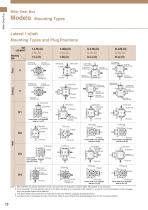
Mounting Types Lateral 1-shaft Mounting Types and Plug Positions Shaft arrangement Mounting type 1-LR(-O) 1-R(-O) 1-L(-O) Oil filling plug (Opposite side) Oil gauge (Opposite side) Grease nipple Oil filling plug (Opposite side) D-LR(-O) D-R(-O) D-L(-O) Oil filling plug (Opposite side) Grease nipple (Opposite side) Oil filling plug (Opposite side) Y Drain plug (Opposite side) Drain plug (Opposite side) Drain plug Oil gauge (Opposite side) Oil gauge (Opposite side) Oil gauge (Opposite side) Drain plug (Opposite side) Grease nipple Oil filling plug (Opposite side) Grease nipple (Opposite side) Oil...
Open the catalog to page 14
Lateral 2-shaft Mounting Types and Plug Positions Shaft arrangement Mounting type Oil filling plug Oil gauge (side) Grease nipple Oil gauge U-D-LR(-O) U-D-R(-O) U-D-L(-O) Grease nipple (Opposite side) Oil filling plug (Opposite side) Oil gauge (Opposite side) Drain plug (Opposite side) Drain plug Drain plug Grease nipple Grease nipple Oil filling plug Oil gauge (side) Oil filling plug (Opposite side) Drain plug Drain plug Grease nipple Oil gauge (Opposite side) Drain plug (Opposite side) Grease nipple Grease nipple Oil filling plug Oil gauge Oil filling plug Oil filling plug Oil gauge (Opposite...
Open the catalog to page 15All Tsubakimoto Chain catalogs and technical brochures
 TSUBAKI DIRVE CHAINS & SPROCKETS
234 Pages
 TIMING beltand pulleys
72 Pages
 REDUCER FOR SERVO MOTORS TERVO
42 Pages
 TSUBAKI COUPLINGS
120 Pages
 Drive Chains & Sprockets
219 Pages
 Cam Clutch BR-HT Series
8 Pages
 Tsubaki Couplings
120 Pages
 Tsubaki Lambda Chain Leaflet
6 Pages
 Tsubaki Pin Gear Drive Units
6 Pages
 Tsubaki gear motors 40 W - 5.5 kW
268 Pages
 Titan Series Chain
4 Pages
 TRAXLINE Cables for Motion
88 Pages
 Power-Lock
88 Pages
 SJ3 Sealed Joint Technology
2 Pages
 TKA Series Plastic Cable Carrier
21 Pages
 Tsubaki Smart Tooth
2 Pages
 Tsubaki Cam Clutch Box Series
16 Pages
 Tsubaki Cam Clutch
92 Pages
 Tsubaki Pin Oven Chain
4 Pages
 Top Chain Engineering Manual
76 Pages
 Tsubaki Pin Gear Drive Units
16 Pages
 Tsubaki Cleanveyor
12 Pages
 Tsubaki Gripper Chain
6 Pages
 Tsubaki Top Chain
246 Pages
 Tsubaki Small Size Conveyor Chains
168 Pages
 Tsubaki Palm Oil Mill Chain
2 Pages
 Tsubaki PC Chain Brochure
12 Pages


Archived catalogs
 Tsubaki Custom Made Chain
90 Pages
 ZIP CHAIN ACTUATOR
56 Pages


- Cylinder
- Actuator
- Electric gearmotor
- Linear actuator
- Power transmission belt
- Articulated telesocpic boom lift
- Tsubaki conveyor belt
- Precision gearhead
- Hydraulic cylinder
- Tsubaki right angle gear reducer
- Compact gearhead
- Solid-shaft gearhead
- Flexible coupling
- Hollow-shaft gearhead
- Tsubaki shaft coupling
- Gear train gear reducer
- Lifting system
- Protection relay
- Transmission gearhead
- Compact actuator