
- Catalogs
- Tsubakimoto Chain
- Tsubaki Cam Clutch


- Company
- Products
- Catalogs
- News & Trends
- Exhibitions
Tsubaki Cam Clutch

Tsubaki Cam Clutch
The document provides a detailed overview of TSUBAKI Cam Clutches, including their specifications, applications, and operational modes. Cam Clutches are mechanical devices that allow torque transmission in one direction while permitting freewheeling in the opposite direction.
- MZ Series: Prelubricated with special grease, no maintenance required. Bore range: ø15 to ø70 mm, Torque range: 186 to 3,040 N·m.
- MZ-G Series: Similar to MZ with machine-finished outer race.
- MZEU Series: European style, Bore range: ø12 to ø150 mm, Torque range: 60 to 33,800 N·m.
- 200 Series: Shaft-mounted, requires two bearings, prelubricated.
- BB Series: Similar to #62 type ball bearing, easy handling and installation.
- PB Series: Special grease, outer race for mounting gears, pulleys, sprockets.
- LD Series: Light-duty applications, no lubrication maintenance.
- MDEU Series: European style, no bearing needed, easy installation.
- Full Cam Complement: Maximizes load transmission.
- Cam Design: Made of special alloy steel for durability.
- High-Quality Components: Precision-ground races for accurate cam rotation.
- General Overrunning: Clutches overrun during most of the operation, occasionally locking to drive.
- Indexing: Converts reciprocating motion into unidirectional intermittent motion.
- Backstopping: Prevents reverse rotation, commonly used in conveyors and gear reducers.
Cam Clutches are used in various applications including air cleaning plants, agricultural machines, bucket elevators, compressors, conveyors, cranes, dry cleaning machinery, and more.
Choosing the right Cam Clutch involves understanding the application and operational conditions. The document provides a selection chart to aid in choosing the appropriate series based on specific operational needs.
This document provides a detailed explanation of the operational mechanics and applications of Cam Clutches in various drive systems. It covers the behavior of Cam Clutches under different rotational conditions and their applications in dual drive and two-speed drive systems.
- Overrunning States: The document describes two main states of overrunning: when the outer race rotates counterclockwise and when it rotates clockwise. In both cases, the engagement and overrunning of the Cam Clutch depend on the relative speeds of the inner and outer races.
- Dual Drive Systems: Dual drive systems use two driving units to operate a single driven unit. The Cam Clutch acts as an automatic switcher between the driving units, allowing for high or low-speed operation.
- High-Speed Overrunning and Engagement: Used in systems like pumps or fans driven by a motor and turbine. The Cam Clutch automatically switches between the driving units based on speed differences.
- Energy Saving Systems: Cam Clutches are used in energy recovery systems to save power by utilizing both motor and turbine outputs efficiently.
- Medium and Low-Speed Applications: These include systems like soaking pit fans and corrugating machines, where Cam Clutches enable automatic switching between different speed drives.
The document lists various Cam Clutch series, highlighting their advantages such as minimal lubrication maintenance, compact design, and high torque transmission. Specific series are recommended for different applications based on speed and load requirements.
Cam Clutches provide efficient and automatic switching between driving units in various industrial applications, offering energy savings and operational flexibility. The document emphasizes the importance of selecting the appropriate Cam Clutch series based on specific operational needs.
- Low-Speed Overrunning: Suitable for conveyor shafts and pumps with speeds up to 150 r/min. It offers high reliability and reduced wear due to low overrunning speeds.
- Medium-Speed Overrunning: Designed for intermediate shafts of reduction gears, operating between 150 to 700 r/min. It requires smaller Cam Clutches due to lower torque demands.
- High-Speed Overrunning: Applicable for high-speed rotating shafts in conveyor-drive machines and pumps, with speeds ranging from 700 to 3,600 r/min. These are ideal for space-limited applications.
- Type A: For low-speed overrunning, mounted on pulley shafts with large reversing torque.
- Type B: For medium-speed overrunning, mounted on intermediate shafts with medium reversing torque.
- Type C: For high-speed overrunning, directly connected to motor shafts with small reversing torque.
- BS Series: Dust-proof design with enhanced lubrication, suitable for conveyor backstopping.
- MG-R Series: Features a large oil reservoir for reduced maintenance and compact design for large torque transmission.
- BB Series: Combines bearing and Cam Clutch in one unit, suitable for high-speed applications.
- Ensure proper mounting by applying pressure to the inner race only.
- Use parallel keys for securing the clutch to the shaft.
- Consult manufacturer for vertical mounting applications.
- Maintain ambient temperature between –5° to 40°C for optimal performance.
1. Shaft tolerance recommended is h7, with ISO R773 (DIN 6885.1) keyway as standard.
2. Tolerances for sprockets, gears, and other fitted parts should be B H7 or H8.
3. Clutch models MZEU12 to MZEU80 are pre-greased and operate between -40°C to +40°C, while models MZEU90 to MZEU150 require oil lubrication.
1. Clean the surfaces of the outer race and contact surfaces of flanges and torque arms.
2. For models MZEU90 to MZEU150, apply seal adhesive to the outer race ends.
3. Attach flanges and torque arms according to the direction of rotation.
4. When mounting the clutch onto the shaft, apply pressure to the inner race only.
5. For high-speed indexing applications (more than 50 cycles/min), a strong spring type is recommended.
1. Ensure correct alignment of sprockets using a straight edge.
2. Check the clearance between sprockets before wrapping the chain.
3. Specify right-hand or left-hand drive as needed.
1. Torque capacities range from 60 N·m to 33,800 N·m depending on the model.
2. Bore sizes and keyway dimensions are specified for each model.
3. Maximum overrunning speeds for inner and outer races are provided.
1. Do not apply a large overhung load to the outer race using the E7 flange.
2. Refer to page 31 for additional usage instructions.
- Model Numbers: Various models such as MZEU12 to MZEU150, B203 to B214, BB15 to BB40, TSS8 to TSS60, and PB3 to PB14 are covered.
- Dimensions and Capacities: Detailed tables provide torque capacities, maximum overrunning speeds, and dimensions for each model.
- MZEU Models: MZEU12 to MZEU80 are pre-greased and require no lubrication, while MZEU90 to MZEU150 require oil lubrication. Specific brands and types of grease and oil are recommended, avoiding those with EP additives.
- 200 Series: Oil lubrication is recommended for indexing, with specific maintenance intervals outlined.
- BB Series: Pre-greased and require no additional grease before use. Oil lubrication should be applied inside the unit if used.
- TSS and TFS Series: Oil lubrication is recommended, and greases with EP additives should be avoided.
- General Guidelines: Proper installation involves ensuring correct interference dimensions, maintaining concentricity, and avoiding shock during installation.
- Specific Instructions: Each series has unique installation requirements, such as press fit installation for BB and TSS Series, and specific shaft and housing tolerances.
- Ensure proper lubrication and maintenance to extend the life of the cam clutches.
- Follow specific installation guidelines to avoid damage and ensure optimal performance.
- Use recommended lubricants and avoid those with EP additives to prevent damage.
- Torque Arms: Dimensions for models BS160HS TA to BS450HS TA are provided, including measurements for installation and weight specifications.
- End Plate Dimensions: Recommended dimensions for end plates are listed for different models, indicating mounting bolt sizes and other critical measurements.
- Safety Covers: Specifications for safety covers designed to protect the rotating parts of the Cam Clutch are detailed, including dimensions and mounting bolt sizes.
- Cam Clutches: The document outlines the dimensions and capacities for BSEU and BR series cam clutches, including bore sizes, torque capacities, and overrunning speeds.
- Installation: Detailed instructions for installing cam clutches, including recommended shaft tolerances, keyway standards, and the importance of correct rotation direction.
- Usage: Guidelines for using cam clutches, emphasizing the need for proper lubrication and the avoidance of excessive impact during installation.
- Use ISO R773 (DIN6885.1) keyway standards for installation.
- Ensure proper alignment and secure fastening of components to prevent damage.
- Pre-packed with low-temperature grease, cam clutches require no additional lubrication maintenance under normal conditions.
- Install safety covers to prevent accidental contact with rotating parts.
- Follow handling precautions to avoid applying unnecessary loads that could damage the cam clutch.
- Torque arm dimensions and weights for various models.
- End plate dimensions and mounting bolt sizes for different models.
- Safety cover dimensions and weights for BS series models.
- Cam clutch dimensions, torque capacities, and speed limits for BSEU and BR series models.
The document outlines the specifications for various models of the BREU series Cam Clutch, including torque capacity, maximum engagement speed, and inner race overrunning speed. The models range from BREU 30 (K) to BREU 150 (K), with torque capacities from 607 N·m to 33908 N·m and maximum engagement speeds from 1300 r/min to 3600 r/min.
Key installation steps include ensuring the correct direction of rotation, using appropriate shaft tolerances (h6 or h7), and employing a soft hammer to avoid impact loads. The document emphasizes the importance of using bolts with a tensile rating of 10.9 or greater and maintaining a 2mm clearance between the torque arm and stopper to prevent damage.
The Cam Clutch is pre-packed with grease and ready for installation. It is crucial to avoid using grease with EP additives and to refer to specific pages for detailed lubrication guidelines. The operational temperature range is from -40°C to +40°C.
Recommendations include using ISO R773 (DIN 6885.1) parallel keys, ensuring the key does not move in the keyway, and installing thrust bearings if thrust loads are present. The document also advises against excessive grease application as it can inhibit the clutch's function.
The document describes various configurations with optional parts like flanges and torque arms (E1, E2, E3, E4, E5, E7) that can alter the direction of rotation and provide additional support. Each configuration has specific installation instructions and dimensions.
Detailed tables provide dimensions for each model, including bore size, keyway dimensions, and weights. These are crucial for ensuring compatibility with existing systems and for planning installations.
The document provides detailed specifications for various models of BREU, MG, MI, MR, and MG-R series Cam Clutches. It includes dimensions, torque capacities, and other mechanical properties. The document specifies the ambient temperature range for operation as –40°C to +40°C and emphasizes the importance of using the correct amount of grease to maintain functionality.
Instructions are provided for installing the Cam Clutches, including the importance of applying pressure to the inner race during installation and ensuring proper alignment of sprockets. The document advises against applying pressure to the outer race and highlights the need for periodic maintenance and lubrication. It also specifies the use of parallel keys and the importance of avoiding over-greasing.
The document outlines a maintenance schedule, recommending re-greasing every three months. It provides a list of recommended greases from brands like Exxon Mobil, Shell, BP, and TOTAL, and warns against using greases with EP additives. The procedure for re-greasing includes removing the set screw, injecting grease, and allowing excess grease to escape.
Tables are included detailing the dimensions and capacities of various models, such as BREU, MG, MI, MR, and MG-R series. Each model's torque capacity, weight, and maximum overrunning speed are specified. The document also provides information on the number of tapped holes and their sizes for each model.
For high-speed applications, the document recommends considering the BR-P series for long life. It advises consulting Tsubaki for continuous overrunning applications and emphasizes the importance of using the correct shaft tolerances and key specifications.
The document includes diagrams and illustrations to aid in the installation and understanding of the Cam Clutches. It also provides guidance on selecting the appropriate model based on application requirements and offers additional resources for selection and maintenance on specified pages.
The document discusses various series of cam clutches, including BS, BS-R, and BSEU series, with specific lubrication requirements. The BS series ranges from BS135 to BS450HS, with grease lubrication for BS30 to BS350HS. The BS-R series is designed for oil lubrication, while the BSEU series is recommended for environments with minimal dust.
Transmission power is calculated using the formula: Motor kW × 9550. The document provides guidelines for shaft speed and service conditions, indicating different service factors (SF) based on usage frequency.
Proper lubrication and maintenance are crucial for the longevity of cam clutches. The document lists recommended oils and greases, emphasizing the avoidance of EP additives. Maintenance schedules vary by series, with some requiring oil changes every 300 hours and others every six months.
The BR series requires periodic maintenance and lubrication. Specific oils and greases are recommended, and guidelines for both oil and grease lubrication are provided. Over-lubrication should be avoided to prevent overheating.
Detailed methods for replenishing lubricants in various series (MG, MR, MI, MI-S, PO, PS, MX) are outlined. The document specifies the correct oil levels and plug configurations for effective lubrication.
The document discusses the factors affecting the service life of cam clutches, including overrunning abrasion and engagement fatigue life. Graphs illustrate the wear life and fatigue life for different series, emphasizing the importance of proper lubrication and maintenance.
In cases where routine maintenance is challenging, special lubrication methods are suggested, such as using a rotor seal to force oil into the clutch.
The document includes various graphs and tables illustrating wear life, fatigue life, and recommended grease volumes for different models and series.
Catalog excerpts

TSUBAKI CAM CLUTCH TSUBAKI offers the most complete and versatile selection of one-way clutches in the industry. Design Features Full Cam Complement The full complement of cams provide the maximum number of load transmitting members per given diameter. The result is a greater torque capacity sizefor-size than other clutches. Cam Design Precision formed cams made of a special alloy steel provide extra long wear and fatigue life. High Quality Components The clutch races are made of high-quality alloy steel with high surface hardness and core toughness. The races are precision ground, provide excellent...
Open the catalog to page 2
MX Series clutch is best suited for indexing applications. This model ensures long life and accurate intermittent motion at the driven race. MI-S Series has special surface-treated cams for use in large feed angle indexing applications. Bore Range: ø22 to ø70 mm Torque Range: 78 to 784 N·m Bore Range: ø20 to ø30 mm Torque Range: 43 to 196 N·m BS, BS-HS, BS-R, BSEU Series BR Series clutch is mainly used as backstop of inner race high-speed over running. BR-P Series is the BR Series with the bearings, BREU series clutch is European style model. BS, :Bore Range: ø20 to ø450 mm BS-HS Torque Range:...
Open the catalog to page 3
Taking Advantage of Differences in Rotating Direction and Speed... TSUBAKI Cam Clutches One-way clutches are efficient mechanical devices that utilize differences in axial rotating direction and the speed of rotation to prevent reverse rotation and ensure safety. In order to create a more reliable uni-directional clutch, engineers have spent many years developing and improving clutches, from the simple prop type, to the ratchet type and the roller type, and then culminating to the Cam Clutch, which has become the mainstream. The TSUBAKI Cam Clutch introduced here is a cam-type, one-way clutch...
Open the catalog to page 4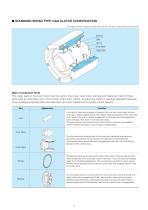
I STANDARD SPRAG TYPE CAM CLUTCH CONSTRUCTION The figure shows a typical model from the MZ Series for explaining construction. Major Component Parts The major parts of the Cam Clutch are the cams, inner race, outer race, springs and bearings. Each of these parts play an important role in the function of the Cam Clutch. All parts are made of carefully selected materials, have undergone appropriate heat treatment, and have passed strict quality control checks. Part Function A number of cams set regularly in between the inner and outer races function as props or sliders depending on the relative...
Open the catalog to page 5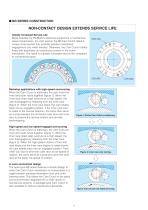
NON-CONTACT DESIGN EXTENDS SERVICE LIFE Greatly Increased Service Life Made possible by TSUBAKI’s extensive experience in mechanical power transmission, the cam used in the BR Cam Clutch offers a unique cross section that provides positive mechanical engagement only when needed. Otherwise, the Cam Clutch rotates freely with absolutely no mechanical contact in the clutch mechanism. The result is a greatly increased service life compared to conventional types. Backstop applications with high-speed overrunning When the Cam Clutch is stationary, the cam locks the inner and outer races together (figure...
Open the catalog to page 6
I MODES OF OPERATION TSUBAKI Cam Clutches are precision devices which lock to transmit torque in one direction of rotation, but overrun (freewheel) in the opposite direction of rotation. All the series of clutches utilize the same principles of operation. Since clutch applications encompass a variety of load and speed characteristics, TSUBAKI Cam Clutches are manufactured in a range of capacities and styles, which are designed to provide the best functional characteristics for performing in the following three basic modes of operation: 1. General overrunning Clutches used in this type of application...
Open the catalog to page 7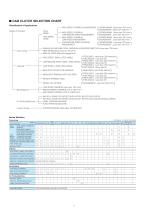
■ CAM CLUTCH SELECTION CHART Modes of Operaion DUAL Custom Design HIGH SPEED OVERRUN, ENGAGEMENT /OVERRUNNING HIGH SPEED OVERRUN, /OVERRUNNING LOW-MEDIUM SPEED ENGAGEMENT I ENGAGEMENT HIGH SPEED OVERRUN, /OVERRUNNING LOW SPEED ENGAGEMENT I ENGAGEMENT LOW-MEDIUM SPEED OVERRUN, /OVERRUNNING More than 700 r/min / Less than 700 r/min / Less than 200 r/min / Less than 700 r/min 1 Less than 700 r/min / - ENGAGE IN ONE DIRECTION, OVERRUN IN REVERSE DIRECTION (Less than 700 r/min) -FREEWHEELING (Less than 700 r/min) - MANUAL DRIVE (Manual engagement) More than 300 times/min Less than 300 times/min Less...
Open the catalog to page 8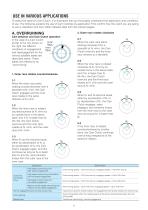
To select the optimum Cam Clutch, it is imperative that you thoroughly understand the application and conditions of use. The following explains the use of Cam Clutches by application: First confirm how the clutch you are going to use is classified, and then obtain detailed data from the relevant pages. Cam behavior and Cam Clutch operation various possible states are described below. These 1. Outer race rotates counterclockwise. When the outer race starts rotating counterclockwise from a Clutch engages and the inner race rotates in the same When the inner race is rotated an outside force in the...
Open the catalog to page 9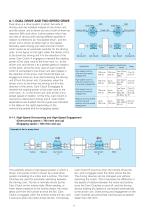
A-1. DUAL DRIVE AND TWO-SPEED DRIVE Dual drive is a drive system in which two sets of driving units are installed instead of one driven unit, and the driven unit is driven by one or both of them as required. With dual drive, a drive system which has two sets of driving units having different speeds of rotation is referred to as “two-speed drive”, and the driven unit is driven at either high or low speed. Normally, each driving unit uses one Cam Clutch which works as an automatic switcher for the driving units. In the figure on the right, when the driven unit is to be driven by driving unit A...
Open the catalog to page 10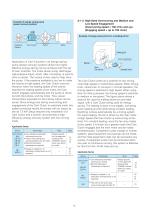
A-1-2. High-Seed Overrunning and Medium and Low-Speed Engagement (Overrunning speed = 700 r/min and up) (Engaging speed = up to 700 r/min) Example of energy saving pump (power recovery system) Example of energy saving drive for a soaking pit fan Application of Cam Clutches in an energy saving pump (power recovery system) shows how highly effective energy saving can be achieved with the aid of Cam Clutches. The motor-driven pump discharges high-pressure liquid, which, after circulating, is used to drive a turbine. The turbine is then used to help drive the pump. If the pressure available is too...
Open the catalog to page 11All Tsubakimoto Chain catalogs and technical brochures
 TSUBAKI DIRVE CHAINS & SPROCKETS
234 Pages
 TIMING beltand pulleys
72 Pages
 REDUCER FOR SERVO MOTORS TERVO
42 Pages
 TSUBAKI COUPLINGS
120 Pages
 Tsubaki Miter Gear Box
64 Pages
 Drive Chains & Sprockets
219 Pages
 Cam Clutch BR-HT Series
8 Pages
 Tsubaki Couplings
120 Pages
 Tsubaki Lambda Chain Leaflet
6 Pages
 Tsubaki Pin Gear Drive Units
6 Pages
 Tsubaki gear motors 40 W - 5.5 kW
268 Pages
 Titan Series Chain
4 Pages
 TRAXLINE Cables for Motion
88 Pages
 Power-Lock
88 Pages
 SJ3 Sealed Joint Technology
2 Pages
 TKA Series Plastic Cable Carrier
21 Pages
 Tsubaki Smart Tooth
2 Pages
 Tsubaki Cam Clutch Box Series
16 Pages
 Tsubaki Pin Oven Chain
4 Pages
 Top Chain Engineering Manual
76 Pages
 Tsubaki Pin Gear Drive Units
16 Pages
 Tsubaki Cleanveyor
12 Pages
 Tsubaki Gripper Chain
6 Pages
 Tsubaki Top Chain
246 Pages
 Tsubaki Small Size Conveyor Chains
168 Pages
 Tsubaki Palm Oil Mill Chain
2 Pages
 Tsubaki PC Chain Brochure
12 Pages


Archived catalogs
 Tsubaki Custom Made Chain
90 Pages
 ZIP CHAIN ACTUATOR
56 Pages


- Cylinder
- Actuator
- Electric gearmotor
- Linear actuator
- Power transmission belt
- Articulated telesocpic boom lift
- Tsubaki conveyor belt
- Precision gearhead
- Hydraulic cylinder
- Tsubaki right angle gear reducer
- Compact gearhead
- Solid-shaft gearhead
- Flexible coupling
- Hollow-shaft gearhead
- Tsubaki shaft coupling
- Gear train gear reducer
- Lifting system
- Protection relay
- Transmission gearhead
- Compact actuator