
- Catalogs
- Tsubakimoto Chain
- Top Chain Engineering Manual


- Company
- Products
- Catalogs
- News & Trends
- Exhibitions
Top Chain Engineering Manual

Top Chain Engineering Manual
Tsubaki provides a wide range of top chains and accessories, focusing on quality, technology, and environmental responsibility. The Kuki Plant emphasizes minimizing environmental impact through green practices.
The Tsubaki Group is dedicated to environmental conservation, aiming to reduce its environmental footprint through innovative practices, legal compliance, and employee awareness.
- Plastic Chains: Lightweight, low friction, quiet, sanitary, and corrosion-resistant, ideal for delicate items.
- Stainless Steel Chains: Corrosion and heat-resistant, suitable for high-load and extreme temperature environments.
- Plastic Modular Chains: For transporting large quantities on wide conveyors.
- Plastic Block Chains: Simple construction for confined spaces, ensuring smooth transfer.
- Stainless Steel Top Chains: High load capacity, available in integrated or separate designs.
Detailed specifications and comparison charts for plastic and stainless steel chains, covering noise, weight, friction, temperature, and load.
Guidelines for conveyor design, including wearstrip mounting, return-way layouts, and chain selection and installation procedures.
Guidelines for lubrication, temperature considerations, edge face codes, tension calculations, and conveyor design specifics.
Details on components like sprockets, wearstrips, and spacers, emphasizing high-rotation return rollers and wearstrips with float-preventive tabs.
Recommendations for return-way layouts based on chain tension and speed, with specific dimensions for layout components.
Details on support systems using return rollers, wearstrips, and sliding shoes, highlighting the importance of free rotation and high-rotation rollers.
Guidelines for curved sections, including the use of curved wearstrips and corner discs to guide chains effectively.
Cross-sectional designs for various chain types, with measurements for wearstrip positioning and alignment.
Design requirements for specific chain types, including mechanisms to absorb chain elongation.
Tables detailing backflex radius and essential data for component selection and conveyor design.
Design and specifications for chain systems, emphasizing chamfering points to prevent snagging.
Methods for connecting conveyors and guidelines for using KV Top Chains at different temperatures.
Details on side transfers, dead-plate transfers, and turntable transfers, with installation instructions.
Procedures for disconnecting and connecting chains, emphasizing the use of special tools.
Guide for selecting chain type and size, with tables for power calculation.
Guidelines for wearstrip installation, emphasizing support and thermal expansion allowance.
Installation and maintenance procedures for conveyor systems, emphasizing wearstrip material and cleaning.
Instructions for adjusting roller center distance and ensuring frame width.
Guidelines for chain installation, slack adjustment, and sprocket alignment.
Recommendations for nose bars in high-speed and heavy-load conditions.
Instructions for disconnecting and reconnecting chains, emphasizing tool use.
- Ensure proper installation for thermal expansion.
- Regularly clean wearstrips.
- Use tensioners for chain slack adjustment.
- Align sprockets correctly.
- Use nose bars for specific conditions.
- Structure: Snap attachments prevent pin dislodgement.
- Disconnecting/Reconnecting: Use specific tools for detaching and securing chain links.
- Sprocket Installation: Ensure alignment and secure locking.
- Inspection: Regular checks for wear and proper engagement.
- Lubrication: Use high-quality oil to reduce wear and noise.
- Cleaning: Remove dust and debris to prevent contamination.
- Chains: Replace if elongation or corrosion exceeds limits.
- Sprockets and Wearstrips: Replace when wear reaches specified limits.
- Noise and Vibration: Check for contact issues and lubrication.
- Abnormal Wear: Inspect components and ensure proper lubrication.
- Chain Damage: Remove obstructions and modify conditions if necessary.
Address excessive wear and elongation, contamination, and material deterioration.
Modify specifications for curved wear strips and address lubrication inadequacies.
Adjust guide angles, positions, speed, and lubrication for smooth transfers.
Replace stiff sections due to overload.
Use set-screw type bearings and H1-grade grease for food machines.
Chamfer shaft corners and apply grease to prevent seal damage.
Use specific tools for efficient chain maintenance.
Graphs provide maximum loads for various conditions, with lubrication recommendations.
Install safety equipment, conduct regular inspections, and follow installation precautions.
Avoid reusing certain components and using chains in unsuitable conditions.
Products are warranted against defects, with specific claim procedures.
Buyer indemnifies Seller against certain claims, with terms constituting the entire agreement.
Contact details for Tsubaki offices worldwide are provided.
Catalog excerpts

ENGINEERING MANUAL
Open the catalog to page 1
Tsubaki Top Chains: The Result of Trust and Close Ties with Customers We bring customers ideal chain solutions by putting our materials technology to work. Comprehensive Product Selection Tsubaki’s line-up of top chains offers an extensive range of features and constructions. We also have a wealth of accessories besides chains. If you’re looking for a particular type of chain to suit your needs or improve work processes, you’ll nd it at Tsubaki. Dedication to Quality and Technology Tsubaki’s Kuki Plant meets the needs of worldwide customers through its long years of know-how, consistently high...
Open the catalog to page 2
in Motion We aim to provide the best value and comprehensive solutions to our customers worldwide. We aim to be a world-leading company in plastic chain products and modular conveyor systems. Tsubaki Group Environmental Policy Philosophy The Tsubaki Group believes that environmental conservation is a critical challenge facing humanity. We will remain mindful of the environment in all our operations and contribute to the world through our workmanship. Basic Policy We will acknowledge the environmental impact of our operations, products, and services. In the interests of environmental conservation,...
Open the catalog to page 3
Tsubaki Top Chain Features and Line-up Plastic Chain Features Protects Conveyed Goods Simple Construction Using a roller conveyor or steel chain to convey objects such as parts, manufactured items, pallets, and the like can result in damage from sliding or impact. The unique softness of plastic top plates makes them ideal for transporting products and materials that are easily scratched. Plastic chain consists of connecting pins and links with a top surface on which objects are carried. Links can be removed or replaced simply by removing the connecting pins—there’s no need to remove bearing blocks,...
Open the catalog to page 4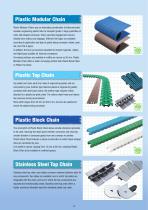
Plastic Modular Chain Plastic Modular Chains use an alternating combination of interconnected modular engineering plastic links to transport goods in large quantities on wide, belt-shaped conveyors. Chain-sprocket engagement ensures reliable drive without any slippage. Different link types are available according to application and type of goods being conveyed: closed, open, net, and GTO-K types. In addition, the line-up has been expanded to include magnetic, rubber, and ight types suitable for inclined conveyance. Conveying surfaces are available in widths as narrow as 50 mm. Plastic Modular...
Open the catalog to page 5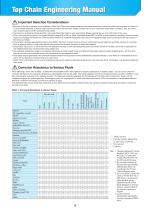
Top Chain Engineering Manual Important Selection Considerations • ecause of the risk of damage and/or breakage, Plastic Top Chain is not recommended for use under conditions in which the chain may be subject to impact, or B in which foreign materials or objects might become jammed in the conveyor. Please consider the use of a metal chain under these conditions. Also, be sure to start up slowly (using inverter control) and stop slowly. • The presence of abrasives during operation will cause Plastic Top Chain to wear prematurely. Please consider the use of a metal chain in this case. • hen conveying...
Open the catalog to page 7
Top Chain Engineering Manual Step 3: Select Wearstrip Material 1. Selection Procedure Follow the procedure below to select the top chain and wearstrip that are most economical and suitable for the application. Step 1: Establish operating conditions Step 2: Select top plate material Step 3: Select wearstrip material Step 4: Determine factors and coefficients Step 5: Select top plate width Step 6: Calculate chain tension Step 7: Determine chain size Choose a suitable wearstrip material according to the type of top plate material. Table 3: Wearstrip Material Selection Guide Top plate material (chain...
Open the catalog to page 8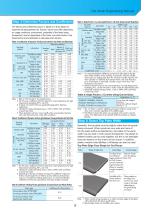
Top Chain Engineering Manual Step 4: Determine Factors and Coefficients Table 7: Angle Factor (αL) and Length Factor (αS) when Using Curved Wearstrips Top plate material Table 4: Coefficient of Dynamic Friction (μ1) between Top Plate and Wearstrip Lubrication Stainless steel or steel Stainless steel No lube or water Soapy water Oil No lube or water Soapy water No lube or water Soapy water No lube or water Soapy water No lube or water Soapy water No lube (dry) No lube or water Soapy water No lube or water Soapy water No lube (dry) No lube (dry) Angle factor ( Wearstrip material Top plate material...
Open the catalog to page 9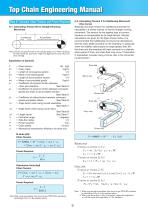
Top Chain Engineering Manual 6-2. Calculating Tension F for Sideflexing Movement (One Curve) Basically, the chain tension for sideflexing movement is calculated in a similar manner to that for straight-running movement. The tension for the applied load at corners, however, is compensated for by angle factors. Sample calculations are given for the figure shown below. It is recommended that sideflexing conveyors be lubricated so that the chain slides smoothly on the wearstrip. In particular, when the sideflex radius spans an angle greater than 90°, the chain and the wearstrip will wear unevenly...
Open the catalog to page 10
Top Chain Engineering Manual 6-3. Calculating Tension F for Sideflexing Movement (Two Curves) When wearstrips, etc., are used for sliding in curved sections, there can be up to two 90° curved sections. Three or more curved sections will cause pulsation in the chain. To include additional curved sections, consider splitting the conveyor into sections or use the corner disc system. 6-4. Calculating Tension F for Sideflexing Movement (Horizontal Drive) Applicable chain: TPUH-BO (horizontal conveyance), Plastic Crescent Top Chain (TORP, TOSP), TO, TU Basically, the chain tension for sideflexing movement...
Open the catalog to page 11
Top Chain Engineering Manual 6-5. Calculating Tension F for Inclined Movement Step 7: Determine Chain Size Select a top chain having a maximum allowable load larger than the maximum tension (F ) to be applied to the chain. Consult the maximum allowable load graphs beginning on page 55 and consider conveyor speed and ambient temperature in the selection process. F ≦ Maximum allowable load (coupled with speed and temperature) The effects of speed, conveyed goods, center of gravity, mass, environment, and other parameters will make it difficult to precisely determine the maximum inclination angle....
Open the catalog to page 12All Tsubakimoto Chain catalogs and technical brochures
 TSUBAKI DIRVE CHAINS & SPROCKETS
234 Pages
 TIMING beltand pulleys
72 Pages
 REDUCER FOR SERVO MOTORS TERVO
42 Pages
 TSUBAKI COUPLINGS
120 Pages
 Tsubaki Miter Gear Box
64 Pages
 Drive Chains & Sprockets
219 Pages
 Cam Clutch BR-HT Series
8 Pages
 Tsubaki Couplings
120 Pages
 Tsubaki Lambda Chain Leaflet
6 Pages
 Tsubaki Pin Gear Drive Units
6 Pages
 Tsubaki gear motors 40 W - 5.5 kW
268 Pages
 Titan Series Chain
4 Pages
 TRAXLINE Cables for Motion
88 Pages
 Power-Lock
88 Pages
 SJ3 Sealed Joint Technology
2 Pages
 TKA Series Plastic Cable Carrier
21 Pages
 Tsubaki Smart Tooth
2 Pages
 Tsubaki Cam Clutch Box Series
16 Pages
 Tsubaki Cam Clutch
92 Pages
 Tsubaki Pin Oven Chain
4 Pages
 Tsubaki Pin Gear Drive Units
16 Pages
 Tsubaki Cleanveyor
12 Pages
 Tsubaki Gripper Chain
6 Pages
 Tsubaki Top Chain
246 Pages
 Tsubaki Small Size Conveyor Chains
168 Pages
 Tsubaki Palm Oil Mill Chain
2 Pages
 Tsubaki PC Chain Brochure
12 Pages


Archived catalogs
 Tsubaki Custom Made Chain
90 Pages
 ZIP CHAIN ACTUATOR
56 Pages


- Cylinder
- Actuator
- Electric gearmotor
- Linear actuator
- Power transmission belt
- Articulated telesocpic boom lift
- Tsubaki conveyor belt
- Precision gearhead
- Hydraulic cylinder
- Tsubaki right angle gear reducer
- Compact gearhead
- Solid-shaft gearhead
- Hollow-shaft gearhead
- Flexible coupling
- Gear train gear reducer
- Tsubaki shaft coupling
- Lifting system
- Protection relay
- Transmission gearhead
- Compact actuator