
- Catalogs
- Tsubakimoto Chain
- Roller Chain & Sprocket Maintenance Manual


- Company
- Products
- Catalogs
- News & Trends
- Exhibitions
Roller Chain & Sprocket Maintenance Manual

Roller Chain & Sprocket Maintenance Manual
This manual provides comprehensive guidelines for the maintenance of Tsubaki roller chains and sprockets, including both small and large size conveyor chains. It emphasizes the importance of understanding the instructions for proper handling, installation, and maintenance to ensure safety and longevity.
Before Use: Users should familiarize themselves with the construction and accessories of roller chains. Proper handling and troubleshooting techniques are outlined to prevent accidents.
Construction: The manual details the structure of roller chains, highlighting components like plates, pins, bushes, and rollers, and the importance of dimensions such as pitch and roller diameter.
Accessories: Essential parts like spring clips and cotter pins are crucial for maintaining chain strength.
Handling: Guidelines for safe handling, installation, maintenance, and troubleshooting are provided, warning against improper use and modifications.
Small Size: Instructions for the use and maintenance of small size conveyor chains are provided, including construction details.
Large Size: Details on the construction and handling of large size conveyor chains are included, along with troubleshooting and repair parts information.
The manual emphasizes safety precautions, such as avoiding unintended uses and exposure to corrosive substances. Warranty information outlines conditions for claims.
- Connecting Links: Various types of connecting links are outlined, emphasizing the importance of maintaining chain strength by not altering pin or plate dimensions.
- Sprockets: Specifications include models and materials, with a focus on induction-hardened teeth. Welding A-type sprockets is discouraged due to potential quality issues.
- Chain Cutting Tools: Various models are listed for cutting different chain types, requiring special tools for specific chains.
- Chain Breakers: Instructions for using chain breakers are provided, with safety precautions to prevent damage during disassembly.
- Connecting Endless Roller Chains: Methods for connecting chains in different positions are detailed, emphasizing proper alignment and use of appropriate connecting link plates.
- Ensure proper grinding of rivet-type pins before extraction to avoid chain damage.
- Do not reuse removed parts and check for missing or damaged components before reassembly.
- Importance of Lubrication: Proper lubrication minimizes wear and prevents corrosion. Chains are pre-lubricated, and additional lubrication should be applied regularly.
- Oil Application Locations: Lubricate between pins and bushes, ensuring grease penetrates all necessary areas.
- Recommended Lubricants: Tables provide guidance on lubricant types based on temperature and chain specifications.
- Speed Ratio and Chain Wrap: Guidelines for optimal speed ratios and chain wrap angles are provided, with specific recommendations for lifting applications.
- Distance Between Shafts: Proper installation affects chain life and transmission smoothness. Instructions for adjusting slack and ensuring horizontal precision are included.
- General Layout: Recommendations for sprocket alignment and layout configurations to prevent chain issues like vibration and misalignment.
The document provides detailed technical information on the use of pin gear sprockets and roller chains, focusing on their specifications, installation procedures, and maintenance requirements. It highlights the advantages of pin gears in specific applications and outlines necessary precautions for effective use.
- Pin gears are suitable for applications requiring large speed ratios and limited space.
- They offer design flexibility in drum diameter and linear length but are not suitable for ultra-precise drives and have higher noise levels compared to traditional gears.
- For linear applications, ensure the chain is taut and secured with bolts and nuts to prevent slack.
- When wrapping chains around drums, use shims to eliminate slack and ensure a circular radius.
- Adjust sprocket shafts for proper chain engagement and avoid using curved chains with pin gears.
- Regular inspections are recommended at one-month intervals, with more frequent checks in corrosive environments or high-speed operations.
- Inspect lubrication conditions, link plates, pins, rollers, and sprockets for wear and damage.
- Chain elongation should be monitored, and chains should be replaced when elongation exceeds specified limits.
- Use standard roller chains and attachment chains for optimal performance.
- Ensure proper lubrication and alignment to extend chain life and prevent premature wear.
- Follow preventive maintenance guidelines and adhere to industry standards for safety and efficiency.
The document details the construction of various types of chains, emphasizing key components for strength and wear resistance. The importance of spring clips and cotter pins in maintaining chain integrity is highlighted.
Two types of fits are described: Slip Fit and Press Fit, crucial for the assembly and function of the chain.
The basic dimensions of a roller chain include pitch, roller diameter, and inner width, determining compatibility with sprockets.
Various attachments and links are described, each serving different functions and applications.
Proper installation of sprockets and rails is critical for smooth operation and chain longevity. Detailed procedures for checking shaft parallelism, centering, and rail material selection are provided.
Instructions for cutting chains and removing pins are provided, emphasizing safety precautions.
Correct installation procedures are detailed to secure chain links and prevent accidents.
Methods for assembling with a connecting link and different types of connecting links are described.
Lubrication reduces wear, prevents corrosion, and economizes power demands. Chains should be lubricated weekly.
Regular adjustments are necessary to maintain proper tension and prevent accidents. Trial runs and regular inspections are recommended.
Chain wear elongation should be measured to determine when replacement is necessary.
Guidelines for shutdown/restart, temperature considerations, and storage are provided.
Recommendations for conveyor length, environmental considerations, and noise reduction are included.
Proper assembly, lubrication, and maintenance are crucial for the efficient operation and longevity of conveyor chains.
Temperature ranges and corresponding SAE lubrication numbers are specified for different operating conditions.
Details are provided for lubrication positions on various chain types.
Proper installation is crucial for smooth conveyor operation and chain longevity.
Care is needed when handling chains with snap covers made of engineering plastic.
Procedures for cutting and connecting various types of chains are detailed.
Maintenance of large size conveyor chains involves understanding the construction and wear points of components.
The document outlines the components of a conveyor chain and their functions.
Two types of fits are described: slip fit and press fit.
The three basic dimensions are pitch, roller diameter, and inner link inner width.
Safety precautions and proper handling techniques are emphasized.
Proper installation involves aligning the sprocket teeth and keyway phases.
Various tools are used for chain maintenance, and procedures for connecting and disconnecting chains are provided.
Regular chain adjustments are necessary due to initial elongation and wear.
Before operation, checks include ensuring proper T-pin attachment, chain lubrication, and bolt tightness.
Ensure the chain winds up correctly on the sprocket and that rails and sprockets are properly installed.
Maintain a small amount of slack on the return side to prevent excessive wear.
Regularly check for wear on rollers, bushes, and plates.
Lubricate chains weekly with ISO VG100 – VG150 oil.
Store chains and sprockets in dry areas to prevent rust.
Remove loads before stopping conveyors to prevent overloading.
Measure chain elongation regularly, with a limit of 2% elongation.
Address issues such as chain riding up on sprockets and unusual noises.
Consider environmental factors and select appropriate materials and protective measures accordingly.
Catalog excerpts

TSUBAKI Roller Chain & Sprocket Maintenance Manual ■ Drive Chains & Sprockets ■ Small Size Conveyor Chains & Sprockets ■ Large Size Conveyor Chains & Sprockets
Open the catalog to page 1
Thank you for your purchase of a Tsubaki chain or sprocket. Be sure to thoroughly read this instruction manual before handling your chain or sprocket to ensure that you cut, connect, install, and maintain your product properly. This manual should be kept handy for persons handling the chain, or for persons operating the equipment using the chain, to reference at any time. Small Size Conveyor Chain Maintenance ……………… 27 1.Before Use ……………………………………………………………… 27 2.Small Size Conveyor Chain Construction …………………………… 29 3.Engineering Manual …………………………………………………… 33 4.Engineering Manual Free Flow Chain...
Open the catalog to page 2
Persons installing, maintaining, and using the chain or sprocket should thoroughly familiarize themselves with the points outlined in this instruction manual to ensure no mistakes occur. Obey the following points in order to prevent hazardous situations. Do not use chains and accessories (accessories and parts) for anything other than their original purpose. Never perform additional processing on the chain. . Do not anneal the various parts of the chain. . Do not clean the chain with either acid or alkali, as they may cause cracking. . Do not electroplate the chain or its parts, as it may cause...
Open the catalog to page 3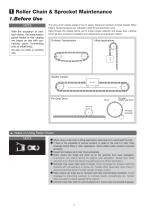
Roller Chain & Sprocket Maintenance 1.Before Use NOTE With the exception of endless chains, the transmission power tables in this catalog are based on use with connecting parts (connecting links or offset links). This drive chain catalog explains how to select, install and maintain all listed Tsubaki Roller Chains. Numerical figures are indicated in both SI and gravimetric units. Read through this catalog before use to ensure proper selection and usage. Also, carefully inform persons involved in installation and maintenance of all pertinent matters. Ordinary Transmission Lifting Applications...
Open the catalog to page 4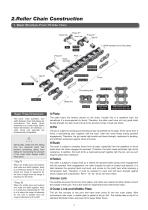
1. Basic Structure (Photo: RS Roller Chain) Outer link Width between inner link plates Roller diameter Inner plate Outer plate Connecting link plate Spring clip Offset link Connecting link Middle plate Inner link Basic Three Dimensions The pitch, roller diameter, and width between inner link plates are considered the basic three dimensions of a roller chain. When these dimensions are identical, a roller chain and sprocket are dimensionally compatible. *1Slip Fit When the shafts (pins and bushes) and holes are fitted together, there is a continuous loose fit. This is a fit where the range of tolerance...
Open the catalog to page 5
Roller Chains are usually made up of a number of connected links in an endless formation, or used by fixing the chain ends, but the need for connecting links will eventually arise. Although offset links can be used when there are an odd number of links in the roller chain, please use a design that requires an even number of links as much as possible. Please note that connecting links and offset links are normally coated with an anti-rust agent only. Always thoroughly lubricate pin and bush when assembling. M-type Connecting link | L| Clip typ^l-["Cotter pin type Spring pin type (RS240 only) Cotter...
Open the catalog to page 6
3.1 Specifications Standard Tsubaki RS Sprocket tooth profiles are precisely finished to JIS standards. Tsubaki uses S-type tooth profiles in JIS standards. (Some U-type teeth are also used.) Note 1: I n addition to standard sprockets with pilot bores (unfinished bores), we also offer Fit Bore Sprockets with bores can be used as is (bore finished, keyway processed, two set screws included). 2: Refer to the Tsubaki Drive Chains & Sprockets catalog and various instruction manuals regarding lock sprockets (with integrated keyless friction type integrated couplings). 2C type (welded specifications)...
Open the catalog to page 7
4|Poly Steel Chain Cutting Tools l[Chain Vises Standard chain cutting tools cannot be used on Poly Steel Chains. A special punch and vise for Poly Steel Chains are required. Model Number Note: All models stocked. Special punch <Cutting Tools> Note: All models stocked.
Open the catalog to page 8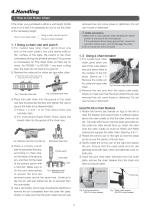
4.Handling 1. How to Cut Roller Chain If the chain you purchased is either a unit length (3,048 mm) or on a reel, it is necessary for you to cut the chain to the necessary length. How to cut a roller chain removed has not come loose or deformed. Do not use if loose or deformed. Safety precautions Using a chain vise and punch 1) Make sure to use a grinder when grinding the riveted portion of one end of the rivet-type pin. If it is extracted without being ground first, more time and effort will be spent, and will damage the chain. 2) Do not reuse any removed parts. Using a chain breaker 1. 1 Using...
Open the catalog to page 9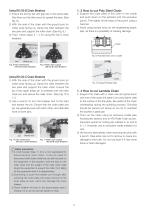
Using RS-CS-B Chain Breakers 1) Ensure the tommy bar and grip are on the same side. Grip them so that they touch to spread the jaws. (See Fig. 8.) 2) With the side of the chain with the ground pins (or cotter pins) facing up, clamp the roller between the two jaws and support the roller chain. (See Fig. 9.) 3) Then, follow steps 2 – 4 for using RS-CS-A chain breakers. 1. 3 How to cut Poly Steel Chain 1) Support the outer plate of the chain in the cradle and push down on the pinhead with the exclusive punch. Then lightly hit the head of the punch using a hammer. 2) Avoid using excess force on the...
Open the catalog to page 10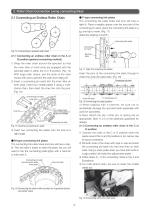
Connecting link plate Outer link plate L1 should ehual L2 2.1 Connecting an Endless Roller Chain 2.1.1 Connecting an endless roller chain in the A or B position (general connecting method) 1) Wrap the roller chain around the sprocket so that the inner links on both ends are engaged with the sprocket teeth in either the A or B position. (Fig. 14) With large roller chains, pull the ends of the roller chains with wire to prevent the chain from falling off. 2) Insert a connecting pin-sashi into the inner links on both ends. Insert two middle plates if using a multistrand chain, then insert the inner...
Open the catalog to page 11All Tsubakimoto Chain catalogs and technical brochures
 TSUBAKI DIRVE CHAINS & SPROCKETS
234 Pages
 TIMING beltand pulleys
72 Pages
 REDUCER FOR SERVO MOTORS TERVO
42 Pages
 TSUBAKI COUPLINGS
120 Pages
 Tsubaki Miter Gear Box
64 Pages
 Drive Chains & Sprockets
219 Pages
 Cam Clutch BR-HT Series
8 Pages
 Tsubaki Couplings
120 Pages
 Tsubaki Lambda Chain Leaflet
6 Pages
 Tsubaki Pin Gear Drive Units
6 Pages
 Tsubaki gear motors 40 W - 5.5 kW
268 Pages
 Titan Series Chain
4 Pages
 TRAXLINE Cables for Motion
88 Pages
 Power-Lock
88 Pages
 SJ3 Sealed Joint Technology
2 Pages
 TKA Series Plastic Cable Carrier
21 Pages
 Tsubaki Smart Tooth
2 Pages
 Tsubaki Cam Clutch Box Series
16 Pages
 Tsubaki Cam Clutch
92 Pages
 Tsubaki Pin Oven Chain
4 Pages
 Top Chain Engineering Manual
76 Pages
 Tsubaki Pin Gear Drive Units
16 Pages
 Tsubaki Cleanveyor
12 Pages
 Tsubaki Gripper Chain
6 Pages
 Tsubaki Top Chain
246 Pages
 Tsubaki Small Size Conveyor Chains
168 Pages
 Tsubaki Palm Oil Mill Chain
2 Pages
 Tsubaki PC Chain Brochure
12 Pages


Archived catalogs
 Tsubaki Custom Made Chain
90 Pages
 ZIP CHAIN ACTUATOR
56 Pages


- Cylinder
- Actuator
- Electric gearmotor
- Linear actuator
- Power transmission belt
- Articulated telesocpic boom lift
- Tsubaki conveyor belt
- Precision gearhead
- Hydraulic cylinder
- Tsubaki right angle gear reducer
- Compact gearhead
- Solid-shaft gearhead
- Flexible coupling
- Hollow-shaft gearhead
- Tsubaki shaft coupling
- Gear train gear reducer
- Lifting system
- Protection relay
- Transmission gearhead
- Compact actuator