
- Catalogs
- Tsubakimoto Chain
- Installation and Mainteanance Guide


- Company
- Products
- Catalogs
- News & Trends
- Exhibitions
Installation and Mainteanance Guide

Installation and Mainteanance Guide
Tsubaki specializes in high-quality roller, attachment, and conveyor chains, focusing on technical innovation and customer-specific solutions. Their product range includes BS/DIN, ANSI drive chains, and specialized chains for various industrial applications.
The document outlines tensile strength standards, with Tsubaki's standards exceeding ISO requirements. It details the tensile strength testing method and the significance of the Maximum Allowable Load (M.A.L.), determined after 10 million repetitive loads.
Tsubaki uses advanced processes like Ring Coining, Ball Drifting, and Shot Peening to enhance chain strength and durability, improving fatigue life and resistance to failures.
The roller chain comprises link plates, pins, bushes, and rollers, each designed to withstand specific forces, ensuring performance and longevity.
Guidelines for ordering, cutting, connecting, and installing Tsubaki chains are provided, emphasizing proper lubrication, tension adjustment, and regular inspections.
Comprehensive troubleshooting sections address common issues with roller, attachment, and conveyor chains, offering solutions for optimal operation.
Tsubaki has a strong global presence, serving markets in Europe, Africa, and the Middle East.
Emphasizes using an even number of links for optimal performance and discusses offset links, recommending two-pitch offset links for higher load capacity.
Describes inner and outer links, advising two-pitch offset links for odd-numbered links and detailing connecting links like spring clip and cotter pin.
Guidelines for ordering include specifying chain size, material, length, and installation position, with a table listing standard chain lengths and links.
Methods for cutting chains using a chain breaker or vice and punch are outlined, with safety precautions emphasized.
Describes connecting chains on sprocket teeth and between shafts, highlighting the importance of correct connecting links and fasteners.
Discusses sprocket material selection based on working conditions, recommending hardened teeth for specific applications.
Key parameters for sprocket and chain selection include chain size, number of strands, teeth, sprocket type, and material.
High-quality sprockets are crucial for efficient power transmission, affecting chain wear, noise level, lifespan, and drive efficiency.
Speed ratio can reach up to 7:1 under normal conditions, with chain lap requirements specified for small and lifting chains.
Optimal shaft distance is 30 to 50 times the chain pitch, with variable loads not exceeding 20 times the pitch.
Roller chains require suitable slack, typically about 4% of the span, with pre-loading minimizing initial elongation.
Proper alignment of sprockets and shafts is essential, with specific precision and parallelism guidelines provided.
Optimal performance requires level sprocket centers, with idlers or guide shoes recommended for vertical installations.
Curved chains require guides for proper sprocket engagement, with minimum lateral bending radius varying by chain type.
Pin gear drives are economical for large speed ratios but not suitable for precision drives.
Proper lubrication is critical for chain performance, with various methods recommended based on application needs.
1. Lubrication
Proper lubrication is crucial for longevity and performance, with recommended methods and specialized lubricants detailed.
2. Chain Test Run
Ensure correct installation and lubrication before starting, checking for unusual sounds and vibrations.
3. Roller Chain Inspection
Regular inspections are recommended, covering lubrication, link plates, pins, rollers, sprockets, and chain elongation.
4. Storage and Environmental Considerations
Store chains in cool, dry environments, using corrosion-resistant materials in harsh conditions.
Chains are susceptible to stress and environmental factors, requiring special attention in abrasive environments.
Countermeasures for abrasive conditions include dust-protection casings and special processing for abrasion resistance.
Corrosion resistance varies with conditions, with a guide available for reference.
Common issues and solutions are provided, including installation adjustments and material selection.
Solutions for static and fatigue fractures include reducing shock loads and selecting appropriate materials.
Regular cleaning and proper lubrication are essential to prevent fatigue fractures.
Attachment chains come in single and double pitch types, with specific applications and sprocket choices.
Key components require specific strength and resistance properties, with proper assembly and maintenance crucial.
Overview of attachment chains, emphasizing even number of links and detailing connecting and offset links.
Describes various chain types, including hollow pin and curved chains, with specific applications.
Details attachment types and their applications, with considerations for bending and twisting forces.
Outlines tolerances for different chain types and introduces the Match & Tag Service for high accuracy.
Guidelines for ordering include specifying chain size, material, length, and attachment configuration.
Chains are specified by strand specs and units, with examples and ordering procedures provided.
Chains are numbered and described by connecting link type and attachment formation.
Methods for cutting chains are detailed, with specific steps for different roller types.
Describes connecting links and installation methods, emphasizing secure attachment and safety precautions.
Guidelines for checking horizontal precision and parallelism of shafts and aligning sprockets.
Guide rails must be accurately positioned, with material selection considerations for new installations.
Lubrication is crucial for reducing wear, with special lubricants available for specific environments.
Regular adjustments are necessary to maintain proper chain tension and prevent overload conditions.
Conduct an unloaded trial run to check for unusual wear and proper installation.
Chains should be replaced when wear elongation exceeds 2% of the chain pitch.
Regular inspections and adjustments are recommended, especially during initial operation periods.
Store spare chains in a dry space, coated with rust-preventive oil, with product details attached.
Maintain a detailed record of operational parameters and maintenance activities.
Regular cleaning of the chain is necessary to remove contamination and particles.
Store in a dust-free, dry place, coated with rust-preventive oil.
Address significant damage or breakage by identifying symptoms and replacing parts as necessary.
Detailed solutions are provided for common issues, including adjusting loads and lubrication.
Tsubaki offers a range of conveyor chains with advanced manufacturing technology, providing solutions for wear and noise reduction.
Specify chain dimensions, materials, length, and attachment configurations when ordering.
Provides detailed procedures and guidelines for handling, cutting, connecting, installing, lubricating, and maintaining Tsubaki conveyor chains.
Recommendations for cutting and connecting chains, emphasizing smooth articulation and avoiding performance-reducing modifications.
Proper alignment of sprockets and shafts is crucial, with specific accuracy requirements provided.
Regular lubrication is essential, with specific oil grades recommended and guidance on when to avoid lubrication.
Proper chain tension is critical, with a schedule for adjustments and emphasis on even adjustment.
Conduct a test run before starting the conveyor, with regular inspections and maintenance recommended.
Discusses expected life of chain components and impact of wear, with guidelines for measuring elongation.
Precautions include removing loads before stopping conveyors and securing loose parts.
Addresses common issues with possible causes and solutions.
1. Chain Wear and Elongation
Causes and solutions for chain wear and elongation are provided.
2. Unusual Noises
Causes and solutions for unusual noises are detailed.
3. Excessive Wear
Causes and solutions for excessive wear are outlined.
4. Chain Rusting
Causes and solutions for chain rusting are provided.
5. Link Plate Issues
Causes and solutions for link plate issues are detailed.
6. Pin and Bush Problems
Causes and solutions for pin and bush problems are outlined.
7. Roller and Bush Issues
Causes and solutions for roller and bush issues are provided.
Appendix - Chain Cutting Tools
Tools and usage for cutting chains are detailed.
Appendix - Chain Elongation Scale
Purpose and precautions for using the chain elongation scale are provided.
Corrosion Resistance Guide
Resistance levels for various substances and chain materials are detailed.
All disputes are submitted to the court in Tsubaki's judicial district, with the Dutch version of terms prevailing in case of discrepancies.
Chains and accessories should only be used for their intended purpose, with specific prohibitions on additional processing.
Follow the instruction manual for installation, removal, maintenance, and lubrication, with safety measures in place.
Tsubakimoto Europe B.V. reserves the right to change product specifications without notice, with no liability for loss or damage resulting from catalogue use.
Contact details for Tsubakimoto Europe B.V. and their offices in Germany and the UK are provided.
Catalog excerpts

ROLLER-, ATTACHMENT- AND CONVEYOR CHAIN
Open the catalog to page 1
LEADING PRODUCTS AND EXCELLENT SERVICE At TSUBAKI we know that customers want the best. We are also aware that each and every one of our customers has unique requirements. Therefore, we take pride in our ability to deliver an extensive product line-up that satisfies these high expectations. We believe that in coming years there will be an increase in demand for quality in products as well as in services. With an eye on these future trends, we are committed to take on the challenge of technical innovation. Key products such as BS/DIN, ANSI drive chains, small pitch attachment and large pitch conveyor...
Open the catalog to page 2
TABLE OF CONTENTS Roller Chain Introduction to TSUBAKI Roller Chain . . . . . . . . . . . . . . . . . . . . . . . . . . . . . . . . . . . . . . . . . . . . . . . . . . . . . . 6 Ordering TSUBAKI Roller Chain . . . . . . . . . . . . . . . . . . . . . . . . . . . . . . . . . . . . . . . . . . . . . . . . . . . . . . . . 11 Cutting TSUBAKI Roller Chain . . . . . . . . . . . . . . . . . . . . . . . . . . . . . . . . . . . . . . . . . . . . . . . . . . . . . . . . . . 15 Connecting TSUBAKI Roller Chain . . . . . . . . . . . . . . . . . . . . . . . . . . . . . . . . . . . . . . . . . . . . . . . ....
Open the catalog to page 3
TABLE OF CONTENTS Conveyer Chain Introduction to TSUBAKI Conveyor Chain . . . . . . . . . . . . . . . . . . . . . . . . . . . . . . . . . . . . . . . . . . . . . . . . . . 65 Ordering TSUBAKI Conveyor Chain . . . . . . . . . . . . . . . . . . . . . . . . . . . . . . . . . . . . . . . . . . . . . . . . . . . . . . 68 Cutting TSUBAKI Conveyor Chain . . . . . . . . . . . . . . . . . . . . . . . . . . . . . . . . . . . . . . . . . . . . . . . . . . . . . . . 68 Connecting TSUBAKI Conveyor Chain . . . . . . . . . . . . . . . . . . . . . . . . . . . . . . . . . . . . . . . . . . . . . . . . . . . ....
Open the catalog to page 4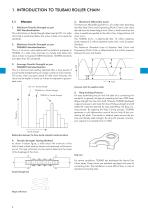
1. INTRODUCTION TO TSUBAKI ROLLER CHAIN ISO min. Tensile Strength TSUBAKI min. Tensile Strength TSUBAKI av. Tensile Strength 3. Average Tensile Strength as per TSUBAKI Standardisation This is a fracture load reading obtained after a long period of actual tensile strength testing of a large number of chain strands. Of course, when any given strand of roller chain fractures, this value may be higher or lower, so it does not represent a guaranteed value. 2. Minimum Tensile Strength as per TSUBAKI Standardisation This is a minimum value determined by statistical processes at TSUBAKI. If a roller...
Open the catalog to page 5
1. INTRODUCTION TO TSUBAKI ROLLER CHAIN 7. Ball Drifting Process Shot Peening increases resistance to: • fatigue failure • corrosion fatigue • hydrogen assisted cracking • cavitation erosion • stress corrosion cracking • galling • fretting Ball Drifting Repetitive load Residual compressive stress Repetitive load Residual Compressive Stress Ball drifting is the process of pressing a hardened steel ball through a hole in an already hardened steel plate. The goal of this process is to create local plastic deformation and effectively add compressive stress to the walls of the hole. Besides this,...
Open the catalog to page 6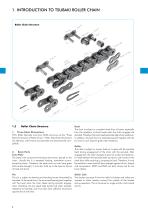
1. INTRODUCTION TO TSUBAKI ROLLER CHAIN Roller Chain Structure Roller Chain Structure 1. Three Basic Dimensions Pitch, Roller Diameter and Inner Width are known as the “Three Basic Dimensions of Roller Chain.” When these three dimensions are identical, roller chains and sprockets are dimensionally compatible. 2. Basic Parts Link Plate The plate is the component that bears the tension placed on the chain. Usually this is a repeated loading, sometimes accom panied by shock. Therefore, the plate must not only have great static tensile strength, it must also hold up to the dynamic forces of load...
Open the catalog to page 7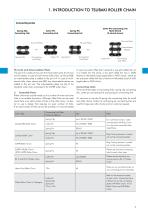
Spring Clip Connecting Link Cotter Pin Connecting Link Spring Pin Connecting Link Cotter Pin Connecting Link Multi-Strand (2-strand shown) Intermediate Plate(s) Link Plate Pin Link and Intermediate Plate The pin link consists of two pins that have been press fit into two pin link plates. In case of multi-strand roller chain up till size 08B, an intermediate plate is added to the pin link. In case of multistrand roller chain above size 08B, two intermediate plates are added to the pin link. The intermediate plates are slip fit for standard roller chain and press fit for SUPER roller chain. 3....
Open the catalog to page 8
1. INTRODUCTION TO TSUBAKI ROLLER CHAIN ONE Pitch Offset Link (OL) Single Strand TWO Pitch Offset Links (2POL) Single Strand Offset Link Plate Pin Offset Links An offset link is used when an odd number of chain links is required. Different types are available: One pitch offset link (OL) The pin and two plates are slip fit. The maximum allowable load is 35% (applicable to ANSI chain) lower than the chain itself. Two pitch offset link (2POL) Two pitch offset links are the combination of a roller link and an offset link connected with a rivet pin. The maximum allowable load for ANSI chain is higher...
Open the catalog to page 9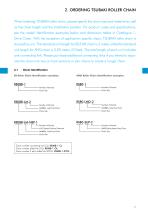
2. ORDERING TSUBAKI ROLLER CHAIN When ordering TSUBAKI roller chain, please specify the chain size and material as well as the chain length and the installation position. For product codes and specifications, see the model identification examples below and dimension tables in Catalogue 1, Drive Chain. With the exception of application specific chain, TSUBAKI roller chain is stocked by unit. The standard unit length for BS/DIN chain is 5 meter, while the standard unit length for ANSI chain is 3.05 meter (10 feet). The total length of each unit includes one connecting link. Please purchase additional...
Open the catalog to page 10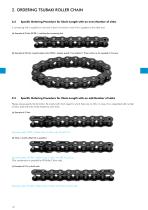
2. ORDERING TSUBAKI ROLLER CHAIN 2.2 Specific Ordering Procedure for Chain Length with an even Number of Links A connecting link is supplied on one end of each unit and an inner link is supplied on the other end. (a) Example of 8 links RS12B-1 including the connecting link (b) Example of 20 links riveted endless chain RS50-1 (please specify “rivet endless”). There will be no CL supplied in this case. Specific Ordering Procedure for Chain Length with an odd Number of Links Please always specify the formation. Be careful with chain types for which there are no OL’s. In case of an unspecified odd...
Open the catalog to page 11All Tsubakimoto Chain catalogs and technical brochures
 TSUBAKI DIRVE CHAINS & SPROCKETS
234 Pages
 TIMING beltand pulleys
72 Pages
 REDUCER FOR SERVO MOTORS TERVO
42 Pages
 TSUBAKI COUPLINGS
120 Pages
 Tsubaki Miter Gear Box
64 Pages
 Drive Chains & Sprockets
219 Pages
 Cam Clutch BR-HT Series
8 Pages
 Tsubaki Couplings
120 Pages
 Tsubaki Lambda Chain Leaflet
6 Pages
 Tsubaki Pin Gear Drive Units
6 Pages
 Tsubaki gear motors 40 W - 5.5 kW
268 Pages
 Titan Series Chain
4 Pages
 TRAXLINE Cables for Motion
88 Pages
 Power-Lock
88 Pages
 SJ3 Sealed Joint Technology
2 Pages
 TKA Series Plastic Cable Carrier
21 Pages
 Tsubaki Smart Tooth
2 Pages
 Tsubaki Cam Clutch Box Series
16 Pages
 Tsubaki Cam Clutch
92 Pages
 Tsubaki Pin Oven Chain
4 Pages
 Top Chain Engineering Manual
76 Pages
 Tsubaki Pin Gear Drive Units
16 Pages
 Tsubaki Cleanveyor
12 Pages
 Tsubaki Gripper Chain
6 Pages
 Tsubaki Top Chain
246 Pages
 Tsubaki Small Size Conveyor Chains
168 Pages
 Tsubaki Palm Oil Mill Chain
2 Pages
 Tsubaki PC Chain Brochure
12 Pages


Archived catalogs
 Tsubaki Custom Made Chain
90 Pages
 ZIP CHAIN ACTUATOR
56 Pages


- Cylinder
- Actuator
- Electric gearmotor
- Linear actuator
- Power transmission belt
- Articulated telesocpic boom lift
- Tsubaki conveyor belt
- Precision gearhead
- Hydraulic cylinder
- Tsubaki right angle gear reducer
- Compact gearhead
- Solid-shaft gearhead
- Flexible coupling
- Hollow-shaft gearhead
- Tsubaki shaft coupling
- Gear train gear reducer
- Lifting system
- Protection relay
- Transmission gearhead
- Compact actuator