
- Catalogs
- Triple R Europe NV
- V100 - VARNISH REMOVAL oil filter

V100 - VARNISH REMOVAL oil filter
V100 - VARNISH REMOVAL oil filter
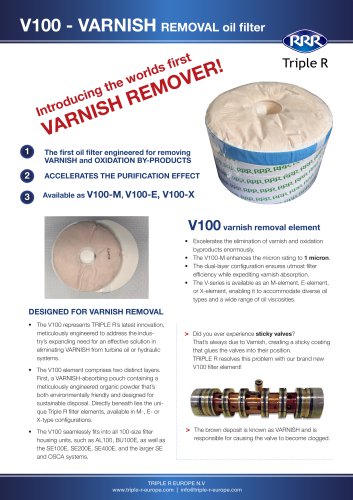
The V100 Varnish Removal Oil Filter by TRIPLE R EUROPE N.V. is an innovative solution designed to address the industry's need for effective varnish removal from turbine oil and hydraulic systems. Available in three configurations (V100-M, V100-E, V100-X), it accelerates the purification process by eliminating varnish and oxidation byproducts.
The V100 filter element consists of two layers: a varnish-absorbing pouch with an environmentally friendly organic powder and unique Triple R filter elements. It fits into all 100-size filter housing units and is available in M-, E-, or X-type configurations to accommodate various oil types and viscosities.
- V100-M: Viscosity range 2 - 100 cSt, 1 micron rating, weight 0.75 kg.
- V100-E: Viscosity range 32 - 180 cSt, weight 0.68 kg.
- V100-X: Viscosity range 46 - 320 cSt, weight 0.61 kg.
- All models have a height of 114 mm, diameter of 179 mm, and max pressure of 5 bar.
Oil degradation, leading to varnish build-up, is caused by oxidation, hydrolysis, and thermal degradation. These processes result in the formation of acidic and polymerized compounds, creating varnish that can clog systems. The V100 filter provides a cost-effective and easy-to-apply solution for various systems, including turbines, gearboxes, and engines.
The V100 Varnish Removal Oil Filter offers an efficient method to combat varnish-related issues, ensuring optimal maintenance and performance of lubrication and hydraulic systems. For more information, contact your local TRIPLE R distributor.
Catalog excerpts

V100 - VARNISH REMOVAL oil filter The first oil filter engineered for removing VARNISH and OXIDATION BY-PRODUCTS ACCELERATES THE PURIFICATION EFFECT V100 varnish removal element • Excelerates the elimination of varnish and oxidation byproducts enormously. • The V100-M enhances the micron rating to 1 micron. • The dual-layer configuration ensures utmost filter efficiency while expediting varnish absorption. • The V-series is available as an M-element, E-element, or X-element, enabling it to accommodate diverse oil types and a wide range of oil viscosities. DESIGNED FOR VARNISH REMOVAL • The V100 represents TRIPLE R’s latest innovation, meticulously engineered to address the industry’s expanding need for an effective solution in eliminating VARNISH from turbine oil or hydraulic systems. • The V100 element comprises two distinct layers. First, a VARNISH-absorbing pouch containing a meticulously engineered organic powder that’s both environmentally friendly and designed for sustainable disposal. Directly beneath lies the unique Triple R filter elements, available in M-, E- or X-type configurations. • The V100 seamlessly fits into all 100-size filter housing units, such as AL100, BU100E, as well as the SE100E, SE200E, SE400E, and the larger SE and OSCA systems. > Did you ever experience sticky valves? That’s always due to Varnish, creating a sticky coating that glues the valves into their position. TRIPLE R resolves this problem with our brand new V100 filter element! > The brown deposit is known as VARNISH and is responsible for causing the valve to become clogged. TRIPLE R EUROPE N.V www.triple-r-europe.com | info@
Open the catalog to page 1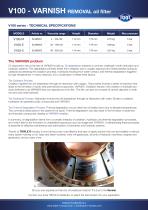
V100 - VARNISH REMOVAL oil filter Quicktoron V100 series - TECHNICAL SPECIFICATIONS MODELS Viscosity range Oil degradation lies at the hart of VARNISH build-up. Oil degredation presents a common challenge in both lubrication and hydraulic systems. This degradation primarily arises from oxidation due to oxygen exposure and metal particles acting as catalysts (accelerating the oxidation process), hydrolysis resulting from water contact, and thermal degradation triggered by high temperatures. In many instances, it’s a combination of these three factors. The Oxidation Process Oxidation signifies...
Open the catalog to page 2All Triple R Europe NV catalogs and technical brochures
 Vacuum dehydrator
2 Pages
 SS series 2025
2 Pages
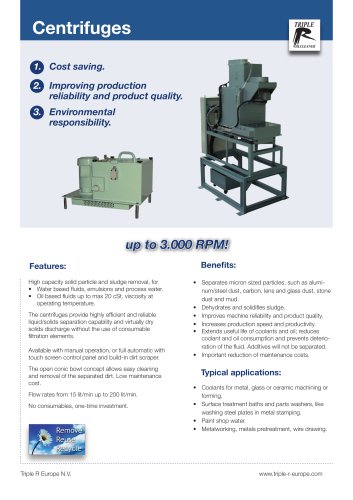 Centrifuges
2 Pages
 BU SERIES
2 Pages
 FILTER ELEMENTS
4 Pages
 monitoring_datasheet
2 Pages
 Wind Turbine
1 Page
 TR SERIES
2 Pages
 SS SERIES
2 Pages
 OSCA-SS SERIES
2 Pages
 WS SERIES
2 Pages
 Quicktoron
2 Pages
 SE SERIES
2 Pages
Archived catalogs
 triple_r_brochure
10 Pages
 Triple R Filter Elements
4 Pages
- Liquid filter
- Filter with cartridge
- Solids separator
- Filter cartridge
- Pressure separator filter
- Stainless steel pre-filter
- Centrifugal classifier
- Industrial filter cartridge
- Liquids separator
- Fine filter cartridge
- Cartridge filter housing
- Water filter cartridge
- Plastic filter cartridge
- Cascade separator
- Process separator
- Compact pre-filter
- Hydraulic filter
- Metal filter housing