
- Catalogs
- Trio Motion Technology
- Product comparison

Product comparison

1 / 1 PageView full catalog
Product comparison
Product catalog summary
Product Selection Overview: This guide provides a comprehensive comparison of various panel mount, PC-based, card-based, and drive-in motion controllers. It includes specifications for models such as MC464, MC224, MC206X, MC302X, PCI208, Euro205x, Euro209, and MC302-K.
Specifications: The document details the maximum number of axes, processor type, clock frequency, servo update rate, encoder input frequency, stepper output frequency, user memory, and data table size for each model. For example, the MC464 supports up to 64 axes with a 64-bit MIPS processor and a 400MHz clock frequency.
Performance Metrics: Execution benchmarks are provided in lines per millisecond, with the MC464 achieving 278 lines/mS. The servo update rate varies from 1ms to 125µS depending on the model.
Communication Interfaces: Various communication options are available, including DeviceNet, CANopen, USB, Ethernet, MODBUS, RS232/RS485, and more. The availability of these interfaces varies by model.
Physical Dimensions: The guide lists the width, height, depth, and weight of each model, with the MC464 being one of the larger units at 56mm x 201mm x 155mm and weighing 750g.
Feedback and Inputs/Outputs: Details on encoder inputs, resolver options, SSI, EnDat, and Tamagawa absolute encoders are provided. The number of digital and analog inputs/outputs is specified for each model.
Programming and Software: Support for multitasking, programming languages (Trio BASIC, IEC61131, G Code, HPGL), and software tools like Motion Perfect 2 and MC Simulator is outlined. The MC464 supports up to 30 tasks and includes features like DXF import and project encryption.
Power and Expansion: Power supply requirements and consumption are detailed, with options for expansion modules and daughterboards. The MC464, for instance, supports up to 16 daughterboards and 7 expansion modules.
Additional Notes: The document includes footnotes explaining specific requirements and optional features, such as the need for a servo encoder daughterboard for certain functionalities.
See more
All Trio Motion Technology catalogs and technical brochures
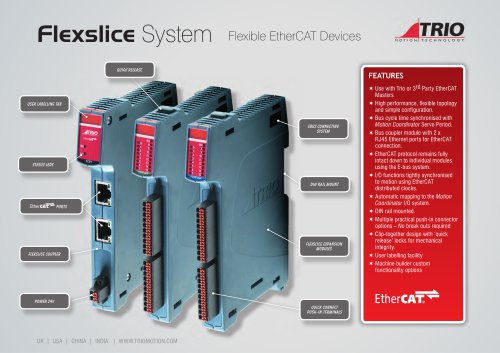 Flexslice System
4 Pages
 MC4N-RTEX Mini RTEX Master
2 Pages
 PC-MCAT 64
2 Pages
 MC664 / MC664-X
4 Pages
 MC508
MC5082 Pages
 MC4N-Mini EtherCAT Master
2 Pages
 UNIPLAY HMI
2 Pages
 I/O Modules
2 Pages
 PCI 208
2 Pages
 MC302X
2 Pages
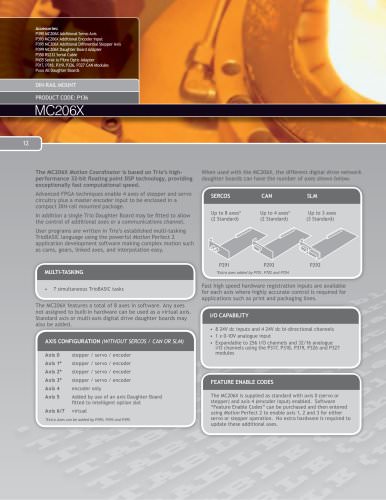 MC206X
2 Pages
 MC464
MC4642 Pages
 EURO205X
2 Pages
 EURO 209
2 Pages
 Euro404 / Euro408
2 Pages
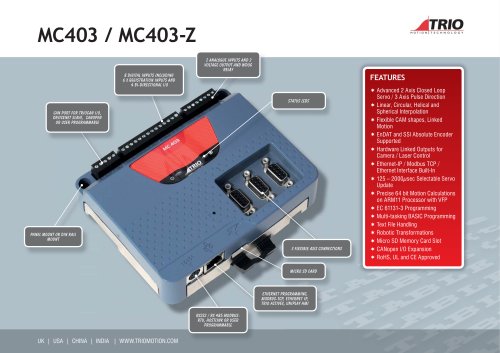 MC403 / MC403-Z
2 Pages
 MC405
MC4052 Pages
 MC464
MC4644 Pages


Archived catalogs
 Full product brochure
17 Pages
Related Searches
- Automation software solution
- Digital I/O
- Windows software
- IO module
- Servo-motor
- Analog I/O
- Monitoring software solution
- Servo-amplifier
- Interface software
- High-performance servo motor
- AC servo-motor
- Fieldbus I/O module
- Touch screen HMI
- Analog IO module
- Fieldbus servo-drive
- Controller servomotor
- DIN rail mounted I O module
- IP65 servomotor
- LCD operator terminal
- Ultra-compact servomotor
*Prices are pre-tax. They exclude delivery charges and customs duties and do not include additional charges for installation or activation options. Prices are indicative only and may vary by country, with changes to the cost of raw materials and exchange rates.
About DirectIndustry
DirectIndustry is a marketplace that offers B2B players a complete experience, from product sourcing to purchase. DirectIndustry is an entity of VirtualExpo Group.
Are you a buyer?
Are you a supplier?