video corpo

User Guide TDL450 L&H - English

User Guide TDL450 L&H - English
1 / 33 PagesView full catalog

User Guide TDL450 L&H - English

Product catalog summary
Contact Information: Trimble Navigation Limited, Engineering & Construction group, Dayton, Ohio. Support is available from 8 am to 5 pm Pacific Time. Visit the website for updates and upgrades.
Legal Notices: ©2018 Trimble Navigation Limited. All rights reserved. Includes trademark information and warranty details.
Warranty: One-year limited warranty covering defects in materials and workmanship. Exclusions include improper maintenance and unauthorized modifications.
Safety Information: A license is required for operating radio communication equipment. Follow warnings and cautions to minimize risks of injury and equipment damage.
Exposure to Radio Frequency Energy: Complies with various national and international standards. Maintain specified distances from the antenna during operation.
Rechargeable Batteries: Use only specified batteries and chargers. Avoid damage and exposure to extreme conditions.
Transmission Rules and Regulations: Licensing is required for operation. Complies with FCC and international regulations. Use CSMA technology to avoid interference.
Automatic Station Identification: Required by FCC every 15 minutes. Program call signs using TDLCONF software.
Introduction: This document is a user guide for the Trimble TDL 450L, TDL 450H, and TDL 450Hx radios, designed for GNSS/RTK applications. It provides detailed instructions for setup, operation, and maintenance.
Features and Compatibility: The radios support 12.5 kHz and 25 kHz channel bandwidth communications and are available in two frequency bands: 410 MHz–430 MHz and 430 MHz–470 MHz. They are compatible with Trimble, Pacific Crest, and SATEL radio products. The user interface includes a backlit LCD display and navigation buttons, allowing users to monitor and change settings easily. The radios offer fast data rates up to 19,200 bps, with user-selectable RF output power to optimize range and battery life.
Setup Procedures: Office Setup: Connect the radio to a power source and a PC using the appropriate cables. Install and use the TDLCONF software for configuration. Field Setup: Attach the antenna and connect the radio to a data source like a GPS receiver. Use the radio's interface for configuration and troubleshooting.
Configuration and Software: TDLCONF software is used for configuring and troubleshooting the radios. It allows users to check status, enter channel tables, and set parameters. Factory default settings can be restored using this software.
Technical Support and Feedback: For technical support, users are advised to contact their local dealer or visit the Trimble website. Feedback on the documentation can be sent to Trimble to help improve future revisions.
Additional Information: The guide includes sections on battery care, operating the radio, and tips for best performance. It also covers the use of radios with machinery and vehicles, emphasizing vibration damping and proper mounting.
Specifications: The document outlines the specifications for the TDL 450 series radios, including a link rate of 9600, operation modes for base/rover, high sensitivity for rover, and a serial baud rate of 38000. Advanced menus can be hidden, CSMA is on, security code is off, and scrambling and forward error correction are enabled. The language is set to English.
Antenna Setup: For optimal performance, it is recommended to elevate the RF antenna. A 50-ohm antenna with a male TNC connector can be directly attached to the radio. Trimble provides antenna cables compatible with standard tripods and range poles. Proper antenna connection is crucial for system performance.
Safety and Installation: When setting up antennas, ensure they are placed at the highest point available and use appropriate antennas for the application. Safety precautions include avoiding power lines, using guy-wire masts for antennas over 10 feet, and installing lightning arrestors in prone areas. Installations must comply with local building regulations.
Data/Power Cable: The radio connects to data sources via a data/power cable, which also connects to external power. Trimble recommends using an external battery with an SAE connector for optimal performance.
Indicator LEDs: The radio features LEDs indicating transmission (Tx), power status (Pwr), and reception (Rx). The Pwr LED indicates power status and error codes, while the Rx LED shows signal reception or interference.
Enclosure and Battery Care: The radio's enclosure is made from impact-resistant aluminum alloy with anti-corrosion treatment. The battery/charger kits include deep-cycle, sealed lead-acid batteries. Proper care involves avoiding full discharge and ensuring full charge before storage. The radios have low voltage warnings and automatic shut-off features to protect the battery.
Operating the Radio: To operate, connect the radio to power, and it will automatically turn on. Proper shutdown procedures are crucial to avoid damage. The user interface includes LEDs, an LCD display, and buttons for configuration. The LCD displays various settings and can be configured using TDLCONF software.
Functions and Configuration: The radio offers various functions such as device status, channel/frequency selection, data protocol, radio link rate, repeater mode, sensitivity, transmit power, and more. Configuration can be done via the radio interface or TDLCONF software.
Overview: The document is a user guide for the TDL 450L, TDL 450H, and TDL 450Hx radios, detailing their functions, configurations, and operational guidelines.
Language Selection: The TDL 450H/Hx models allow users to select the display language from English, Chinese, or Russian.
Function Navigation: Users can navigate through different function screens using arrow buttons. Display-only functions use left/right arrows, while display-and-select functions use up/down arrows to select parameters.
Configuration: The interface displays only compatible settings based on previous selections to prevent unsupported configurations. Modulation type is automatically selected based on channel bandwidth and data protocol.
Advanced Menus: Eight rarely changed functions are hidden by default to streamline navigation. Users can access these through the Advanced Menus feature.
Auto Rover Mode: Available on the TDL 450L, this feature automatically selects the channel with the strongest signal. Two options, Auto Rover 1 and Auto Rover 2, offer different scanning behaviors.
Manual Frequency Entry: Users can manually enter a receive-only channel frequency on the TDL 450L.
CSMA Compliance: CSMA technology is implemented to comply with FCC regulations, preventing transmission on occupied frequencies.
Security Code: Radios can be configured for encrypted data transmission using the TDLCONF software. The Security Code feature must be enabled on all radios in the network for communication.
Edit Configuration: Users can enable or disable configuration via the keypad using a passcode (369369) or through the TDLCONF software.
Scrambling: Scrambling helps synchronize transmissions and is recommended for all radios. It is mandatory for the TRIMTALK v1 protocol.
Forward Error Correction: This feature improves range by adding error-checking bits to data, though it reduces throughput. It is not supported by Trimble protocols.
Error Codes: The guide lists error codes and troubleshooting steps for various issues, such as voltage errors, temperature limits, and memory errors.
Automatic Power Management: TDL radios manage power to prevent heat damage, with features to reduce power or shut down if temperatures exceed safe levels.
Performance Tips: Antenna placement is crucial for performance. Users are advised to maximize antenna height and avoid using gained antennas beyond license limits. Line loss from connectors and cables should be minimized.
Specifications: The document outlines the technical specifications for TDL 450L, TDL 450H, and TDL 450Hx radios. These include communication capabilities with an RS-232 port, power requirements, and consumption details. The radios operate within specific frequency bands and have programmable RF transmitter outputs. They are certified for use in multiple countries and meet environmental standards such as IP67 for dust and water resistance.
Power Supplies: It is recommended to maintain batteries in a fully charged state to prolong their life. Regular charging after use and during periods of non-use is advised.
Equipment Care: Routine care is essential to maintain the reliability of the radios. They should not be operated outside specified conditions to avoid damage.
Use with Machinery and Vehicles: The radios meet MIL-STD 810F standards for vibration and should be mounted with rubber dampers. They can be installed outside vehicle cabins but should be protected from extreme temperatures.
DC Power Supply: Each radio model has specific input voltage requirements, and a power conditioner is recommended for vehicle installations to prevent damage from voltage spikes.
Protection from Electromagnetic Interference: Radios should be positioned away from other antennas and electrical equipment to minimize interference.
Pinouts and Connectors: The radios use a 5-pin circular data/power connector, with specific pin assignments for power, ground, and signal connections.
Antenna: Elevating the antenna improves range, and high-quality 50-Ohm impedance cabling is recommended.
Technical Specifications: Detailed specifications include modulation/link rates, link protocols, frequency control, and environmental operating conditions. The radios are designed to withstand specific temperature ranges and vibration levels.
Mechanical Specifications: Dimensions and weight for each radio model are provided, along with details on connectors used.
See more

Catalog excerpts

User Guide TDL450 L&H - English-2

Contact Information Trimble Navigation Limited Engineering & Construction group 5475 Kellenburger Road Dayton, Ohio 45424-1099 U.S.A Tel: 800-538-7800 (U.S.A toll free) +1-937-245-5600 Phone +1-937-233-9004 Fax www.trimble.com/global-services/ Support hours are 8 am to 5 pm Pacific Time. Please visit our website for up-to-date news and product announcements. Firmware and software upgrades are available from our website, usually free of charge. Legal notices ©2018, Trimble Navigation Limited. All rights reserved. Trimble is a trademark of Trimble Navigation Limited, registered in the United States...

 Open the catalog to page 2
User Guide TDL450 L&H - English-4

Safety Information Before you use your radio, ensure that you have read and understood this publication, as well as safety requirements. CAUTION – A license is required before operating radio communication equipment. Warnings and cautions An absence of specific alerts does not mean that there are no safety risks involved. Always follow the instructions that accompany a Warning or Caution. The information they provide is intended to minimize the risk of personal injury and/or damage to the equipment. In particular, observe safety instructions that are presented in the following formats: WARNING...

 Open the catalog to page 4
User Guide TDL450 L&H - English-5

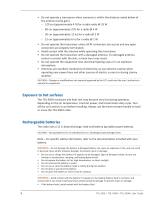
• Do not operate a transceiver when someone is within the distance noted below of the antenna (unity gain). – 120 cm (approximately 4 ft) for a radio radio @ 35 W – 60 cm (approximately 2 ft) for a radio @ 4 W – 30 cm (approximately 12 in) for a radio @ 2 W – 15 cm (approximately 6 in) for a radio @ 1 W • Do not operate the transceiver unless all RF connectors are secure and any open connectors are properly terminated. • Avoid contact with the antenna while operating the transceiver. • Do not operate the transceiver with a damaged antenna. If a damaged antenna comes in contact with the skin,...

 Open the catalog to page 5
User Guide TDL450 L&H - English-6

If battery fluid gets into your eyes, immediately rinse your eyes with clean water and seek medical attention. Do not rub your eyes! If battery fluid gets onto your skin or clothing, immediately use clean water to wash off the battery fluid. WARNING – Charge and use the rechargeable battery only in strict accordance with the instructions. Charging or using the battery in unauthorized equipment can cause an explosion or fire, and can result in personal injury and/or equipment damage. To prevent injury or damage: • • • • • Do not charge or use the battery if it appears to be damaged or leaking....

 Open the catalog to page 6
User Guide TDL450 L&H - English-7

Being part of the RF community Operation of a licensed radio product makes you a member of the RF community. Be aware that virtually all frequencies licensed are provided on a shared basis with other users. Each frequency dedicated specifically to RTK surveying activities has certain restrictions and limitations. For complete information, refer to the appropriate documentation from the licensing agency in your country of operation, e.g., Part 90, Title 47, of the Code of Federal Regulations. Most frequencies sharing data transmissions and voice transmissions give priority to voice users. Be mindful...

 Open the catalog to page 7
User Guide TDL450 L&H - English-8

GPS RTK equipment is designed to function with intermittent gaps in the data. Heavy co-channel use may limit the ability of the radio to transmit the required information. In areas of heavy co-channel usage, try changing channels to a less used frequency. Safety Informa on . . . . . . . . . . . . . . . . . . . . . . . . . . . . . . . . . . . . . . . . . . . . . . . . . . . . . . . . . . . . . . . 3 Introduc on . . . . . . . . . . . . . . . . . . . . . . . . . . . . . . . . . . . . . . . . . . . . . . . . . . . . . . . . . . . . . . . . . . . . 9 Note about this guide . . . . . . . . . . . . ....

 Open the catalog to page 8
User Guide TDL450 L&H - English-10

Introduction This manual describes how to set up and use the Trimble® TDL 450L, TDL 450H and TDL 450Hx radios. The radios are advanced, high speed, wireless data links that are designed specifically for GNSS/RTK applications, but are also appropriate for many other applications requiring digital data links. Your success in using the radios is the primary goal of Trimble. Trimble stands behind its products by providing expert support and service. Your comments and questions are welcome. This guide provides information concerning the use of the following radios: • TDL 450L Model numbers ADLV-1...

 Open the catalog to page 10
User Guide TDL450 L&H - English-11

Overview Features Compatibility • Facilitates radio equipment mix and match • Interoperable with Trimble radio products, Pacific Crest (RFM, PDL, and ADL), and SATEL • All models support 12.5 kHz and 25 kHz channel bandwidth communications • Available in two bands: 410 MHz–430 MHz and 430 MHz–470 MHz • Provides upgrade path for existing installations Enhanced user interface • Backlit LCD display and five-button navigation interface • View and change radio channel, modulation, and protocol types • Monitor signal levels, baud rates, and other parameters Fast over-the-air data rate • Up to 19,200...

 Open the catalog to page 11
User Guide TDL450 L&H - English-12

Plug the radio’s desktop power supply into the wall. You may alterna vely use an approved 12 Volt ba ery for power. But you must never power a radio with a ba ery while it is being recharged. This will damage the ba ery. A ach the desktop power supply’s (or ba ery’s) SAE connector to the radio programming cable’s SAE connector. A ach the programming cable’s DE-9 connector into a serial port on your PC. If your PC does not have a serial port, you should use a serial-to-USB adaptor. A ach the programming cable’s LEMO plug (with the red dot facing up) into the bo om of the radio. This will turn...

 Open the catalog to page 12
User Guide TDL450 L&H - English-13

A ach the antenna to the radio, either directly to the top of the radio or to an antenna cable. A ach the radio to your tripod using the tripod clip on the back of the radio. See the figure be low for setup sugges ons. Connect the radio to the source of the data you will transmit, for example, a GPS receiver, using the data/power cable. The TDL 450L, TDL 450H and TDL 450Hx radios use the same data connector – with the same pinouts - found on the PDL HPB radio. This makes the radios compa ble with exis ng HPB data cables. Join the data/power cable’s SAE connector to the 12 Volt ba ery’s SAE connector....

 Open the catalog to page 13
*Prices are pre-tax. They exclude delivery charges and customs duties and do not include additional charges for installation or activation options. Prices are indicative only and may vary by country, with changes to the cost of raw materials and exchange rates.