
- Catalogs
- Trelleborg Wheel Systems
- ENVIRONMENTAL POLICY
ENVIRONMENTAL POLICY

ENVIRONMENTAL POLICY
The Trelleborg AB Environmental Report 2000 provides an overview of the company's environmental, health, social, and ethical activities, aimed at employees and external stakeholders.
Trelleborg's environmental policy focuses on compliance with national and international standards, minimizing waste and emissions, ensuring safe workplaces, and integrating environmental considerations into operations. The policy mandates adherence to ISO 14001 and EMAS standards.
The company is committed to continuous improvement in environmental performance, emphasizing transparency and collaboration with customers to achieve environmental goals.
In the late 1990s, Trelleborg restructured to focus on polymer operations, enhancing its position in the automotive industry through acquisitions. The Group is organized into four business areas: Automotive, Wheel Systems, Engineered Systems, and Building Systems.
The report details the implementation of environmental management systems, with 23 plants certified under ISO 14001, focusing on chemical handling, energy savings, and waste management.
Data on emissions, waste, and resource utilization are provided, with a focus on chemical safety, energy efficiency, and soil decontamination.
Information on work-related injuries, illnesses, and training is gathered through questionnaires and interviews, despite the absence of a Group-wide system.
Trelleborg emphasizes its commitment to environmental care and protection, with ongoing efforts to enhance performance and stakeholder engagement.
Trelleborg is a leading manufacturer of rubber membranes and sealing systems, with a strong presence in Finland, Poland, and Sweden.
Natural rubber is sourced from Southeast Asia, while synthetic rubber, derived from petroleum, constitutes 75% of Trelleborg's usage, offering various properties for industrial applications.
Rubber mixes include fillers and additives, with production involving mixing, extrusion, and vulcanization.
Trelleborg manages environmental impacts through management systems and action programs, focusing on resource utilization, chemical use, emissions, and waste management.
Risks include nonrenewable resource use, greenhouse gas emissions, chemical exposure, and occupational injuries.
Environmental activities are decentralized, with site managers responsible for compliance, supported by environmental managers.
Efforts to achieve ISO 14001 certification are detailed, with 23 organizations certified by 2000 and a goal of 40 by 2001.
Audits during acquisitions identify environmental risks and liabilities, assessing compliance and potential contamination.
Compliance requirements for plants, particularly in Sweden, are outlined, with regular inspections ensuring adherence to regulations.
Energy consumption increased by 33% from 1999 to 2000, with conservation measures implemented. Water consumption efforts focus on reduction through recirculation systems.
Ongoing efforts to monitor and decontaminate sites are highlighted, with several plants confirming contamination.
The Group is reducing harmful chemical use by substituting safer alternatives, aligning with EU regulations.
Efforts to reduce VOCs, CO2, and other pollutants include switching to water-based solvents and technological upgrades.
Challenges with rubber waste disposal are addressed through energy recycling and material recovery, with significant waste generated and recycled in 2000.
Acquisitions increased the workforce, with integration through training and collaboration with educational institutions.
Commitment to human rights, equality programs, and employee satisfaction is emphasized, with open communication and management practices.
Work environment challenges include noise and chemical exposure, with initiatives to reduce work-related accidents.
Training in health and environmental management averaged 3.9 hours per employee, focusing on ISO 14001-certified plants.
Trelleborg's products enhance comfort and safety, with applications in vehicles and buildings, and environmentally friendly solutions like low-pressure tires.
Participation in tire disposal systems and compliance with EU packaging regulations are highlighted.
Truck transport is predominant, with air travel accounting for 70% of business travel costs.
Environmental performance is emphasized in supplier interactions, with ISO 14000 activities expanding to procurement.
33 environmental incidents were reported in 2000, with minimal impact and complaints mainly concerning noise and odors.
Environmental costs and investments in improvements are detailed, with significant projects in various locations.
Energy and waste reductions were reported, with notable savings in specific plants.
Key metrics include energy consumption, water usage, VOC emissions, and waste management, with several plants holding ISO 14001 certifications.
Various ISO certifications are held by Trelleborg's plants, with a goal to certify all under ISO 14001.
Collaboration with universities and colleges fosters environmental awareness among students.
Trelleborg participates in international seminars and conventions, promoting environmental products and awareness.
Participation in the chemical industry's Responsible Care program involves submitting environmental data and conducting self-evaluations.
Objectives for energy and water savings, waste reduction, and improved work environments are set and reviewed during audits.
Trelleborg contributes to environmental research and development projects through various industry associations.
A glossary of terms related to environmental management and references for further reading are provided.
Trelleborg AB is a global industrial group specializing in polymer materials, with operations divided into four main business areas.
The group reported sales of approximately SEK 17 billion, with a workforce of around 15,500 employees across 40 countries.
Catalog excerpts

Trelleborg ABEnvironmental Report 2000 >
Open the catalog to page 1
At the beginning of the 1990s, the Trelle-borg Group comprised, in addition to theoriginal polymer operations (primarily rub-ber products), mining and metals opera-tions, mineral processing and trading activi-ties. During the latter part of the 1990s, theGroup was restructured and activities out-side the polymer operations were divested,creating a substantially changed Trelleborg.A number of significant acquisitions weremade during the years 1999-2000. Theacquisitions included the antivibration oper-ations (BTR AVS) of the British Invensyscompany, with sales of approximately > The Trelleborg...
Open the catalog to page 6
The Trelleborg Group Worldwide Group Center > Trelleborg Wheel Systems > Trelleborg Engineered Systems > Trelleborg Building Systems >
Open the catalog to page 7
The rubber tree (Hevea brasiliensis) requiresa warm and humid climate, which explainswhy rubber plantations are found in a zoneround the equator. Today, more than 90percent of all natural rubber comes from Southeast Asia. The largest producers areThailand, Indonesia and Malaysia, which together account for 80 percent of worldproduction. There are also rubber planta-tions in South America and Africa.Rubber trees grow to a height of approx-imately 20 meters. Tapping of the trees forlatex can begin seven years after sowing, andthe yield is highest when the trees are tenyears old. A rubber tree can...
Open the catalog to page 8
Chloroprene rubber (CR) ishighly suitable for products that are intend- ed for outdoor use or which could come into contact with oil or gasoline. A typical product is the outer layer of rubber in oil hoses. Butyl rubber is particularly suitablefor use in products designed to prevent gases from penetrating through the material. Among other applications, it is used in inner tubes for tires. > Rubber trees grow to a height of approximately20 meters. Tapping of the trees for latex can begin seven years after sowing,and the yieldis highest when the trees are ten years old. A rubber tree can be tapped...
Open the catalog to page 9
CompoundFunction FillersCarbon black is a fine powder that is added to strengthen and fill the rubber. Chalk can also be used as a filler.Vulcanizing ingredientsOther substances in addition to sulfur can be used to influence the properties of rubber. The vulcanization speed is governed by accelerators and the process is initiated by activators.Aging inhibitorsVarious substances can be added to increase the lifespan of products. Examples are antioxidants and anti-ozonants,which protect against the effects of contact with the air.SoftenersSofteners are added to control product hardness and simplify...
Open the catalog to page 10
Environment/workenvironment aspectPriority levelExamples of possible health and environmental impacts Localization Local disturbance due to noise, transports and unpleasant odors.Soil and groundwater Contamination of soil and groundwater.Consumption of natural resources Environmental impact from rubber plantations during production of natural rubber. Utilization(raw materials)of nonrenewable resources during production of synthetic rubbers and other polymers.Consumption of natural resources Utilization of nonrenewable resources (oil, natural gas). Clean water is a scarce resource in(water, energy)many...
Open the catalog to page 13
Environment-related activities within theTrelleborg Group are decentralized andbased on the individual operations of thedifferent plants. Formal responsibility for the environmental, health and safety issuestherefore resides within the various line orga-nizations. Site managers are key personnel inthis context and are required to managetheir operations in accordance with: ҕlegal and other requirements (e.g. custo-mer requirements),TrelleborgՒs environmental policy, environ-mental management manual, environmen-tal standards and position papers, requirements of ISO 14001.There are environmental...
Open the catalog to page 14
Interviews Օ Document studies InspectionUncertainties oridentified risks Phase 1 > No,or limited,environmental risks Phase 2 Environmental risksno obstacle to transaction Planning and implementation ofsoil surveys > 17 size="-1">
Open the catalog to page 17
Other 0.01% Oil 21% Electricity 41% Natural gas 35% Coal 3% >
Open the catalog to page 21
Chemical Environment/Health impactStatus > SolventsGive rise to local air pollu-Changed processes and,in some cases,tants. Health impact in the a transition to water-based substitutes work environment.have reduced use.Chlorinated Some are suspected to causeUse of chlorinated solvents has decreased solventscancer and other health prob-or ceased at many plants. lems. In the outdoor environ- ment,they contribute to dep- letion of the ozone layer.MOCACancer-classified accelerator. The substance is used on a few sites in polyurethane manufacturing.ETUAccelerator classified as a Still used within the...
Open the catalog to page 23
External transport and disposal > 11% Internal waste management Purchased raw materials > Other countries Sweden 18% 19% Other Nordic countries 3% > North America 22% Other European countries 38% > 20001999 Average no. of Group employees12,39712,655Women (%)2023 Men (%)8077Average no. of employees in Sweden2,2504,434Women (%)3027 Men %7073Average no. of employees outside Sweden10,1478,221Women %1821Men %8279 26 size="-1">
Open the catalog to page 26
has been clarified, however, and we know thatthe greatest exposure to chemical particlestakes place during the first stages of produc- tion, i.e. the handling of raw materials, and the weighing and mixing of compound ingredients. Solvents are used primarily atthe coating and compounding stages. The vulcanization process itself generates vapor and gases containing hundreds of different substances, such as benzene, aromatic hydro-carbons and nitrosamines. Finally, during thehandling and warehousing of finished prod-ucts, gaseous substances are emitted.Trelleborg monitors the development ofscientific...
Open the catalog to page 28
Rubber has many properties that provide forbetter comfort and safety and an improvedhuman environment. Many of Trelleborgsproducts are used for the damping of noiseand vibration in cars and trains. Similarproperties are utilized in industrial applica-tions, e.g. the damping of vibrations inmachines and other equipment. Anotherimportant area consists of rubber seals forwindows and doors, where the environmen-tal gains lie in the saving of energy andreduction of noise.Rubber also has other favorable attributes,in that the material constitutes a durablemembrane that is impenetrable for both airand...
Open the catalog to page 29All Trelleborg Wheel Systems catalogs and technical brochures
 Trelleborg tires range
8 Pages
 TM700 ProgressiveTraction®
12 Pages
 TM800_2023
8 Pages
 TM1000 ProgressiveTraction®
12 Pages
 T-900
T-9002 Pages
 TR-900
2 Pages
 TM900 High Power_2023
8 Pages
 TM700_2023
8 Pages
 TM600_2023
8 Pages
 TM2000_2023
2 Pages
 Trelleborg Premia
2 Pages
 Twin Forestry_2023
12 Pages
 TM1000 High Power_2023
16 Pages
 2023 TM3000
8 Pages
 2024 TM150
8 Pages
 TM100_2023
2 Pages
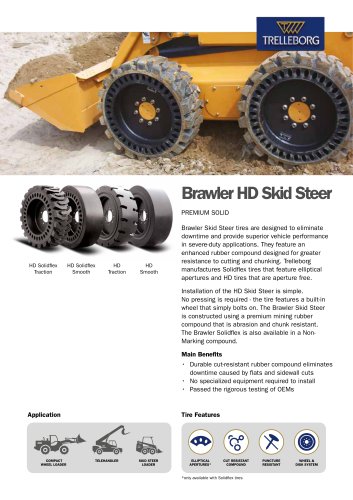 Brawler HD Skid Steer 2024
2 Pages
 Agro Industrial range
8 Pages
 Dual Mounting Systems
10 Pages
 TM1060
8 Pages
 ProHD_Maximum productivity
2 Pages
 ProTEX
2 Pages
 TUBES
TUBES344 Pages
 PREMIA Balanced Performance
2 Pages
 Construction series
16 Pages
 BRAWLER HD LOADER
2 Pages
 T418 Skidder
2 Pages
 Twin Radial_2015
8 Pages
 TM90
TM9012 Pages
 Trelleborg Wheel Systems
8 Pages
 T410 Agroforest
2 Pages
 TM 90
TM 9012 Pages
 Marshland
2 Pages
 Implement Standard
2 Pages
 technical data TM900
2 Pages
 Twin Implement
2 Pages
 Watts POS
2 Pages
 Sherpa
2 Pages
 hpt-qz4
2 Pages
 dl-qz1
2 Pages
 Wheels for Agriculture
6 Pages
 Twin Radial 710/50R26.5
2 Pages
 TH400
TH4008 Pages
 TM Blue
12 Pages
 Industrial Wheels
20 Pages
 Infinity
8 Pages
 Orca
Orca2 Pages
 Monarch
4 Pages
 Trelleborg POS
8 Pages
 Trelleborg Excavator
2 Pages
 Trelleborg SKS-900
4 Pages
 Mastersolid
2 Pages
 Rota
Rota8 Pages
 Monarch M²
2 Pages
 Bergougnan Elite XP
12 Pages
 Trelleborg Expert
4 Pages
 Visual Folder
2 Pages


Archived catalogs
 ProHD
ProHD2 Pages
 T-800
T-8002 Pages
 T-900
T-9002 Pages
 TR-900
4 Pages
 TM900 High Power_2012
8 Pages
 TM800_2011
8 Pages
 TM700_2012
8 Pages
 TM600_2012
8 Pages
 TM2000_2012
2 Pages
 Trelleborg Premia
2 Pages
 Twin Forestry_2012
2 Pages
 TM1000 High Power_2012
12 Pages
 2015 TM3000
4 Pages
 2015 TM150
8 Pages
 TM100_2015
2 Pages
 BRAWLER HD SKID STEER
4 Pages
 TH400 Agro Industrial
8 Pages
 DUO 500
4 Pages
 TM1060 - 2018
16 Pages
 Twin Radial_2012
8 Pages
 TM100_2012
2 Pages
 OEM INTERVIEW TRELLEBORG
3 Pages

