
- Catalogs
- Trelleborg Antivibration Solutions
- Specialist Vehicle Product Catalogue


Specialist Vehicle Product Catalogue

Specialist Vehicle Product Catalogue
Trelleborg Industrial AVS specializes in designing and manufacturing rubber-to-metal bonded components for anti-vibration applications and suspension systems. With headquarters in Leicester, UK, and production facilities in Sweden, the company serves industrial, off-highway, rail, and marine markets globally.
The catalogue features product lines such as TrellExtreme®, Metalastik®, and Novibra®, each designed for specific applications. TrellExtreme® is tailored for off-highway vehicles, offering superior vibration isolation to protect operators.
Controlling vibration is crucial to prevent noise and structural damage. Trelleborg provides solutions like vibration isolation and sound insulation, highlighting rubber springs for their load-bearing capacity and ability to handle complex loadings.
Trelleborg offers extensive resources, including R&D facilities and advanced testing technologies, focusing on continuous product development and environmental improvements to exceed legislation.
The document explains vibration theory, emphasizing rubber's high elasticity and damping capacity for isolation. It covers dynamic stiffness, creep performance, and the Joule effect, detailing rubber's behavior under various conditions.
Trelleborg uses various rubber compounds for specific performance needs, focusing on reducing environmental impact through improved processes and eco-friendly materials.
Trelleborg positions itself as a comprehensive partner in solving vibration issues, offering education, training, and tailored solutions.
Springs are used between source and receiving structures to reduce transmitted force, potentially lowering it to 2-3% of a rigidly mounted machine's force.
Key terms such as amplitude, interference frequency, natural frequency, mass, spring force, deflection, and damping coefficient are defined to aid understanding.
Formulas for deflection, isolation degree, and reduction in decibels are provided, with tuning ratio and magnification factor crucial for effectiveness.
Shock is a transient phenomenon, and soft mountings are recommended for low natural frequencies and effective isolation.
Guidelines emphasize moderate temperature, low humidity, and protection from light and ozone for storing rubber products.
Specifications for mounting products like MDS and Metacone™ include dimensions, load capacities, and installation instructions.
A table for converting units such as feet to meters and pounds to kilograms is included.
The document stresses selecting the right antivibration mountings for effective isolation in machinery applications.
The document details mounting solutions for compactor drums, vibratory screen equipment, and off-highway vehicles, including installation guidelines.
Mountings are made from high tensile strength rubber compounds bonded to steel plates, offering easy installation and maintenance-free operation.
Various mounting types are listed with part numbers, maximum bolt torque, and load capacities, including dimensions like diameter and height.
- Cushyfloat™ Special: Designed for rough environments, featuring bump and rebound control.
- CR-Controlled Rebound Mounting: High load capacity with low installation height for off-highway engines and cabs.
- EH Mountings: Effective for vibration isolation on engines and cabins.
Mountings are used in off-highway vehicles, military vehicles, construction equipment, and agricultural vehicles.
Installation arrangements and notes on natural frequencies and isolation degrees are provided.
Trelleborg emphasizes continuous improvement and reserves the right to change product designs and specifications without notice.
Product codes with specifications such as dimensions and part numbers are listed, including types A, B, and C washers.
Contact details for Trelleborg offices in various countries are provided, including addresses, telephone, fax numbers, and emails.
The importance of using overload and rebound washers for safety and reliability in mobile applications is emphasized.
Catalog excerpts

OFF HIGHWAY PRODUCT CATALOGUE
Open the catalog to page 1
Trelleborg Industrial AVS Sound solutions for your world How to control vibration 4 6 Vibration Theory Vibration Theory 8 Products Assistance Guide MDS Mounting Metacone™ HydroMounting Compactor Shearmounting Cushyfloat™ Special Cab Mounting 2-piece CR Mounting EH Mushroom Suspension Systems Spherilastik™ Control Links Conical Bearing Suspension Spring Washers 14 16 18 26 27 28 30 32 34 36 38 39 40 41 42 43 Trelleborg IAVS is a world leader in the design and manufacture of rubber to metal bonded components for anti-vibration applications and suspension systems. There are three main brands: TrellExtreme®...
Open the catalog to page 3
SOUND SOLUTIONS FOR YOUR WORLD Trelleborg Industrial AVS is your partner in tough terrain. The company has developed the new TrellExtreme® range of isolators specifically for off-highway vehicles – from the smallest skid steer loader and mini excavator to the largest articulated dump truck. These superior vibration isolation systems with motion control are designed to protect vehicle operators from the harmful and fatiguing effects of vibration and noise in extreme off-highway conditions. With our new TrellExtreme® range and our specialized expertise in vibration control, we can help you find...
Open the catalog to page 4
The primary function of Trelleborg Industrial AVS antivibration mountings is to eliminate harmful vibration and effectively reduce structure-borne sound. Our mission is to be our customers’ preferred choice for engineered solutions in the Industrial, Off-highway, Rail and Marine markets. Unrivalled r esour ces Trelleborg Industrial AVS has all the resources you would expect from a global market leader: • An R&D centre and purpose-built, state-of-the-art manufacturing plant at our Leicester head office in the UK, plus production facilities in Sweden. • Our own laboratories equipped with the very...
Open the catalog to page 5
HOW T O C O N T R O L V I B R AT I O N Causes and consequences Vibration is generated by all kinds of machinery, particularly equipment with rotating or reciprocating movements. If solidly mounted, these generated motions are transmitted directly to the foundations causing irritating noise in the immediate surroundings of the machine installation. Noise may also occur in areas some distance away, transmitted through the structure. This is normally referred to as structure-borne noise (structural noise). In addition to noise, the creation of vibration can cause serious problems to sensitive machinery....
Open the catalog to page 6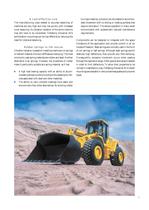
A cost-ef fective cure The manufacturing costs related to accurate balancing of machines are very high and may rise quickly with increased inner balancing. As vibration isolation of the entire machine may still have to be considered, Trelleborg Industrial AVS antivibration mountings can be cost-effective by reducing the need for intensive balancing. Rubber springs to the r escue Vibration isolation is based on installing machinery on springs or resilient material of known stiffness and damping. The most commonly used spring materials are rubber and steel. Another alternative is air springs. However,...
Open the catalog to page 7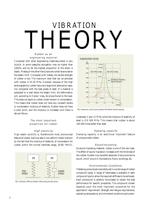
V I B R AT I O N THEORY Rubber as an engineering material Compared with other engineering materials,rubber is very ductile. In some cases,the elongation may be higher than 1000%, and by far the highest proportion of this strain is elastic. Metals,on the other hand,have very small strains below the elastic limit. Compared with metals, the tensile strength of rubber is low. The maximum level that can be achieved with rubber is 25-30 MPa. However, because of the high straincapability, rubber has a very large work absorption capacity compared with the best grade of steel. If a material is subjected...
Open the catalog to page 8
tial contaminates must be considered. Most Trelleborg rubber compounds are based on natural rubber compunds, offering high strength and excellent performance characteristics. A range of synthetic rubber compounds is also available for special applications where resistance to continuous high temperatures (>60 °C) or other harsh environmental conditions is required. Anti-oxidants and anti-ozonants are included in many formulations to provide resistance against ozone and ultra violet rays. Dynamic elasticity Dynamic load Static load Deformation FIG.6. Schematic representation of the internal damping...
Open the catalog to page 9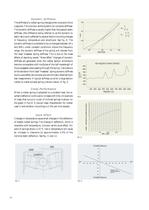
Joule ef fect Changes in temperature cause small changes in the deflection of loaded rubber springs. This change in deflection, which is reversible with temperature, is known as the Joule effect. For pairs of springs shown a 10 °C rise in temperature will cause an increase in clearance by approximately 4.5% of the nominal static deflection. See fig. 11 and 12. Kd = P1 X1– X5 P3– P4 X3– X4 DEFLECTION FIG.8 HIGH FREQUENCY DYNAMIC STIFFNESS db ref 1 N/M FREQUENCY (Hz) FIG.9 CREEP - % INCREACE ON BASE DEFLECTION Cr eep Per for mance When a rubber spring is subjected to a constant load, the resultant...
Open the catalog to page 10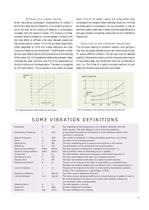
Stif fnes of a r ubber spring When calculating compression characteristics of rubber, it should be noted that the deflection is not directly proportional to the load, as the modulus of elasticity in compression increases with the degree of stress. The modulus of shear, however, remains constant for normal stresses. The factor with the most effect on stiffness is the ratio between loaded and free surface area of rubber. This is the so-called shape factor (often designated S). With thin rubber sections,a very high modulus of elasticity can be achieved. The stiffness of a rubber spring is also determined...
Open the catalog to page 11
Calculation of deflection When calculating deflection the following formula shall be used. happens when vibration isolation is achieved. The low elasticity and shear moduli of rubber are used to achieve a low natural frequency. Calculation of isolation degr ee The following formulas are used for calculating the isolation degree for a given spring. To summarize, transmission of vibration forces can be effected in three ways: 1. Rigidly mounted machines transmit vibration forces in unchanged form to the base, which is therefore forced to be a part of the movement of the machine. The magnification...
Open the catalog to page 12All Trelleborg Antivibration Solutions catalogs and technical brochures
 EH Mount
2 Pages
 DX mount
2 Pages
 Conical mount
4 Pages
 Cushymount K product range
4 Pages
 Compactor shear range
2 Pages
 Cushyfoot?
2 Pages
 Cushyfloat?
2 Pages
 Circular SAW? Mountings
2 Pages
 Novibra® AV Plate
2 Pages
 Metaxentric? Bushes
1 Page
 Cab mountings
2 Pages
 Buffers?
2 Pages
 Bobbins
5 Pages
 BA? & Double U Shear?
2 Pages
 ANB?
ANB?3 Pages
 Marine Product Catalogue
6 Pages
 Industrial Product Catalogue
96 Pages
 Marine Brochure
2 Pages
 Rail Brochures
2 Pages
 Specialist Vehicle Brochure
2 Pages
 2011 Windpower Brochure
4 Pages
 2011 Defence Brochure
6 Pages
 Rail Product Catalogue
6 Pages


Archived catalogs
 Industrial Product Catalogue
104 Pages
 Industrial Products Catalogue
96 Pages