

Series 100

Series 100
The Series 100 Linear Velocity Transducers are designed to measure linear velocity accurately without external excitation. They utilize high coercive force permanent magnet cores that generate DC voltage when moving within shielded coils. These transducers are suitable for applications requiring instantaneous velocity measurements, such as seismology and hydraulic ram speed.
Key Features
- Self-generating DC voltage output
- Magnetically shielded
- High sensitivity
- High frequency response
Performance Specifications
The transducers offer various models with different magnet dimensions, output sensitivity, and frequency response. The output voltage varies linearly with the magnet's velocity, and the operating temperature range is from -50°F to +200°F (-46°C to +93°C).
Mechanical Specifications
The transducers have specific coil housing and magnet dimensions, with weights varying by model. The mechanical setup requires precise positioning of the magnet for accurate operation, and the housing can be secured using a split block or clamping arrangement.
Installation Recommendations
Core extension rods, made of nonmagnetic stainless steel, are recommended for full-range operation. Using rods shorter than recommended may reduce the measurement range. The rods are available in various lengths to accommodate different models.
Conclusion
The Series 100 Linear Velocity Transducers provide a reliable solution for measuring linear velocity in various industrial applications. Proper installation and use of recommended accessories ensure optimal performance.
Catalog excerpts
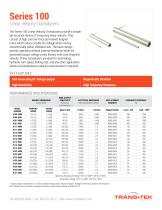
Linear Velocity Transducers The Series 100 Linear Velocity Transducers provide a simple yet accurate means of measuring linear velocity. They consist of high coercive force permanent magnet cores which induce sizable DC voltage while moving concentrically within shielded coils. The basic design permits operation without external excitation while the generated output voltage varies linearly with core (magnet) velocity. These transducers are ideal for seismology, hydraulic ram speed, drilling rate, and any other application where an instantaneous velocity measurement is required. KEY FEATURES Self-Generating DC Voltage Output Magnetically Shielded High Sensitivity High Frequency Response NOM. OUTPUT SENSITIVITY mV/in/sec (mV/mm/sec) Open Circuit ELECTRICAL IMPEDANCE Coils Connected in Series R Ohms REPLACEMENT MAGNETS Magnet Number * Output voltage is attenuated < 1% of the constant velocity value. Polarity of Output: Voltage at Red lead is positive with respect to that at Black when north pole of magnet is closest to, and traveling towards, lead end of LVT. FREQUENCY RESPONSE* Hz Load = 10R
Open the catalog to page 1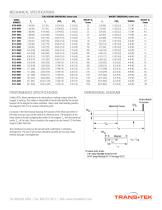
PERFORMANCE SPECIFICATIONS DIMENSIONAL DIAGRAM Unlike LVDTs, these transducers do not produce a voltage output unless the magnet is moving. This makes it impossible to electrically identify the correct location of the magnet for linear operation. Users must mechanically position the magnet in the LVT at a known reference point. As shown in the Dimensional Drawing, the location of the electrical center of the coils is known, and can be used as a reference point. The midpoint of the linear stroke is found by aligning the center of the magnet, CC, with the electrical center, CA , of the coils. Once...
Open the catalog to page 2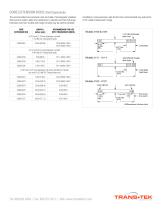
CORE EXTENSION RODS (SoldSeparately) The recommended core extension rods are made of nonmagnetic stainless steel and are sized to allow the transducers to operate over their full range. Extension rods from models with longer strokes may be used to facilitate installation. Using extension rods shorter than recommended may reduce the LVT's usable measurement range. Both Ends
Open the catalog to page 3All TRANS-TEK catalogs and technical brochures
 Series 240
4 Pages
 Series 310-320
2 Pages
 Series 330
3 Pages
 Series 605
2 Pages
 Series 607 Specs
4 Pages
 Series 280
2 Pages
 Series 230
4 Pages
 Series 430
3 Pages
 Series P010 Specs
2 Pages
 Series D100 Specs
1 Page
 Series 1003 Specs
2 Pages
 Series 1000 Specs
2 Pages
 Series 605 Versatile ADTs
2 Pages


- Position transducer
- Displacement transducer
- Linear displacement sensor
- No-contact position sensor
- Analog displacement transducer
- Non-contact displacement sensor
- Metal position sensor
- Metal displacement sensor
- Angular position sensor
- LVDT displacement sensor
- Digital displacement sensor
- Rugged displacement sensor
- DC output displacement sensor
- Absolute displacement sensor
- Angular displacement sensor
- Miniature displacement sensor
- Vibration velocity sensor
- Capacitive displacement sensor
- SSI displacement transducer
- Capacitive position sensor