
- Catalogs
- TORO EQUIPMENT
- Static Sieve


Static Sieve

Static Sieve
Catalog excerpts
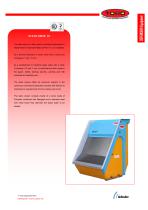
STATIC SIEVE TE The static sieve is a filter used in solid-liquid separation in Waste Water Treatment Plants (W.W.T.P.). It is installed: As a primary treatment of urban water with a mesh size of between 1 and 1.5 mm. As a pretreatment in industrial waste water with a mesh of between 0.5 and 1 mm, to eliminate the thick waste in the paper, textile, tanning, laundry, canning and milk industries and abattoirs etc... The static screen offers an economic solution in the continuous solid-liquid separation process with almost no maintenance requirements and no energy input at all. The static screen consists mainly of a body made of Polyester reinforced with fiberglass and a stainless steel wire mesh frame that channels the waste water to be treated. Toro Equipment 2013 DEFENDER® STATIC SIEVE TE
Open the catalog to page 1
FEED BOX: In the upper rear part, where the liquid to be treated is pumped in. There is a small retention that causes a laminate overflow output. FILTER CHANNEL: At the front, terminating in the wire mesh, where the solid-liquid separation takes place. WIRE MESH: Made up of v-shaped threads in AISI 304, separated according to the space required by the process. This is the principal element of the equipment. COLLECTION TANK: In the lower part, below the wire mesh, this receives the filtered waste water which is evacuated through pipes. Unscreened water Laminate overflow Separated solids Screened...
Open the catalog to page 2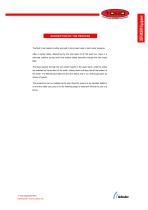
The fluid to be treated is either pumped to the screen head or sent under pressure. After a certain delay, determined by the time taken to fill the feed box, there is a laminate overflow during which the residue slides smoothly through the wire mesh filter. The liquid passes through the wire mesh (mainly in the upper part), while the solids are retained on the surface of the mesh, sliding down until they fall off the bottom of the mesh. The filtered liquid falls into the tank below and is run off through pipes by means of gravity. The equipment can be installed at the plant head by means of an...
Open the catalog to page 3
APPLICATIONS Static screens TE have many applications in the pretreatment of waste water for practically any kind of industry. Performance is optimum in those applications where there is no oil, a dryness greater than that obtained even by rotary screens being achieved with this system. In the food industry in general. Tank cleaning. The screening of water from the plastics, paper, wood industries, etc… screening in urban water cleaning. Recycling of water in cleaning circuits. Toro Equipment 2013 DEFENDER® STATIC SIEVE TE
Open the catalog to page 4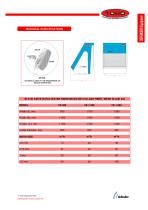
TECHNICAL ESPECIFICATIONS STATIC SIEVE IN POLYESTER REINFORCED WITH GLASS FIBER / MESH IN AISI 304 MODEL MESH SIZE Toro Equipment 2013 DEFENDER® STATIC SIEVE TE
Open the catalog to page 5
AUTOMATIC CLEANING: This is a device for washing the wire mesh, thus maintaining its filtering efficiency in fluids with high oily solids content. The water for washing must be supplied at a pressure of 3 Kg/cm3. VIBRATORY SYSTEM: This introduces an oscillatory movement into the mesh which can be adjusted, thus increasing the filtering efficiency. FILTER MESH in AISI 316. The output connections for the treated residue are by means of clamps according to DIN 2546. All models are equipped with a frame to equalize the flow over the surface of the wire mesh. The solids are evacuated by sliding them...
Open the catalog to page 6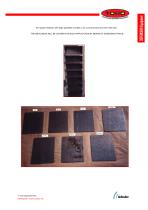
For special residues, with large quantities of solids or oil, consult screen and wire mesh size… THE IDEAL MESH WILL BE CHOSEN FOR EACH APPLICATION BY MEANS OF SCREENING TRIALS. Toro Equipment 2013 DEFENDER® STATIC SIEVE TE
Open the catalog to page 7All TORO EQUIPMENT catalogs and technical brochures
 Dosage Equipment
8 Pages
 Pre-assembled plant
8 Pages
 Pretreatment Equipment
12 Pages
 Screen
16 Pages
 Clarifiers
12 Pages
 FILTER PRESS
12 Pages
 Dissolved Air Flotation
12 Pages
 Rotay Screens Defender®
16 Pages
 Pretreatment Equipment Defender®
16 Pages
 Filter Press Draco®
12 Pages
 Fine Bubble Diffuser
6 Pages
 Hydrocarbon Separator DEFENDER
11 Pages


- Rail conveyor
- Dynamic agitator
- Transport rail conveyor
- Storage vessel
- Horizontal conveyor
- Industrial tank container
- Stainless steel homogenizer
- Cylindrical reservoir
- Vertical tank
- Electric drive conveyor
- In-line mixer
- Inclined conveyor
- Solid/liquid agitator
- Stainless steel conveyor
- Water tank
- Horizontal kneader
- Protective cabinet
- Screw conveyor
- Trash compactor