
- Catalogs
- TORO EQUIPMENT
- Hydrocarbon Separator DEFENDER


Hydrocarbon Separator DEFENDER

Hydrocarbon Separator DEFENDER
The Hydrocarbon Separator FSH is engineered to extract mineral oils, grease, and other pollutants from water, crucial for settings like workshops, garages, and carwashes to avert environmental harm and sewage system issues.
Wastewater generally contains mineral oils and grease at concentrations between 100 to 500 ppm, with regulations mandating levels below 50 ppm. The separator addresses oil in free, emulsified, or dissolved states.
The separator functions through three stages: predecantation, flotation and separation, and oil storage. Predecantation eliminates solids to safeguard the separator. Flotation differentiates water and oil, directing water through laminated coalescing sheets. Separated oil is stored in a separate tank.
Separation efficiency is based on Stokes Law, emphasizing the ascent speed of oil droplets. The effective separation area is influenced by the separator's capacity and fluid overflow speed. Coalescing enhances separation efficiency by enlarging oil droplets through collisions.
Important factors include capacity and wastewater composition. An example calculation for a vehicle repair garage illustrates the selection process, considering flow rates and particle sizes.
The separator features an open rectangular tank with overflow, separation, and collection chambers. It employs a laminar flow system with coalescing sheets to separate oil from water, with adjustable controls for oil collection.
The Hydrocarbon Separator FSH efficiently reduces oil concentrations in wastewater, ensuring environmental protection and regulatory compliance.
The document details specifications for various hydrocarbon separator models (FSH-2, FSH-5, FSH-10, FSH-15, FSH-20, FSH-40, FSH-80). Key parameters include medium capacity from 5-7 m3/h to 280-450 m3/h, dimensions such as maximum width, useful width, maximum height, and length, along with installation space requirements. All models are made with P.R.F.V. material and a galvanized steel structure. Tubing specifications for water inlet, water outlet, oils outlet, and bottom drainage are included, along with details on the laminar sheets package.
The document specifies norms for oil discharge, noting that permissible discharge varies by location, with municipal systems allowing up to 100 ppm and rivers requiring 20-40 ppm. For biological treatment, discharges should be below 25 ppm. Separator selection depends on oil density, with different configurations (simple, double, triple) recommended based on density ranges. For densities over 950 kg/m3, a dissolved air float is necessary.
Catalog excerpts

The purpose of hydrocarbon separators is to remove mineral oils and grease, fuel oils and other types of waste products from the water. It must be installed in: machinery and vehicle workshops, garages, car parks, service stations, carwashes, machinery cooling circuits, tank and cistern cleaning, ship cleaning, etc., to save the environment from the aggressions that a direct spillage would suppose, or to avoid complications caused in municipal sewage works when such waste is discarded down the This kind of waste water is mainly characterized by the presence of mineral oils and grease in concentrations that range from 100 up to 500 ppm. The maximum limit varies according to different standards, but should, in any case, be lower than 50 ppm. ©Toro Equipment 2013 defender
Open the catalog to page 1
HYDROCARBON SEPARATOR FSH Solubility is thus a property of the colloidal electrolytes. It is Besides floating, oil can be present in waste water in the form of large and unstable globules, fine stable a special solubility case that can be defined as the passing of an insoluble substance to a detergent solution. globules, stuck to solids, or as a small quantity of dissolved oil. The complete installation is made up of: The design of a separator is based on the complete elimination of oil globules with a certain separation rate. The choice of separation rate adopted for the design, depends on the...
Open the catalog to page 2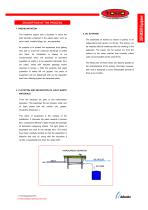
DESCRIPTION OF THE PROCESS 1. PREDECANTATION The treatment begins with a decanter in which the solid particles contained in the waste water, such as sand, earth, metallic filings, etc., are separated. 3. OIL STORAGE The separated oil travels by means of gravity to an independent tank where it is stored. This allows it to Its purpose is to protect the separators from getting be emptied without interfering with the working of the dirty and to avoid the continual discharge of solids separator. The waste can be sucked out from the exterior by the same vehicles that normally collect recommended when...
Open the catalog to page 3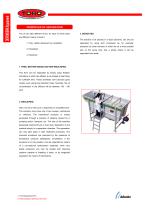
PRINCIPLES OF SEPARATION The oil can take different forms, for each of which there are different means to treat it: The solution of oil (solute) in a liquid (solvent), can only be separated by using such processes as, for example, 1. Free, neither dissolved nor emulsified. extraction by other solvents in which the oil is more soluble 2. Emulsified. and, at the same time, has a phase where it can be separated from water. 1. FREE, NEITHER DISSOLVED NOR EMULSIFIED. This form can be separated by simply using flotation chambers in which the effluent to be treated is kept there for sufficient time....
Open the catalog to page 4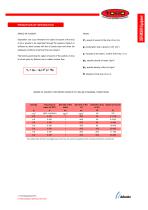
PRINCIPLES OF SEPARATION SPEED OF ASCENT Separation can occur whenever the speed of ascent of the drop Vs: speed of ascent of the drop of oil, m/s. of oil or grease to be separated through the aqueous medium is sufficient to allow contact with the oil phase layer and when the adequate conditions of laminar flow are present. The factors governing the speed of ascent of the particle or drop of oil are given by Stokes Law on stable, laminar flow: φw: specific density of water, Kg/m3. φo: specific density of the oil, Kg/m3. SPEED OF ASCENT FOR DROPS FROM 20 TO 300 µM IN NORMAL CONDITIONS Diameter...
Open the catalog to page 5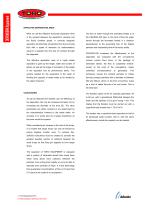
EFFECTIVE SEPARATION AREA What we call the Effective horizontal separation Area The flow of water through the laminated sheets is of is the quotient between the separator's capacity and the CROSSFLOW type. In this kind of flow the water the fluid's overflow speed. A correctly designed travels through the laminated sheets in a direction separator will eliminate all particles from the incoming perpendicular to the ascending flow of the floated fluid with a speed of elevation (or sedimentation) particles and descending flow of the heavy solids. equal to or greater than the rate of overflow through...
Open the catalog to page 6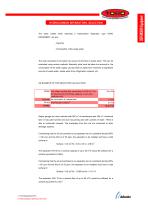
HYDROCARBON SEPARATORS. SELECTION The basic criteria when selecting a Hydrocarbon Separator, type TORO EQUIPMENT, are two: - Capacity - Composition of the waste water The main parameter to be taken into account is the flow of waste water. This can be evaluated using various methods. Basically, what must be taken into account is: the consumption of the water supply, pluvial waste or waste from machines or significant sources of waste water, waste water from refrigeration systems, etc. AN EXAMPLE OF THE SELECTION CALCULATION: Garaje: The mean monthly flow consuption is of 95 m3. For 20 days/month...
Open the catalog to page 7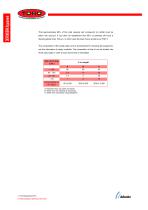
That approximately 60% of the total capacity will correspond to rainfall must be taken into account. It can then be established that 95% of particles will have a density greater than 100 µm, in which case the best choice would be an FSH 5. The composition of the waste water is thus fundamental for choosing the equipment, yet this information is rarely available. The composition of the oil can be divided into three case types in order to have some kind of orientation: A: Rainwater from car parks and tracks. B: Water from the cleaning of workshops. C: Water from carwashes using detergents Toro...
Open the catalog to page 8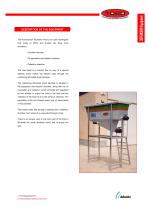
The Hydrocarbon Separator Float is an open rectangular tank made of PRFV and divided into three main chambers: - Overflow chamber - Oil separation and flotation chamber - Collection chamber The inlet leads to a laminar flow by way of a special spillway which makes the effluent pass through the coalescing laminated sheet package. The coalescing laminated sheet package is situated in the separation and flotation chamber, along with the oil evacuation and collection canal controlled and regulated by two wheels, to adjust the level in the float and the collection of the layer of oil in the previous...
Open the catalog to page 9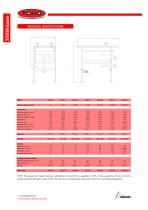
TECHNICAL SPECIFICATIONS Medium capacity (m3/h) Dimensions Galv steel Galv stee lGalv steel Galv stee lGalv stee lGalv steel Galv steel Tubing Water inlet (mm.) Package of laminar sheets Distance between plates, (mm.) Alarm units NOTE: The average work capacity has been calculated as the maximum for a separation of 100% of drops greater than 100 µm of oil with a density of less than 850 kg/m3 in water at 20º C (Vs: 2.94 m/h). To obtain outputs of less than 10 ppm of free oil of these characteristics. Toro Equipment 2013 HYDROCARBON SEPARATOR FSH
Open the catalog to page 10All TORO EQUIPMENT catalogs and technical brochures
 Dosage Equipment
8 Pages
 Pre-assembled plant
8 Pages
 Pretreatment Equipment
12 Pages
 Screen
16 Pages
 Clarifiers
12 Pages
 FILTER PRESS
12 Pages
 Dissolved Air Flotation
12 Pages
 Rotay Screens Defender®
16 Pages
 Pretreatment Equipment Defender®
16 Pages
 Filter Press Draco®
12 Pages
 Static Sieve
7 Pages
 Fine Bubble Diffuser
6 Pages


- Rail conveyor
- Dynamic agitator
- Transport rail conveyor
- Storage vessel
- Horizontal conveyor
- Industrial tank container
- Stainless steel homogenizer
- Cylindrical reservoir
- Vertical tank
- Electric drive conveyor
- Inclined conveyor
- In-line mixer
- Solid/liquid agitator
- Stainless steel conveyor
- Water tank
- Horizontal kneader
- Protective cabinet
- Screw conveyor
- Trash compactor