
- Catalogs
- TOPWAY LCD
- IC Epson S1D13L01 LCD Controller


- Company
- Products
- Catalogs
- News & Trends
- Exhibitions
IC Epson S1D13L01 LCD Controller

IC Epson S1D13L01 LCD Controller
- Scope: This document is the Hardware Functional Specification for the S1D13L01 Series Simple LCD Controller, aimed at Video Subsystem Designers and Software Developers. It includes timing diagrams, AC and DC characteristics, register descriptions, and power management details.
- Operational Overview: The S1D13L01 is a simple LCD controller with a 384K byte display buffer, supporting various CPU interfaces and resolutions, including hardware rotation, Alpha Blending, and Transparency.
- Display Resolution: Supports multiple resolutions for single and dual-layer displays.
- CPU Interface: Compatible with 8/16-bit direct/indirect and SPI interfaces.
- Display Interface: Supports TFT panels with hardware rotation and PIP Layer Flash.
Details on integrating the S1D13L01 into a system, including pin configurations and interface mappings.
- Pinout Diagram: Provides a detailed layout of the pin configurations.
- Pin Description: Describes the function of each pin, including host and panel interfaces, clock input, and power connections.
Illustrates the logical structure and data flow within the S1D13L01.
- Memory Map: Details the memory allocation and usage within the controller.
- Sample Maximum Resolution: Provides examples of maximum resolution capabilities.
- Clock Tree: Describes the clock distribution and settings within the system.
- PLL Setting: Details the configuration of the Phase-Locked Loop for clock management.
- Absolute Maximum Ratings: Lists the maximum operational limits for the device.
- Recommended Operating Conditions: Provides the optimal conditions for device operation.
- Clock Timing: Details the timing requirements for clock signals.
- Power Supply Sequence: Describes the power-on and power-off sequences.
- Configuration Registers: Details the settings for configuring the device's operation.
- Clock Configuration Registers: Provides settings for clock management.
Describes the procedures for writing and reading data via indirect and SPI interfaces.
- RGB Data Formats: Details the supported image data formats for host interfaces.
- 24 bpp LUT: Describes the architecture for 24-bit per pixel look-up tables.
- PIP Layer: Supports Picture-in-Picture functionality with transparency and alpha blending.
- Rotation: Provides hardware rotation capabilities.
Provides physical dimensions and mechanical specifications of the device.
Documents any changes or revisions made to the specification.
- The controller supports up to two display layers: Main Layer and PIP (Picture-in-Picture) Layer.
- Display resolutions vary based on color depth and layer configuration, with maximum resolutions of 480x272 at 24 bpp for a single layer and 400x240 at 24 bpp for the Main Layer with a PIP Layer at 8 bpp.
- Features include independent rotation, alpha blending, transparency, and configurable PIP effects like blink and fade in/out.
- Supports 8/16-bit direct and indirect interfaces, as well as SPI (Mode 0, Mode 3).
- Input data formats include RGB 8:8:8, RGB 5:6:5, 8 bpp grayscale, and 8/16/24 bpp with Look-Up Table (LUT).
- Typical system diagrams are provided for various modes, including direct and indirect 16-bit and 8-bit modes, as well as SPI mode.
- Each mode has specific pin configurations and connections to generic TFT panels.
- The document includes detailed pinout diagrams and descriptions for the QFP15-128pin package.
- Pin types are categorized as Input, Output, Bi-Directional, Power, and Ground, with specific functions for each pin in different modes.
- Power supply pins include IOVDD for IO power and COREVDD for core power, with additional pins for PLL power and ground.
- Miscellaneous pins include test enable and scan enable for production testing, which should be grounded during normal operation.
- Host interface selection is determined by the CNF[2:0] pins, with options for direct and indirect modes, as well as SPI.
- Panel interface mode is specified by register settings, with mappings for 16-bit, 18-bit, and 24-bit generic TFT panels.
- The S1D13L01 includes 384K bytes of embedded VRAM for image data storage.
- 16-bit and 8-bit Timing: The document provides setup and hold times for various signals such as CS#, WR#, RD#, and DB[15:0] or DB[7:0]. These parameters are crucial for ensuring proper data transfer during read and write cycles.
- SPI Timing: Details on SPI timing include chip select setup and hold times, serial clock pulse widths, and data setup and hold times. The SPI data is transmitted MSB first, and the SO line is driven low when no data is present.
- TFT Panel Timing: The document outlines timing parameters for driving TFT displays, including horizontal and vertical timing details. Parameters like horizontal display width, non-display periods, and pulse start positions are defined.
- General Registers: Registers start at offset 608XXh, with specific addresses for configuration, clock, panel, and layer settings. The document specifies the power save modes and their impact on register access.
- Clock Configuration: The PLL settings are detailed, including lock status, bypass, and enable bits. The document emphasizes the need to be in Power Save Mode 0 before making changes to these registers.
- Panel Configuration: Registers for setting horizontal and vertical display parameters are provided, with specific bits allocated for each setting.
- Indirect 16-bit and 8-bit Mode: Tables specify command and data write/read operations based on control signals like P/C#, WR#, and RD#.
- SPI Function Select: Commands for 8-bit and 16-bit read/write operations are defined, with reserved commands noted.
- Ensure the S1D13L01 is in the correct power save mode before accessing certain registers.
- Do not access memory or LUT during specific power save modes to avoid conflicts.
- For TFT panels, horizontal display width must be set in multiples of 8 pixels.
The document outlines the configuration of the Phase-Locked Loop (PLL) for the S1D13L01 series. The clock to the PLL (PFDCLK) should be between 1MHz and 2MHz. The PFDCLK is calculated using the formula: PFDCLK = CLKI ÷ (M-Divider + 1). The M-Divider settings are detailed in Table 10-3, with ratios ranging from 1:1 to 33:1. The PLL must be disabled before changing the register settings.
PLL Output Configuration
The PLL Output (POCLK) is configured using the L-Counter and N-Counter settings. The formula for POCLK is: POCLK = (L-Counter + 1) x (N-Counter + 1) x PFDCLK. For example, with a CLKI input of 1MHz and a target POCLK of 42MHz, the L-Counter is set to 29h.
Internal Clock Configuration
The Internal Clock Configuration Register (REG[16h]) determines the divide used to generate the Pixel Clock (PCLK) from the Memory Clock (MCLK). The PCLK Divide Selection is detailed in Table 10-5, with ratios from 1:1 to 16:1.
Panel Configuration
The Panel Configuration Registers control various aspects of the LCD panel, including DE Polarity, PCLK Polarity, and Panel Data Width. The Panel Setting Miscellaneous Register (REG[20h]) includes settings for DE Polarity, PCLK Polarity, and Panel Port Enable. The Panel Interface must be enabled before setting the Panel Interface Enable.
Display Settings
The Display Settings Register (REG[22h]) includes settings for TE Output Pin Disable, TE Status, Display Blank, and Software Video Invert. The TE Function can be configured for different modes, such as VNDP and Line Count.
Horizontal and Vertical Display Configuration
The Horizontal Display Width Register (REG[24h]) and Vertical Display Height Register (REG[28h]) specify the display dimensions. The Horizontal Non-Display Period Register (REG[26h]) and Vertical Non-Display Period Register (REG[2Ah]) define the non-display periods.
Sync Signal Configuration
The HS Pulse Width Register (REG[2Ch]) and VS Pulse Width Register (REG[30h]) configure the width and polarity of the horizontal and vertical sync signals. The HS Pulse Start Position Register (REG[2Eh]) and VS Pulse Start Position Register (REG[32h]) specify the start positions of the sync signals.
Layer Configuration
The Layer Configuration Registers manage the synchronous latching of multi-byte layer registers. The Multi-Byte Layer Registers Synchronous Latching Disable bit controls the latching behavior.
- Rotation and Color Depth: The Main Layer can be rotated in increments of 90° (0°, 90°, 180°, 270°) using bits 4-3 of REG[40h]. Color depth options include RGB 8:8:8, RGB 5:6:5, and various LUT configurations, controlled by bits 2-0 of REG[40h].
- Start Address: The Main Layer Start Address is specified in REG[42h] and REG[44h], requiring 32-bit alignment.
- Dimensions: Width and height are read-only and depend on rotation settings, with values updated after a two-frame delay.
- Rotation and Color Depth: Similar to the Main Layer, the PIP Layer supports rotation and color depth settings, controlled by REG[50h].
- Start Address: Defined in REG[52h] and REG[54h], also requiring 32-bit alignment.
- Dimensions and Position: Width, height, and start positions (X, Y) are specified in REG[56h] to REG[5Ch].
- Effects: PIP Layer supports various effects like Blink, Fade In/Out, controlled by REG[60h].
- Alpha Blending: The blending ratio and steps are managed by REG[62h], allowing dynamic changes during fade effects.
- Enable/Disable: Controlled by REG[64h], transparency can be toggled on or off.
- Key Color: Defined in REG[66h] and REG[68h], used to determine pixel transparency based on color matching.
GPIO[3:0] are dedicated pins, while GPIO[15:4] depend on panel type and data width. GPIO pins can be configured as inputs (0b) or outputs (1b). Output configuration allows writing 1b to drive high and 0b to drive low. Input configuration allows reading the pin status. Pull-down resistors can be activated (1b) or deactivated (0b) for each pin.
Look-Up Table Registers
The document details the configuration of Look-Up Tables (LUT1 and LUT2) for color data storage. Each LUT address stores green, blue, and red data components. Access to LUT1 and LUT2 is restricted during PSM0.
Indirect and Serial Host Interface
The indirect interface requires address definition before data operations, supporting burst transfers. Single and burst write/read procedures are illustrated for 16-bit and 8-bit modes. The SPI interface supports Mode 0 and Mode 3, with specific command sequences for read/write operations. The address auto-increments during burst access, and the first byte in read operations is dummy data.
SPI Function Select
Commands for SPI operations include 8-bit and 16-bit read/write, with specific command codes provided. The address for 16-bit operations must be even.
The document outlines the hardware functional specifications for the EPSON S1D13L01 Series, focusing on the Simple LCD Controller (LCDC). It includes detailed procedures for SPI 8-bit and 16-bit read sequences to read N words, emphasizing the importance of even-numbered addresses and the use of verbose 5-bit commands.
Image Data Formats:
Chapter 12 discusses various image data formats for the host interface, including RGB 8:8:8, RGB 5:6:5, 24 bpp + LUT, 16 bpp + LUT, and 8 bpp + LUT. Each format is detailed with tables showing data cycles for both 16-bit and 8-bit host interfaces. The document specifies the necessary register settings for each format to ensure proper data handling and display.
Data Expansion and Color Depth:
Data is expanded to 24-bit between VRAM and the panel interface. The document explains how color depth is defined using specific registers, with all image data handled as 24-bits. The master logic outputs 24-bits, and the slave logic removes unused bits.
Look-Up Table Architecture:
Chapter 13 describes the LUT architecture for different color depths, including 24 bpp, 16 bpp, and 8 bpp LUTs. Each layer (Main and PIP) has its own LUT, and the document provides figures illustrating the LUT configurations.
Display Features:
Chapter 14 covers display features such as the PIP (Picture-in-Picture) Layer, transparency, alpha blending, and PIP effects. The PIP Layer can be configured with various effects like Normal, Blink, and Fade, and is displayed on top of the Main Layer. Transparency and alpha blending are also discussed, with specific register settings provided for enabling these features.
Catalog excerpts

Hardware Functional Specification Document Number:XA8A-A-001-01 Issue Date: 02/28/14 SEIKO EPSON CORPORATION
Open the catalog to page 1
NOTICE No part of this material may be reproduced or duplicated in any form or by any means without the written permission of Seiko Epson. Seiko Epson reserves the right to make changes to this material without notice. Seiko Epson does not assume any liability of any kind arising out of any inaccuracies contained in this material or due to its application or use in any product or circuit and, further, there is no representation that this material is applicable to products requiring high level reliability, such as, medical products. Moreover, no license to any intellectual property rights is granted...
Open the catalog to page 2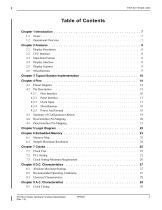
Table of Contents Chapter 1 Introduction . . . . . . . . . . . . . . . . . . . . . . . . . . . . . . . . . . . . 7 1.1 Scope . . . . . . . . . . . . . . . . . . . . . . . . . . . . . . . . . . . 7 1.2 Operational Overview . . . . . . . . . . . . . . . . . . . . . . . . . . . . 7 Chapter 2 Features . . . . 2.1 Display Resolution 2.2 CPU Interface . . 2.3 Input Data Format . 2.4 Display Interface . 2.5 Display Features . 2.6 Miscellaneous . . Chapter 3 Typical System Implementation . . . . . . . . . . . . . . . . . . . . . . . . 10 Chapter 4 Pins . . . . . . . . . . . . . 4.1 Pinout Diagram . ....
Open the catalog to page 3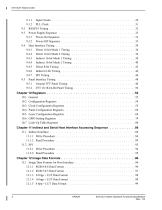
Chapter 11 Indirect and Serial Host Interface Accessing Sequence . . . . 11.1 Indirect Interface . . . . . . . . . . . . . . . . . . . . . . . . 11.1.1 Write Procedure . . . . . . . . . . . . . . . . . . . . . . . . . . . . . 11.1.2 Read Procedure . . . . . . . . . . . . . . . . . . . . . . . . . . . . . 11.2 SPI . . . . . . . . . . . . . . . . . . . . . . . . . . . . . 11.2.1 Write Procedure . . . . . . . . . . . . . . . . . . . . . . . . . . . . . 11.2.2 Read Procedure . . . . . . . . . . . . . . . . . . . . . . . . . . . . . Chapter 12 Image Data Formats . . . . . . 12.1 Image Data Formats...
Open the catalog to page 4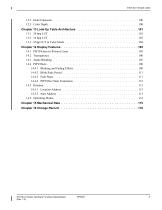
12.2 Data Expansion . . . . . . . . . . . . . . . . . . . . . . . . . . . . . . 100 12.3 Color Depth . . . . . . . . . . . . . . . . . . . . . . . . . . . . . . . 100 Chapter 13 Look-Up Table Architecture 13.1 24 bpp LUT . . . . . . . . . . 13.2 16 bpp LUT . . . . . . . . . . 13.3 8 bpp LUT in Color Mode . . . . Chapter 14 Display Features . . . . . . 14.1 PIP (Picture-in-Picture) Layer . . 14.2 Transparency . . . . . . . . . 14.3 Alpha Blending . . . . . . . . 14.4 PIP Effects . . . . . . . . . . 14.4.1 Blinking and Fading Effects . 14.4.2 Blink/Fade Period . . . . . . 14.4.3 Fade Steps . ....
Open the catalog to page 5
S1D13L01 Series Hardware Functional Specification (Rev. 1.0)
Open the catalog to page 6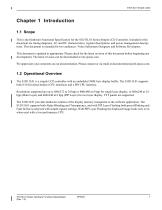
Chapter 1 Introduction 1.1 Scope This is the Hardware Functional Specification for the S1D13L01 Series Simple LCD Controller. Included in this document are timing diagrams, AC and DC characteristics, register descriptions, and power management descriptions. This document is intended for two audiences: Video Subsystem Designers and Software Developers. This document is updated as appropriate. Please check for the latest revision of this document before beginning any development. The latest revision can be downloaded at vdc.epson.com. We appreciate your comments on our documentation. Please contact...
Open the catalog to page 7
Chapter 2 Features 2.1 Display Resolution • 384K bytes of embedded VRAM for storing the image data • Display Resolutions for one layer display (Main Layer Only): • Up to 480x272 at 24 bpp • Up to 800x480 at 8 bpp • Display Resolutions for two layer display (Main and PIP Layer): • Up to 400x240 at 24 bpp (Main Layer) and 400x240 at 8 bpp (PIP Layer) 2.2 CPU Interface • 8/16-bit Direct interface • 8/16-bit Indirect interface • SPI (Mode 0, Mode 3) 2.3 Input Data Format • RGB 8:8:8, RGB 5:6:5, 8 bpp grayscale, or 8/16/24 bpp with Look-Up Table (LUT) 2.4 Display Interface • Active Matrix TFT panels...
Open the catalog to page 8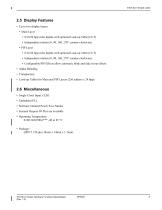
2.5 Display Features • Up to two display layers: • Main Layer • 8/16/24 bpp color depths with optional Look-up Table (LUT) • Independent rotation (0, 90, 180, 270° counter-clockwise) • PIP Layer • 8/16/24 bpp color depths with optional Look-up Table (LUT) • Independent rotation (0, 90, 180, 270° counter-clockwise) • Configurable PIP Effects allow automatic blink and fade in/out effects • Alpha Blending • Transparency • Look-up Tables for Main and PIP Layers (256 address x 24 bpp) 2.6 Miscellaneous • Single Clock Input: CLKI • Embedded PLL • Software initiated Power Save Modes • General Purpose...
Open the catalog to page 9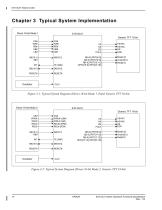
Chapter 3 Typical System Implementation Direct 16-bit Mode 1 Figure 3-1: Typical System Diagram (Direct 16-bit Mode 1, Panel Generic TFT 16-bit) Figure 3-2: Typical System Diagram (Direct 16-bit Mode 2, Generic TFT 18-bit) S1D13L01 Series Hardware Functional Specification (Rev. 1.0)
Open the catalog to page 10
Figure 3-3: Typical System Diagram (Indirect 16-bit Mode 1, Generic TFT 16-bit) Figure 3-4: Typical System Diagram (Indirect 16-bit Mode 2, Generic TFT 18-bit) S1D13L01 Series Hardware Functional Specification (Rev. 1.0)
Open the catalog to page 11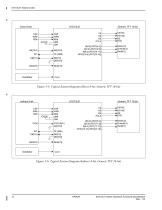
Figure 3-5: Typical System Diagram (Direct 8-bit, Generic TFT 16-bit) Figure 3-6: Typical System Diagram (Indirect 8-bit, Generic TFT 18-bit) S1D13L01 Series Hardware Functional Specification (Rev. 1.0)
Open the catalog to page 12
Figure 3-7: Typical System Diagram (SPI, Generic TFT 24-bit) S1D13L01 Series Hardware Functional Specification (Rev. 1.0)
Open the catalog to page 13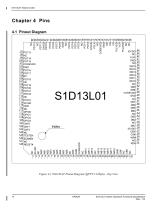
Chapter 4 Pins 4.1 Pinout Diagram IOVDD NC CLKI GND NC DB15 DB14 DB13 DB12 DB11 DB10 NC DB9 DB8 COREVDD GND NC DB7 DB6 DB5 DB4 NC DB3 DB2 NC DB1 IOVDD DB0 CS# WR# NC RD# PDT9 PDT8 PDT7 PDT6 GND NC PDT5 PDT4 PDT3 PDT2 NC PDT1 PDT0 IOVDD PCLK NC COREVDD GND DE HS VS PLLVDD VCP PLLGND NC NC Figure 4-1 S1D13L01 Pinout Diagram (QFP15-128pin) - Top View S1D13L01 Series Hardware Functional Specification (Rev. 1.0)
Open the catalog to page 14
Input Output Bi-Directional (Input/Output) Power pin Analog Power pin Ground Analog Ground RESET# / Power Save State H = High level output L = Low level output Hi-Z = High Impedance Q = Output Pin, retains output state QB = IO Pin, if configured as output retains state Table 4-1: Cell Description Item H System LVCMOS Schmitt Input Buffer with Fail Safe H System LVCMOS Schmitt Input Buffer with pull-down resistor and Fail Safe H System LVCMOS Schmitt Input Buffer with pull-up resistor and Fail Safe H System LVCMOS Input Buffer with pull-down resistor and Fail Safe H System LVCOMOS Output buffer...
Open the catalog to page 15All TOPWAY LCD catalogs and technical brochures
 TOPWAY Smart LCD SGTools Handbook
108 Pages
 10.1" TFT LCD Module
1 Page
 MONO Product
2 Pages
 LMT050DNCFWU-NNA-2
15 Pages
 LMT080TDGP01
16 Pages
 HKT035BTB-1D
36 Pages
 HMT050AMC-C
17 Pages
 HMT043ATA-6C
31 Pages
 TM035PDHG09
42 Pages
 TM035PDHG03
31 Pages
 TM028HDZP01
28 Pages
 LM256160DCW-1
14 Pages
 LM12896FCW-1
17 Pages
 LM12832KCW
13 Pages
 LM2088EFW-9
12 Pages
 LM3122AGG-2
12 Pages
 LM240160YCW
18 Pages
 LM6093ACW
14 Pages
 HMT104ATA-C
11 Pages
 HMT101ATA-D
36 Pages
 HKT080ATA-C
1 Page
 HMT080ATA
1 Page
 HKT070DTA-1C
11 Pages
 HMT070DTA-D
1 Page
 HKT070DMC-2C
19 Pages
 HMT070ETD-C
31 Pages
 HMT070ETD-1D
34 Pages
 HMT056ATA-C
1 Page
 HMT050CB-1C
31 Pages
 HMT050DTA-D
1 Page
 HKT050ATA-C
1 Page
 HMT043ATA-7C
32 Pages
 HMT043GTA-1D
37 Pages
 HKT043BMC-2C
17 Pages
 HMT043ATA-3C
11 Pages
 HMT043BMC-C
1 Page
 HMT043ATA-4C
11 Pages
 HKT043BMC-C
1 Page
 HKT043ATA-1C
12 Pages
 HMT035ATA-D
13 Pages
 HMT028ATB-C
12 Pages
 HKT104ATA-C
31 Pages
 HMT068BTA-C
33 Pages
 HMT070ATA-1C
32 Pages
 HMT080ATA-C
33 Pages
 HMT090ATA-C
30 Pages
 HMT101ATA-C
33 Pages
 HMT050ATA-2C
31 Pages
 HMT043ATA-2C
32 Pages
 IC Raio RA6963 LCD Controller
42 Pages
 IC EPSON S1D13700 LCD Controller
133 Pages
 EPSON S1D13709 LCD Controller
192 Pages
 Samsung S6B0108 LCD Driver
23 Pages
 Avant SBN0064G LCD Driver
37 Pages
 Avant SBN6400G LCD Driver
34 Pages
 EPSON SED1335 LCD Controller
95 Pages
 SGS-THOMSON ST7282
23 Pages
 Raio RA6963 LCD Controller
42 Pages
 Raio RA8875 TFT LCD Controller
174 Pages
 Raio RA8835 LCD Controller
93 Pages
 RAIO RA8803 LCD Controller
8 Pages
 HMT035ATA-1C
1 Page
 Smart LCD introduction
14 Pages
 Topway company introduction
14 Pages
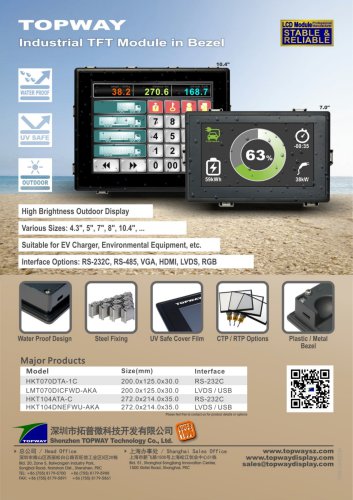 TFT module in bezel
1 Page
 Topway TFT LCD
1 Page
 LM12864L Series
1 Page
 LM12864T Series
1 Page
 LM12864F Series
1 Page
 LM6060C Series
1 Page
 LM12864M Series
1 Page
 LM6029A Series
1 Page
 LM6059B Series
1 Page
 LM24048A Series
1 Page
 LM13232A Series
1 Page
 LM160160A Series
1 Page
 LMB402C Series
1 Page
 LMB242A Series
1 Page
 LMB204C Series
1 Page
 LM3121 Series
1 Page
 LMB404A Series
1 Page
 HMT043FC-1C
1 Page
 LM3123 Series
1 Page
 LMB204B Series
1 Page
 LMB202E Series
1 Page
 LMB202D Series
1 Page
 LMB164A Series
1 Page
 LMB162G Series
1 Page
 LMB162H Series
1 Page
 LMB162N Series
1 Page
 LMB162A Series
1 Page
 LMB0820D Series
1 Page
 LMB0820C Series
1 Page
 LMB0820A Series
1 Page
 LMB081N Series
1 Page
 LMB081A Series
1 Page
 LMB162X series
1 Page
 LMT057DNAFWU-AAN series
1 Page
 LMT057DNAFWU-AAA series
1 Page
 LMT104SDH01 Series
1 Page
 TOPWAY Product List (Y2012)
4 Pages
 TFT LCD module
1 Page
 Without controller
1 Page
 Chinese fonts
1 Page
 Built-in controller
1 Page
 Character module
1 Page



- LCD display panel
- Touch monitor
- LCD screen
- Industrial monitor
- Industrial display panel
- HDMI monitor
- TFT display module
- VESA mounting monitor
- Color display panel
- Touch screen display panel
- LED display panel
- IPS display panel
- High-brightness monitor
- Control display system
- TFT-LCD monitor
- Electronic display panel
- Backlit display panel
- LED-backlit display panel
- Wall-mount monitor