
- Catalogs
- Topas GmbH
- DIL 550 - Dilution System for Aerosols

DIL 550 - Dilution System for Aerosols

DIL 550 - Dilution System for Aerosols
The document discusses various dilution systems for aerosols, specifically the DIL, DDS, and HDS series. These systems are essential for measuring tasks in aerosol technology, allowing for the evaluation of filter media by measuring particle size distributions at varying concentrations.
Fixed Dilution Factor Systems (Series DIL)
The DIL series is designed for fixed total flow rates and dilution factors, ideal for on-site filter testing. The DIL 540 and DIL 554 models feature automatic readjustment of the dilution factor. These systems do not require auxiliary pressurized air and are suitable for mobile use.
Variable Dilution Factor Systems (Series DDS)
The DDS series allows for user-adjustable dilution factors, accommodating different total volume flows. The DDS 560 model includes a microprocessor for calculating the dilution factor and total flow rate, displayed on an LCD screen.
High Dilution Systems (Series HDS)
The HDS 561 system offers extremely high dilution factors with virtually no pressure loss, suitable for high-volume flow rates. It supports remote monitoring and adjustment of the dilution factor.
Applications
These systems are used for validating laminar air flow boxes, evaluating filtration efficiency, measuring highly concentrated aerosols, and basic aerosol research.
Specifications
The document provides detailed specifications for each series, including total volume flow rates, dilution factors, and power supply requirements. The DIL series offers options for remote control and can be used in series to increase dilution factors.
Technical Data
Technical data includes power supply options, maximum counter pressure, tube connector sizes, dimensions, and weight. The document also notes that specifications are subject to change without notice.
Catalog excerpts

Dilution Systems for Aerosols Constant and reproducible aerosol dilution even under changing operation conditions Internal monitoring of the dilution ratio including corresponding display. Designed for mobile use (no auxiliary pressurized air needed) Long term lifetime and reliability, minimum maintenance required Precise operation in both over and under pressure mode Modifications to user defined requirements (flow rates, dilution factor) available Dilution System DIL 554 and DIL 540 (automatic readjustment) Dilution Systems Series DDS (left) and HDS (right) A great number of measuring tasks related to aerosol technology requires defined dilution of the aerosol to be characterized. So the evaluation of filter and filter media is often only possible using suitable dilution techniques in order to measure particle size distributions at both high and low particle concentrations with the same measuring device. Validation of laminar air flow boxes/benches and clean room facilities Evaluation of filtration efficiency Measurement of highly concentrated aerosols Basic aerosol research Dilution systems of the series DIL have been designed for defined total flow rates and fixed dilution factor and have especially been developed for on-site filter testing. The dilution systems DDS and HDS can be used for different total volume flows, with the dilution factor being adjusted by the user. Dilution is performed by all of these devices without any auxiliary pressurized air. The keeping of the dilution factor is continuously monitored by an internal measuring unit and is automatically readjusted at DIL 540 and HDS 561. All types of dilution devices are designed for mobile use. A battery supplies the power for the DIL 554. Example of use of Topas Aerosol Dilution Systems: Laminar Air Flow Bo
Open the catalog to page 1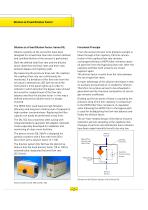
Dilution at Fixed Dilution Factor Dilution at a Fixed Dilution Factor: Series DIL Functional Principle Dilution systems of the series DIL have been designed for a fixed total flow rate at which defined and certified dilution of the aerosol is performed. From the aerosol stream to be diluted a sample is taken through a thin capillary. Particle concentration of the capillary flow rate remains unchanged whereas a HEPA filter removes nearly all particles from the bypassing flow rate. After the capillary and filter both streams are mixed together again. The dilution factor results from the ratio between...
Open the catalog to page 2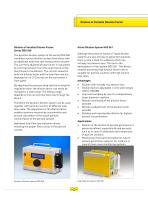
Dilution at Variable Dilution Factor Dilution at Variable Dilution Factor: Series DDS 560 The dynamic dilution system of the series DDS 560 combines aerosol dilution as described above with an additional total flow rate measurement section. The currently adjusted dilution factor is calculated by a microprocessor from the output levels of the two pressure transducers. The current values for both the dilution factor and the total flow rate are displayed on an LCD screen on the instrument’s front panel. By adjusting the pressure drop ratio by turning the regulation valve, the dilution factor can...
Open the catalog to page 3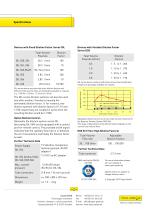
Devices with Fixed Dilution Factor Series DIL Total Volume Flowrate Dilution Factor 2.83 l/min 2.83 l/min 28.3 l/min Dilution Factors Total Volume Flowrate [l/min] DIL series device versions with other dilution factors and different total volume flows are optionally available on request, e.g. 1:100 for 1.0 l/min, 1.2 l/min or 5 l/min. The DIL series dilution systems can also be used one after another, thereby increasing the achievable dilution factor. If, for instance, two dilution systems with dilution factors of 1:10 and 1:100 respectively are coupled in series then the resulting dilution would...
Open the catalog to page 4All Topas GmbH catalogs and technical brochures
 Topas image brochure
23 Pages
 ATM 210, 210/H
2 Pages
 Dust Generator SAG 410
2 Pages


Archived catalogs


- Analysis software solution
- Liquids analyzer
- Test stand
- Portable analyzer
- Automated test bench
- Leak tester
- Vibration motor
- Reporting software
- Data acquisition software
- Homogenizer
- Manual test station
- Vertical test rig
- Automatic leak test bench
- Leak test station
- Universal test bench
- Batch homogenizer
- Photometer
- Liquid homogenizer
- Multi-parameter test station
- Disperser