
- Catalogs
- Top Seiko Co., Ltd
- Top Seiko's Material Guide


- Company
- Products
- Catalogs
- News & Trends
- Exhibitions
Top Seiko's Material Guide

Top Seiko's Material Guide
- Tungsten (W): Known for its high melting point (3387ºC), thermal conductivity (172 W/(m·K)), and specific gravity (19.3). Commonly used in filaments, electrodes, and sputtering targets.
- Molybdenum (Mo): Features a melting point of 2623ºC and thermal conductivity of 142 W/(m·K). Utilized in illumination parts and heaters.
- Tantalum (Ta): With a melting point of 2990ºC, it is used in heat exchangers and semiconductor components.
- Niobium (Nb): Melting point of 2415ºC, used as an additive in iron and steel, and in superconducting magnets.
- Silver (Ag): High thermal and electrical conductivity, used in electric lines and audio cables.
- Copper (Cu): Known for its electrical conductivity, used in wiring and coins.
- Aluminum (Al): Lightweight with a melting point of 660ºC, used in cans and car parts.
- Stainless Steel (SUS): Corrosion-resistant, used in kitchen equipment and machine parts.
- Alumina (Al2O3): High intensity and abrasion resistance, used in insulators and furnace parts.
- Aluminum Nitride (AlN): High thermal conductivity, used in heat sinks and semiconductor devices.
- Silicon Nitride (Si3N4): Thermal shock-resistant, used in engine parts and cutting tools.
- Silicon Carbide (SiC): High solidity and heat conductivity, used in hot water parts and mechanical seals.
Catalog excerpts
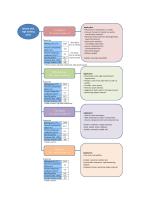
Metals with high melting point Tungsten (W) Atomic number: 74 Properties Melting point (ºC) Thermal conductivity (W/(m・K)) Thermal expansion coefficient (×10⁻⁶) Specific gravity Hardness (Hv) (GPa) Young's modulus (GPa) (the highest from all metals) (the lowest from all metals) (equal to gold) Application • Filaments for illumination, crucible; • Vacuum furnace for heaters as well as construction materials; • All kinds of electrodes for discharge lamps, electrical contacts; • Heat screen material, TIG welding electrodes; • Source components for semiconductor ions; • Sputtering targets; • Balance...
Open the catalog to page 2
Universal metal Silver (Ag) Atomic number: 47 Properties Melting point (ºC) Thermal conductivity (W/(m・K)) Thermal expansion coefficient (×10⁻⁶) Specific gravity Hardness (Hv) (GPa) Young's modulus (GPa) Application • Electric lines (low electric resistance); • Audio cables; • Wiring handling high frequency; • Tableware, jewels, dentist treatment; • Water purifiers (sterilization); Can be used as a compound metal ◇High heat conductivity, high electric conductivity Copper (Cu) Atomic number: 29 Properties Melting point (ºC) Thermal conductivity (W/(m・K)) Thermal expansion coefficient (×10⁻⁶)...
Open the catalog to page 3
Alumina (Aluminum oxide) Al2O 3 Properties Melting point (ºC) Thermal Shock Resistance (ºC) Thermal conductivity (W/(m・K)) Thermal expansion coefficient (×10⁻⁶) Specific gravity Hardness (Hv) (GPa) Application • Insulators, parts insulating electricity; • Furnace walls, furnace parts, jigs; • Nozzles, spinning tube; • Reaction crucible, reaction vessels; • Semiconductor-related parts; • Liquid crystal production parts; • Electron tube parts, pumps, grinding materials ◇High intensity, abrasion-resistant, heat-resistant, corrosion-resistant Aluminum nitride AlN Properties Melting point (ºC) Thermal...
Open the catalog to page 4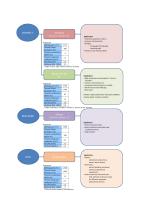
Zirconia (Zirconium dioxide) ZrO2 Properties Melting point (ºC) Thermal Shock Resistance (ºC) Thermal conductivity (W/(m・K)) Thermal expansion coefficient (×10⁻⁶) Specific gravity Hardness (Hv) (GPa) Application • Industrial purposes cutlery; • Scissors, kitchen knife; • Gauges: pin gauge, block gauge, wrecking ball; • Various wear resistant parts ◇High tenacity, high intensity, abrasion-resistant Boron nitride BN Properties Melting point (ºC) Thermal Shock Resistance (ºC) Thermal conductivity (W/(m・K)) Thermal expansion coefficient (×10⁻⁶) Specific gravity Hardness (Hv) (GPa) Application •...
Open the catalog to page 5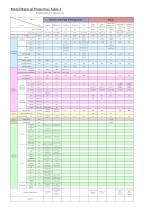
Metal Material Properties Table 1 ※Published data is for reference only Metals with high melting point Material symbol Component amount [%] Alloy (Mo-Cu) Heavy alloy Heavy metal (W-) FeNiCo (sintered) Sealing alloy (Kovar) Sealing alloy (Kovar) Density Hardness 1.30(1 type-HB) 1.60(2 type-HB) 2.00(3 type-HB) 2.30(4 type-HB) Yield strength Machining properties Flexural rigidity Young's modulus Poisson's ratio Boiling point Thermal properties Linear expansion coefficient For sealing hard glass Electronic components For sealing hard glass Electronic components Electrical Electric conductivity characteristic...
Open the catalog to page 6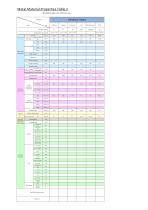
Metal Material Properties Table 2 ※Published data is for reference only Universal metals Material symbol Component amount [%] Stainless steel Density Hardness Tensile strength Machining properties Yield strength Flexural rigidity Young's modulus Poisson's ratio Recrystallization temperature Melting point Boiling point Linear expansion coefficient Thermal properties Thermal conductivity Specific heat Electrical Electric conductivity characteristic 20℃ Volume resistivity s Magnetic characteristic s [J/(kg・K)] [%I.A.C.S] [μΩ・cm] hydrochloric acid hydrochloric acid sulfuric acid Loss Loss Loss sulfuric...
Open the catalog to page 7
Ceramic Material Properties Table 1 Fine ceramics Main component amount [%] Silicon nitride Other component or binder Color General properties Aluminum nitride Silicon carbide Boron carbide SiC: Boron nitride Light yellow Milky white Dark grey Grey beige Water absorption Compressive strength Fracture toughness Young's modulus Poisson's ratio Flexural rigidity Machining properties Oxidizing atmosphere Thermal conductivity Thermal properties Thermal expansion coefficient Non‐oxidizing atmosphere Specific heat Dielectric strength Volume resistivity Electrical characteristics Dielectric constant...
Open the catalog to page 8
Ceramic Material Properties Table 2 ※Published data is for reference only Main component amount [%] Fluorine phlogopite: Fluorine phlogopite: Other component or binder General properties Other materials Machinable ceramics Glass (fused quartz) Dark grey Compressive strength Fracture toughness Poisson's ratio Oxidizing atmosphere Non‐oxidizing atmosphere Young's modulus Thermal expansion coefficient Thermal properties Thermal conductivity 522(strain point) 562(transition point) 568(annealing point) Dielectric strength Dielectric constant Volume resistivity Specific heat Electrical characteristics...
Open the catalog to page 9
Ceramic Material Properties Table 3 ※Published data is for reference only Ceramic compound material(MMC) Silicon carbide Silicon carbide Silicon carbide Silicon carbide Silicon carbide Silicon carbide Silicon carbide Silicon carbide Silicon carbide Silicon carbide based based based based based based based based based based Main component amount [%] Other component or binder Color Density Water absorption General properties Machining properties Compressive strength Fracture toughness Young's modulus Poisson's ratio Specific heat Thermal conductivity Thermal properties Thermal expansion coefficient...
Open the catalog to page 10
Ceramic Material Properties Table 4 ※Published data is for reference only Ceramic compound material(MMC) Boron nitride based Other component or binder Color Boron nitride based Boron nitride based Boron nitride based Boron nitride based Boron nitride based Boron nitride based Boron nitride based Water absorption Light grey Flexural rigidity Machining properties Boron nitride based Main component amount [%] General properties Boron nitride based Compressive strength Poisson's ratio Young's modulus Fracture toughness Thermal expansion coefficient Oxidizing atmosphere Non‐oxidizing atmosphere Thermal...
Open the catalog to page 11All Top Seiko Co., Ltd catalogs and technical brochures
 Diffusion Bonding Examples
10 Pages
 Machining Design Guideline
17 Pages
 Price Option Sheet
1 Page
 Top Seiko's Company Brochure
21 Pages
 Product Catalog
11 Pages
- Machining service
- Metal machining
- CNC machining
- ISO machining
- Precision machining
- ISO 9001 machining
- Turning machining
- Automotive machining
- Industrial machining
- 5-axis machining
- Small series machining
- Precision turning machining
- 3-axis machining
- Medium series machining
- Prototyping machining
- Aeronautic machining
- Large series machining
- Medical machining
- Electronic machining