
- Catalogs
- TiMOTION Europe
- Ultimate Electric Actuators Guidebook


Ultimate Electric Actuators Guidebook
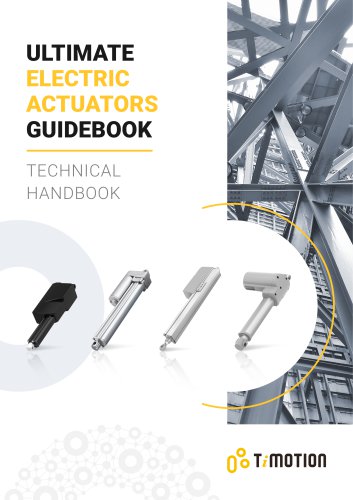
Ultimate Electric Actuators Guidebook
Electric linear actuators are devices that convert energy into mechanical motion, offering precise control and reliability. They are maintenance-free, energy-efficient, and increasingly used in various applications. TiMOTION provides customized actuator solutions for different sectors, emphasizing the importance of selecting the right actuator for specific needs.
An electric linear actuator converts motor rotation into linear motion, suitable for applications requiring precise movement. Key types include parallel drive, right-angle drive, inline, and linear slide actuators. Choosing the right actuator involves considering speed, load, duty cycle, environment, and available space.
Actuators are categorized into pneumatic, hydraulic, and electric types. Electric actuators are compact, programmable, and require minimal maintenance. They offer high precision and efficiency compared to pneumatic and hydraulic actuators, which have their own advantages and limitations.
Understanding the components of an actuator, such as the spindle, safety stop, and wiper, is crucial for implementing effective automation solutions. TiMOTION customizes these components to meet specific application requirements.
Safety features are integral to actuator design, ensuring reliable operation and protection against potential hazards.
Actuators must be selected based on load capacity and speed requirements, which are influenced by spindle type, RPM, and gear ratio.
IP ratings indicate the level of protection against dust and moisture. Understanding these ratings is essential for selecting actuators suitable for specific environmental conditions.
Feedback sensors enhance actuator performance by providing precise control and monitoring capabilities, essential for complex automation projects.
- Clevis: U-shaped metal piece for mounting actuators, customizable for different applications.
- Outer and Inner Tubes: Protect and house actuator components, with the inner tube extending and retracting via a drive nut.
- Spindle: Rotates to create linear motion, available in various thread types for different load and speed capabilities.
- Safety Stop and Wiper: Prevent overextension and protect against contaminants, influencing IP ratings.
- Drive Nut and Limit Switches: Facilitate tube movement and prevent overextension/retraction.
- Gears and Motor Housing: Alter speed relations and protect internal components.
- DC Motor: Powers the actuator, with components like stator, rotor, and commutator ensuring functionality.
- PTC Thermistor: Acts as a fuse to prevent motor overheating.
- Safety Nut and Overload Clutch: Enhance load support and prevent damage from excessive loads.
- Push-only Nut and Quick Release: Prevent damage from obstructions and allow rapid actuator retraction.
- Manual Release and Mechanical/Electromechanical Brakes: Facilitate manual operation and enhance stability under load.
- Spindle Types: Lead screws and ball screws, each with distinct load and speed capabilities.
- Spindle Specs: Pitch, lead, and starts affect speed and self-locking ability.
- Gear Ratio: Adjusts torque and speed, with examples provided for different applications.
- Power Supply: Options for 12V, 24V, and 36V DC, with AC to DC conversion available.
- Ingress Protection: Customizable protection levels against solid objects and liquids, ensuring actuator longevity.
TiMOTION is committed to ensuring the longevity and safety of its equipment by subjecting all products to rigorous pre-commercialization testing. This document provides an overview of IP ratings, feedback sensors, and the advantages of electric actuators.
IP Ratings
IP ratings indicate the level of protection against solid objects and liquids. The first digit (0-6) represents protection against solids, while the second digit (0-8) indicates protection against liquids. Common IP ratings include:
- IP42: Suitable for indoor applications like TV lifts and adjustable beds.
- IP54: Offers higher protection for environments like hospitals and warehouses.
- IP66: Waterproof, ideal for outdoor and medical equipment.
- IP67 & 68: Highest liquid protection, suitable for industrial applications.
- IP69K: Withstands high temperatures and pressure, used in agriculture.
Feedback Sensors
Feedback sensors are crucial for precise control and synchronization of electric actuators. Types include:
- Reed Sensors: Magnetic sensors used for safety and stroke adjustment.
- Optical Sensors: Convert light into electronic signals for position tracking.
- Potentiometers: Provide resistance-based position feedback, retaining information when power is off.
- Hall Effect Sensors: Recommended for their compact size and high resolution, activated by magnetic fields.
Advantages of Electric Actuators
Electric actuators offer numerous benefits, including:
- Smart synchronization
- Efficiency and reliability
- Programmable and quick installation
- Variable speed and customization
- Low maintenance and long life expectancy
- Low energy consumption
- Compact and easy integration
About TiMOTION
Founded in 2005, TiMOTION specializes in customizable equipment automation solutions for industrial, care, comfort, and ergonomic markets. With over 2,500 employees worldwide, TiMOTION is dedicated to providing innovative electric solutions.
For more information, contact TiMOTION through their regional offices.
Catalog excerpts
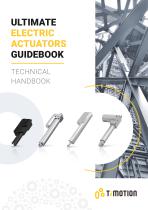
ULTIMATE ELECTRIC ACTUATORS GUIDEBOOK TECHNICAL HANDBOOK
Open the catalog to page 1
SUMMARY • Introduction Chapter 1: What is an electric linear actuator and how to choose it? • What is an electric linear actuator? • How to choose the right electric linear actuator for your application? Chapter 2: Comparison of different actuator systems • Three types of actuators Chapter 3: Components of an electric linear actuator Chapter 4: Electric linear actuators' safety feature options Chapter 5: Electric linear actuators' load and speed features • Different types of spindle • Mechanical power required • Different types of IP Ratings Chapter 7: Electric linear actuators and feedback sensors...
Open the catalog to page 2
INTRODUCTION Anywhere a machine pushes or pulls, raises or lowers, positions or rotates a load, an electric linear actuator can be used. Electric linear actuators are devices that provide reliable and precise movement of your equipment, offering total operator control. They have the advantage to be maintenance-free, having a long-life span, and being energy efficient. The need for electric actuation has increased exponentially in recent years. Wherever modernity takes hold, automated equipment adjustment and electric actuation are emerging. So, wherever you look, you will often find at least...
Open the catalog to page 3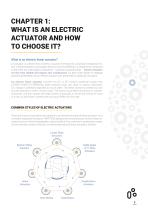
CHAPTER 1: WHAT IS AN ELECTRIC ACTUATOR AND HOW TO CHOOSE IT? What is an electric linear actuator? An actuator is a device that converts a source of energy into a physical mechanical motion. A linear actuator is an actuator that can move something in a straight line. Compared to the other two main types of actuators – hydraulic and pneumatic – electric actuators are the most reliable and require zero maintenance. It’s also much easier to integrate positioning feedback into an electric solution over pneumatic or hydraulic actuators. An electric linear actuator converts an AC or DC motor's rotational...
Open the catalog to page 4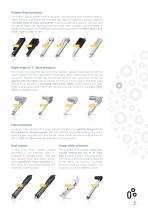
Parallel drive actuators The motor is directly parallel to the drive spindle. Typically, these types of electric linear actuators are spur or spiral gear with more gear ratio options. Parallel drive actuators allow for a broader range of loads and speeds. However, parallel drive actuators with spur gear can operate louder than spiral gear and worm gear driven actuators. Some examples of parallel drive actuators that TiMOTION manufactures can be seen in our MA4, MA5, TA16, TA2P, TA29 and VN1 models. Right-angle or “L” drive actuators The motor is set perpendicular to the drive spindle. Typically,...
Open the catalog to page 5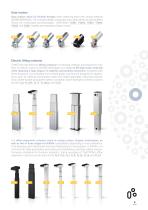
Gear motors Gear motors allow for flexible designs when matching them with various external spindle assemblies. The compact design is typically worm gear driven and an excellent choice for mechanical synchronization. TiMOTION’s TGM1, TGM2, TGM3, TGM4, TGM5, and TGM7 models are examples of gear motors. Electric lifting columns TiMOTION manufactures lifting columns for industrial, medical, and ergonomic markets. An electric column's primary advantage is its ability to lift high loads vertically while retaining a high degree of stability and bending movement compared with linear actuators. Our industrial...
Open the catalog to page 6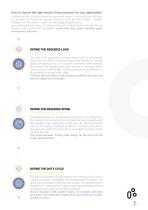
How to choose the right electric linear actuator for your application? An essential part of any successful automation project is choosing the right electric actuator. As you’ve just learned, there are many actuator models – parallel, L-shaped, or inline motor – used in a wide range of applications. Each project need is unique. To help you select the right actuator, consider the application and its technical constraints: speed, load, duty cycle, available space, environment, and more. DEFINE THE REQUIRED LOAD The load to be supported is a determining factor in the actuator choice and will define...
Open the catalog to page 7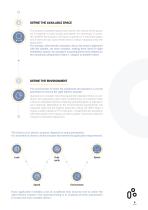
DEFINE THE AVAILABLE SPACE The system’s available space also informs the choice of the actuator. In addition to load, stroke, and speed, it is necessary to consider whether the actuator will have to operate in a restricted space and if there are any space restrictions to allow integration into the application. For example, inline electric actuators, due to the motor's alignment with the spindle, are more compact, making them ideal for tight installation spaces. An actuator's mounting dimensions depend on the mounting configuration (inline, L-shaped, or parallel motor). DEFINE THE ENVIRONMENT...
Open the catalog to page 8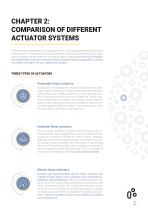
CHAPTER 2: COMPARISON OF DIFFERENT ACTUATOR SYSTEMS There are many misconceptions or outdated notions involving the three types of actuator motion systems – pneumatic, hydraulic, and electric. While you may think that your application's actuation needs depend on one specific type of actuator, the march of progress and technological advances permit greater potential interchangeability, creating more than one option for your application project. THREE TYPES OF ACTUATORS Pneumatic linear actuators Composed of a simple piston inside a hollow cylinder, pneumatic linear actuators are widely used in...
Open the catalog to page 9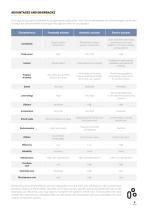
ADVANTAGES AND DRAWBACKS Each type of actuator is essential to its appropriate application. Each has its advantages and disadvantages, so be sure to weigh the options before deciding on the right actuator for your project Characteristics Pneumatic actuator Hydraulic actuator Electric actuator Simple system composition Moderately complex system composition Control systems and motion components can work together in multiple complex configurations Peak power Very high Simple valves User intervention required Flexibility of motion control, capabilities with electronic controller Position accuracy...
Open the catalog to page 10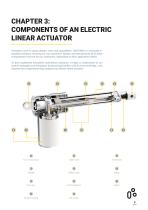
CHAPTER 3: COMPONENTS OF AN ELECTRIC LINEAR ACTUATOR Actuators come in many shapes, sizes and capabilities. TiMOTION is a vertically integrated company, meaning we can customize, design, and manufacture all of these components in-house for our customers, depending on their application needs. To best implement innovative automation solutions, it helps to understand an actuator’s strengths and limitations by becoming familiar with its inner workings. Let’s examine the components that comprise an electric linear actuator. Front/rear clevis Outer tube Inner tube Safety stop Limit switches Motor housing...
Open the catalog to page 11All TiMOTION Europe catalogs and technical brochures
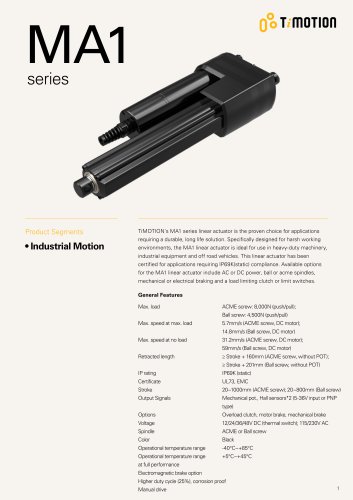 MA1 Series
10 Pages
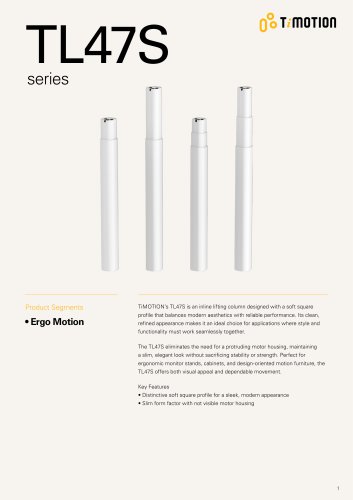 TL47S-3
12 Pages
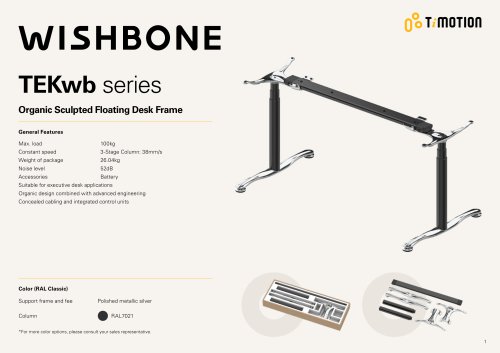 Wishbone
5 Pages
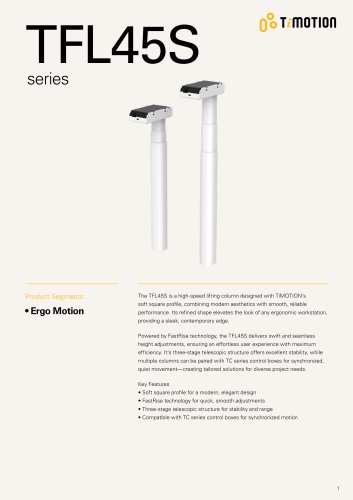 TFL45S
7 Pages
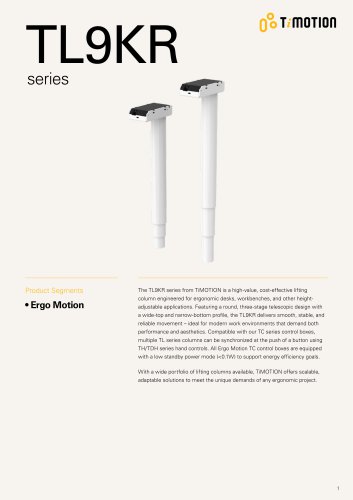 TL9KR
TL9KR6 Pages
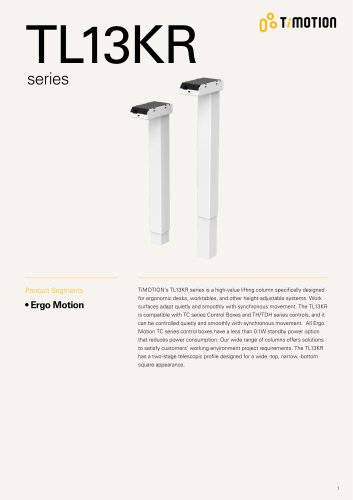 TL13KR
6 Pages
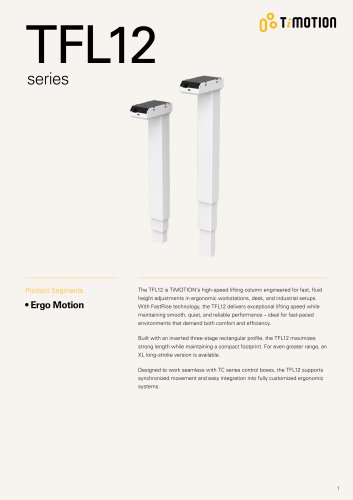 TFL12
TFL126 Pages
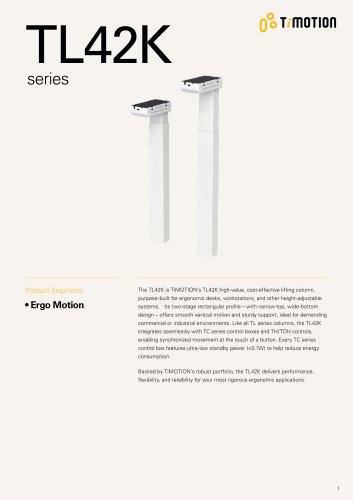 TL42K
TL42K6 Pages
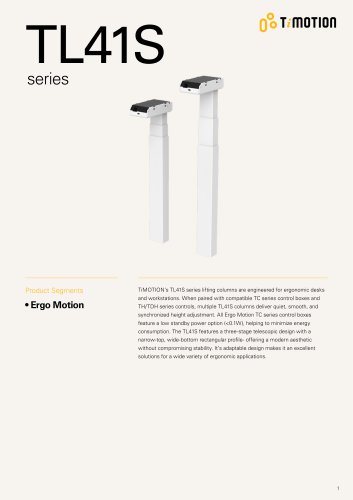 TL41S
TL41S6 Pages
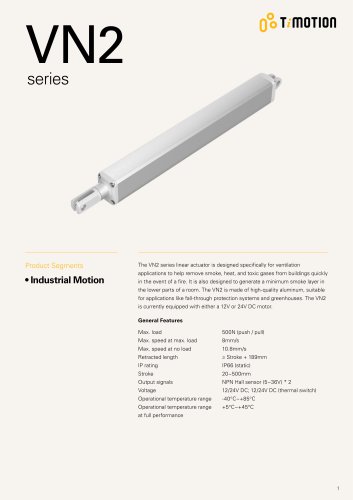 VN2
VN29 Pages
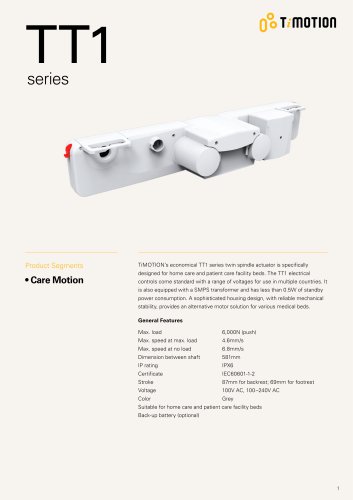 TT1
TT15 Pages
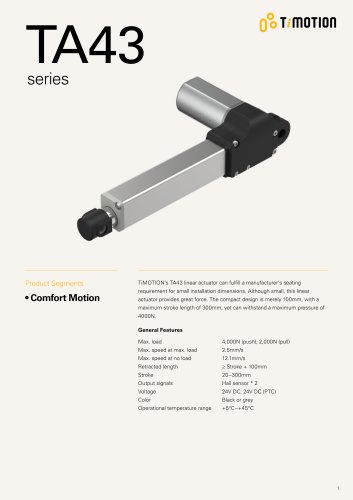 TA43
TA438 Pages
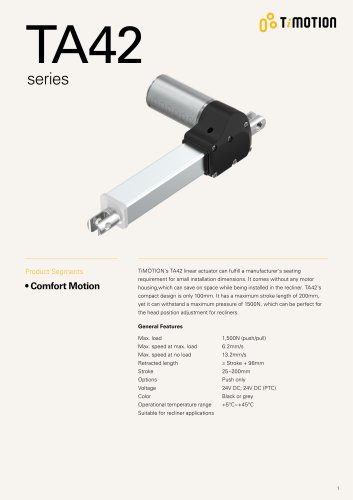 TA42
TA426 Pages
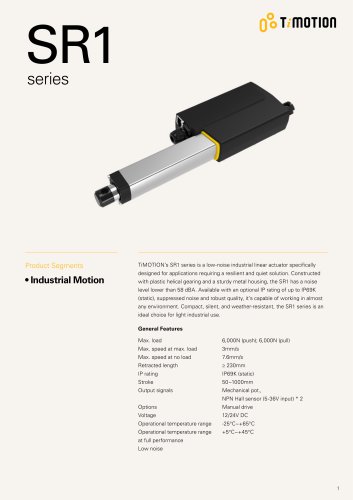 SR1
SR19 Pages
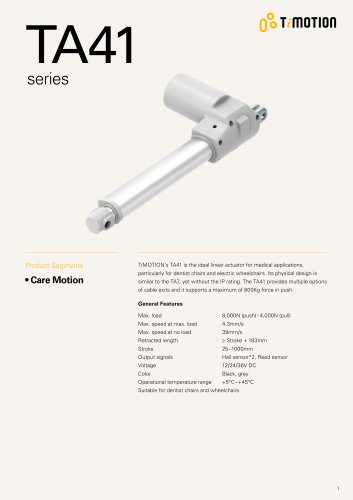 TA41
TA4111 Pages
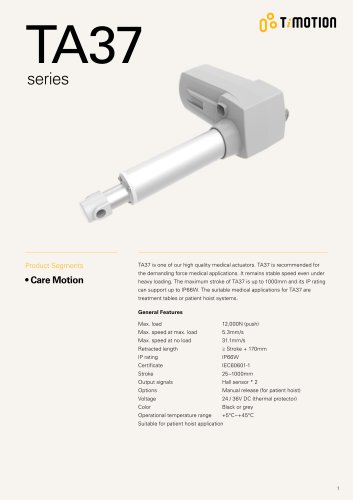 TA37
TA379 Pages
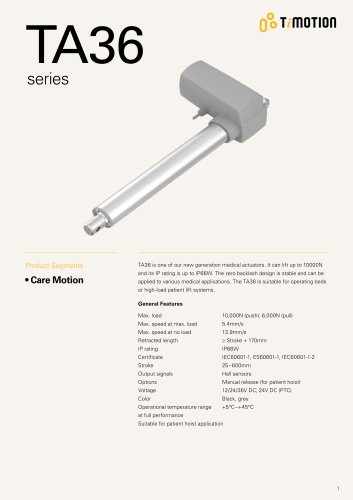 TA36
TA3610 Pages
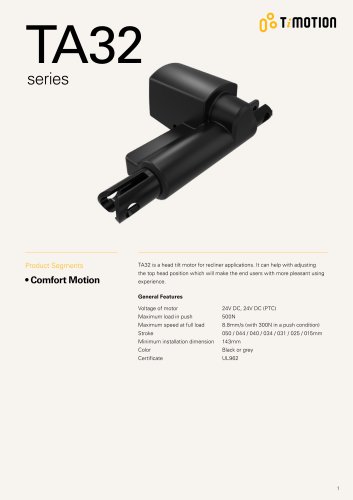 TA32
TA326 Pages
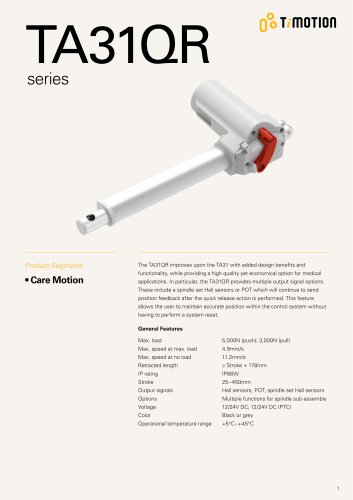 TA31QR
8 Pages
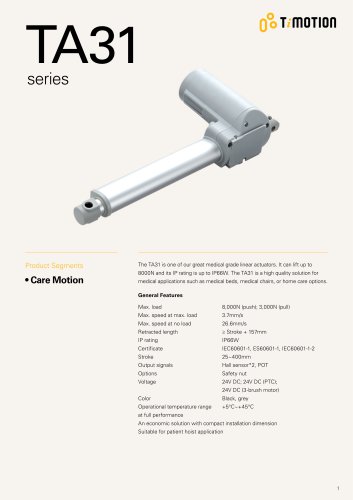 TA31
TA3113 Pages
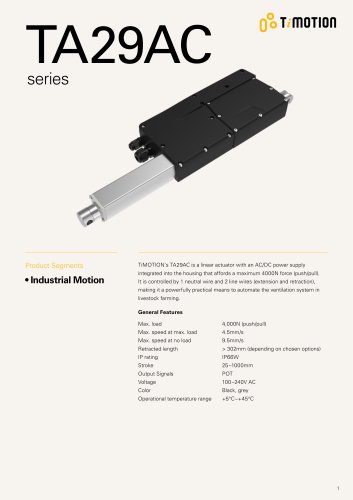 TA29AC
8 Pages
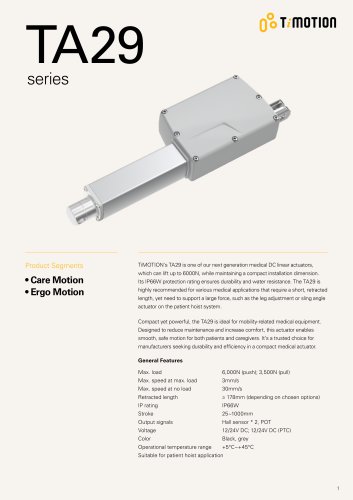 TA29
TA298 Pages
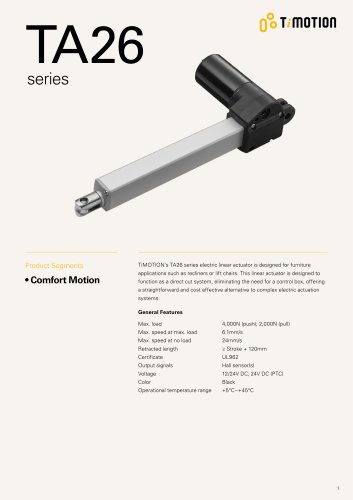 TA26
TA266 Pages
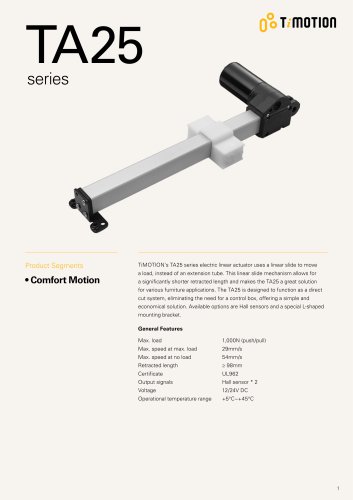 TA25
TA256 Pages
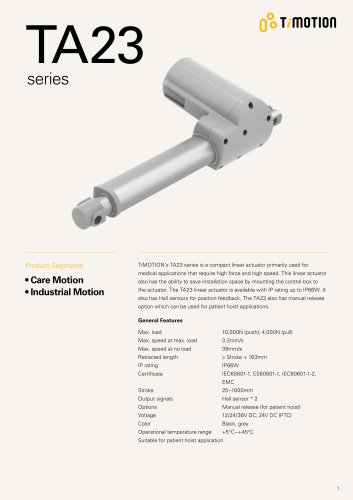 TA23
TA2312 Pages
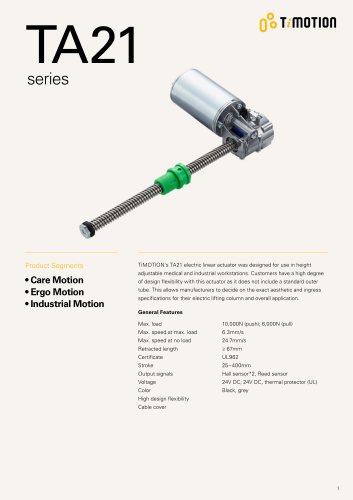 TA21
TA214 Pages
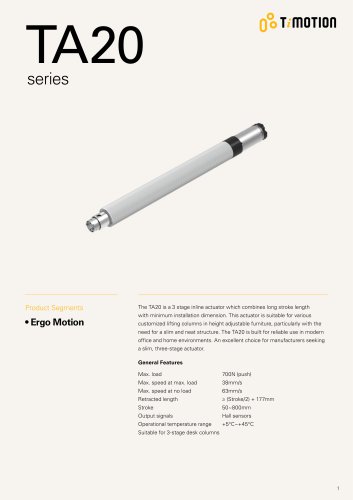 TA20
TA206 Pages
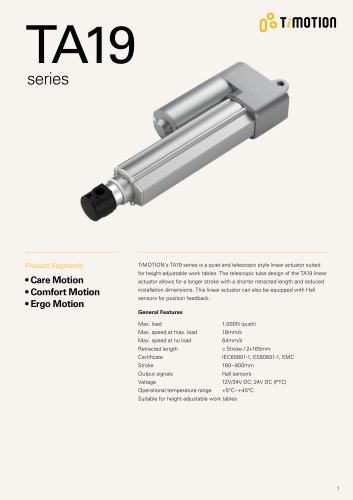 TA19
TA198 Pages
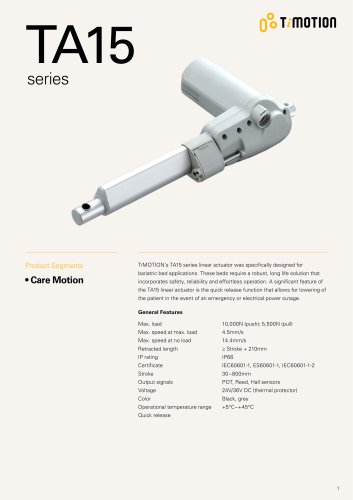 TA15
TA158 Pages
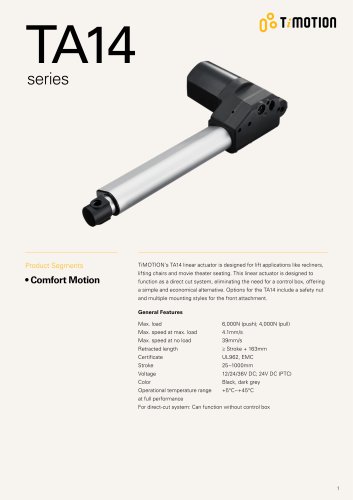 TA14
TA1410 Pages
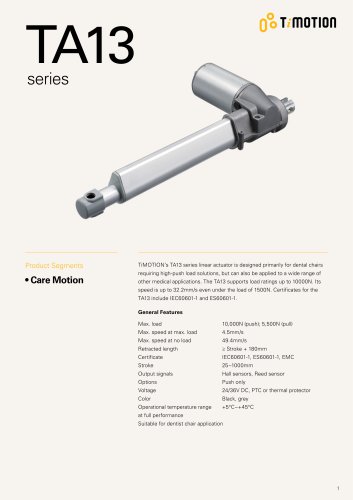 TA13
TA138 Pages
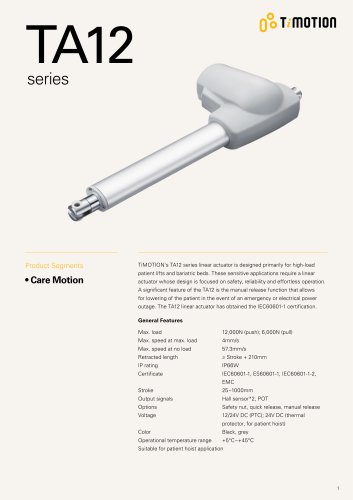 TA12
TA129 Pages
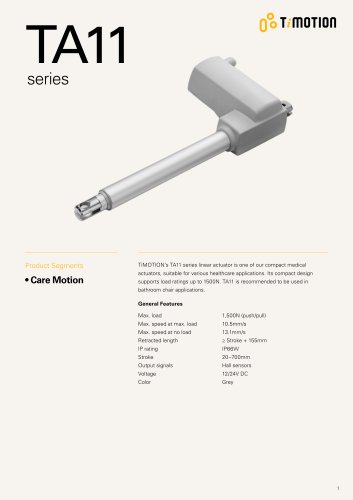 TA11
TA117 Pages
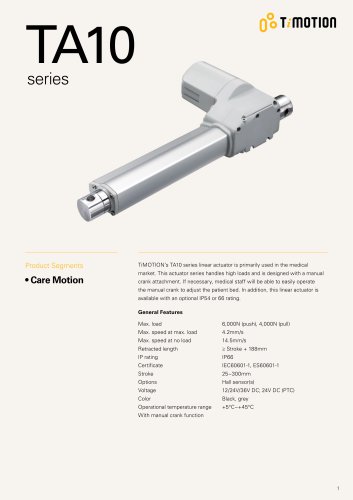 TA10
TA108 Pages
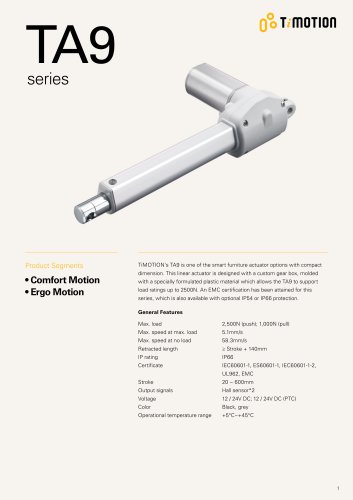 TA9
TA911 Pages
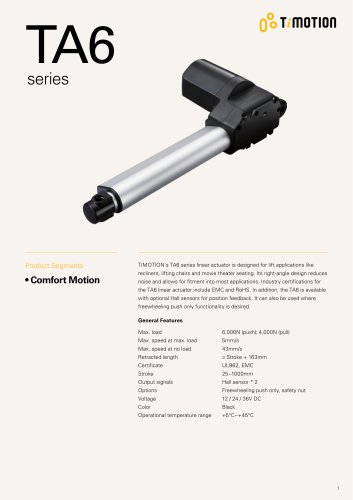 TA6
TA610 Pages
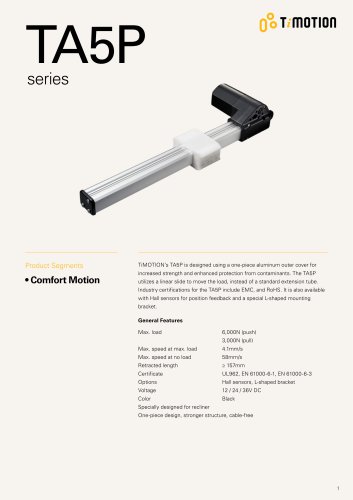 TA5P
TA5P7 Pages
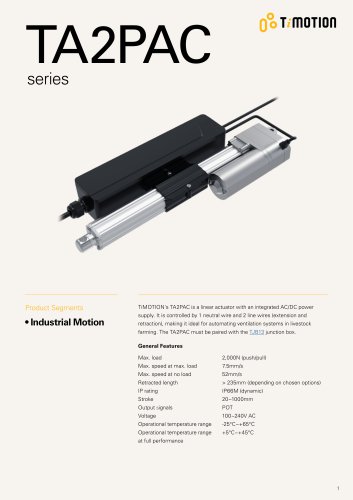 TA2PAC
8 Pages
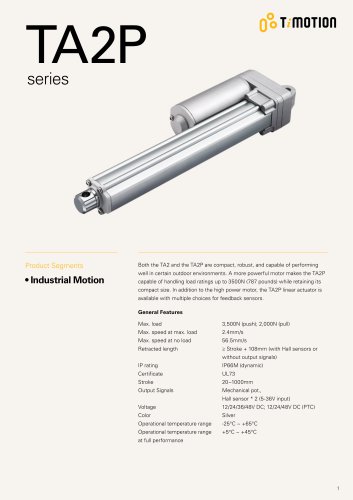 TA2P
TA2P27 Pages
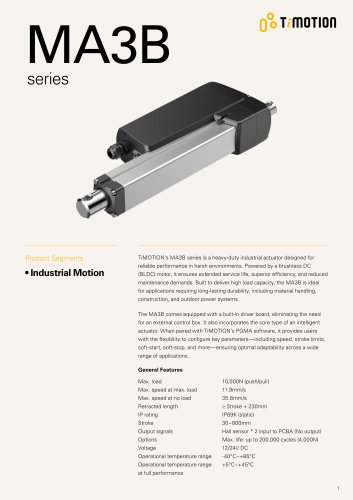 MA3B
MA3B11 Pages
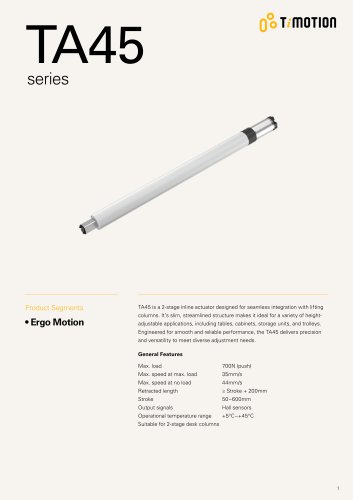 TA45
TA456 Pages
 Industrial Motion Catalog
92 Pages
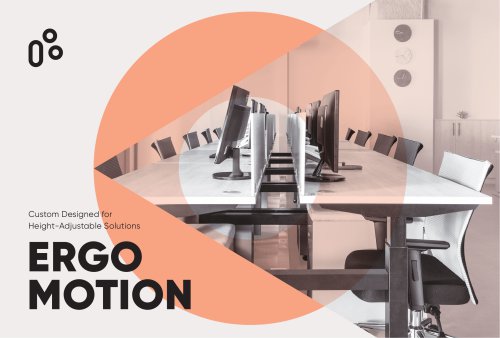 Ergo Motion Catalog
76 Pages
 Comfort Motion Catalog
32 Pages
 Care Motion
40 Pages
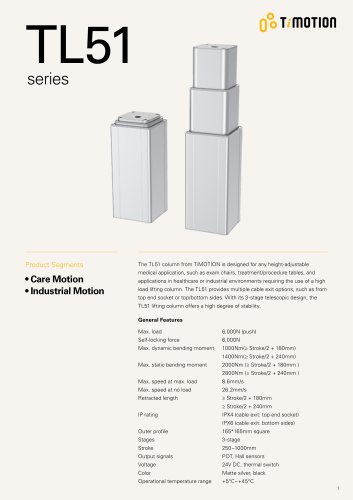 TL51 series
8 Pages
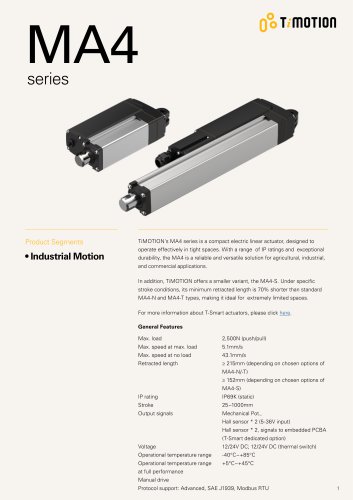 MA4
MA414 Pages
 TA50
TA508 Pages
 TFL33S
6 Pages
 TCH2P
TCH2P3 Pages
 JP6-A
JP6-A6 Pages
 JP5-A
JP5-A7 Pages
 TFL10-B
6 Pages
 TL41K-D
6 Pages
 MA6
MA68 Pages
 VN3 series
6 Pages
 MA2
MA27 Pages
 TIP1 series
4 Pages
 TC22 series
3 Pages
 TA38M series
7 Pages
 T-SMART ACTUATOR SOLUTION
4 Pages
 MA3
MA38 Pages
 VN1
VN112 Pages
 TA48
TA486 Pages
 TA16
TA169 Pages
 TA4
TA411 Pages
 TA38
TA387 Pages
 TA2
TA210 Pages
 TA2P
TA2P12 Pages
 JP4
JP47 Pages
 JP3
JP37 Pages
 TVL3
TVL34 Pages
 TL18AC
7 Pages
 TL17
TL179 Pages
 TL15
TL155 Pages
 TL14
TL145 Pages
 TL13
TL135 Pages
 TL12
TL126 Pages
 TL11
TL115 Pages
 TL10
TL105 Pages
 TL9K
TL9K5 Pages
 TL8
TL85 Pages
 TL5
TL56 Pages
 TL3
TL312 Pages
 TGM7
TGM75 Pages
 TGM5
TGM55 Pages
 TGM4
TGM47 Pages
 TGM3
TGM36 Pages
 TGM2
TGM27 Pages
 TGM1
TGM17 Pages


Archived catalogs
 Catalogue Care Motion
36 Pages
 Catalogue Industrial Motion
88 Pages
 Catalogue Ergo Motion
64 Pages
 Comfort Motion guide
28 Pages
 Comfort Motion
28 Pages
 MA2T
MA2T72 Pages
 Care Motion Catalog
32 Pages
 IndustrialMotion_EN
72 Pages
 Ergo Motion Catalog
44 Pages
 Industrial Motion
56 Pages
- TiMOTION gear-motor
- Double-acting cylinder
- Terminal box
- TiMOTION DC gear-motor
- Industrial remote control
- Remote control with buttons
- Compact actuator
- Screw actuator
- Industrial electric gearmotor
- Right angle electric gearmotor
- TiMOTION 24 V gear-motor
- Solid-shaft gear-motor
- Gear train gearmotor
- Compact gear-motor
- TiMOTION industrial actuator
- TiMOTION DC actuator