


TIMKEN® FAFNIR® SUPER PRECISION BEARINGS FOR MACHINE TOOL APPLICATIONS
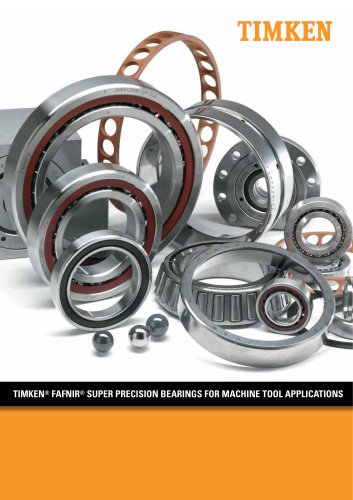
TIMKEN® FAFNIR® SUPER PRECISION BEARINGS FOR MACHINE TOOL APPLICATIONS
Timken is a leading provider of tapered roller bearings, offering products designed to enhance machine tool performance through improved reliability and efficiency. Their commitment to precision and quality supports various applications.
This section details the bearing selection process, load determination, and analysis, including load ratings and life expectancy. It covers permissible operating speeds, lubrication, heat generation, tolerances, fitting practices, and mounting designs, with considerations for shafts and housings.
Timken offers precision tapered roller bearings in styles like TS, TSF, TXR, and TSHR, available in metric and inch sizes, designed for high performance in specific applications.
Manufactured to high precision classes, these bearings include spindle bearings and ball screw support bearings, available in various configurations to meet specific application requirements.
Provides additional technical data, including frequency coefficients, precision tag deviation, runout charts, geometry factors, radial internal clearance, and lubrication specifications, along with conversion tables and forms.
Timken offers a limited warranty, emphasizing proper maintenance and handling. The catalog outlines terms and conditions of sale, including warranty claim remedies.
Guidelines for the shelf life and storage of grease-lubricated bearings are provided to ensure optimal performance, emphasizing proper storage conditions to prevent damage.
Proper storage conditions are crucial to prevent contamination and damage. Bearings should be stored in a clean, dry environment, free from dust and harmful vapors, and kept in their packaging until use.
Timken emphasizes selecting the right bearing type based on boundary conditions and performance expectations, considering factors like external loads, operating temperature, and environmental conditions.
A matrix compares various bearing types, including tapered roller, cylindrical roller, spherical roller, and ball bearings, in terms of load capacity, stiffness, speed, and friction.
Designed for high-speed, high-accuracy applications, these bearings minimize heat generation and vibration, with options for hybrid ceramic technology and specialized lubrication.
Outlines precision classes for bearings, referencing ABEC/ISO standards, ensuring premium performance through strict controls over non-specified parameters.
Runout, or rotational accuracy, is crucial for machine precision. Timken super precision ball bearings offer high control, quiet operation, and reduced vibration.
Preload is essential for distributing loads among rolling elements, affecting heat generation and permissible speed.
Timken offers various precision classes for tapered roller and ball bearings, guiding the selection of the appropriate bearing class for different applications.
Discusses the design principles of tapered roller bearings, highlighting their ability to carry radial and axial loads with true rolling motion.
Timken provides a range of precision bearings designed to meet the demands of the machine tool industry, emphasizing the importance of selecting the right bearing class and tuning critical components.
Discusses various specifications of Timken super precision ball bearings, including different series for ultra-light, extra-light, and light loads, and construction types enhancing spindle speed and radial stiffness.
Outlines the importance of preload levels in bearings, affecting axial and radial deflections, particularly at high speeds.
Recommendations include selecting bearings with large bore diameters for increased stiffness and considering the effect of bearing stiffness on machine repeatability and accuracy.
Figures illustrate the relationship between spindle diameter and stiffness, the effect of bearing spread on spindle deflection, and the comparison of radial spring rates among different bearing types.
Emphasizes the importance of dynamic stiffness, influenced by damping characteristics and static stiffness, and the role of seals in excluding contaminants and retaining lubricant.
Provides detailed equations and specifications for calculating forces and loads in mechanical systems, focusing on worm gears, belt and chain drives, and bearing reactions.
Discusses the complexities of calculating total belt pull due to variations in belt tightness, providing a table for belt or chain pull factors based on the angle of wrap.
Explains the use of simple beam equations to translate external forces on a shaft into bearing reactions.
Outlines the basic dynamic and static load ratings used for bearing selection, emphasizing the importance of realistic ratings for customer assistance.
Provides equations for static equivalent radial and axial loads, with considerations for different bearing types.
Explains the calculation of dynamic equivalent radial loads for tapered roller bearings, considering radial and axial loads in bearing selection.
Discusses the traditional calculation method for bearing loads, providing equations for determining bearing axial reactions and equivalent radial loads.
Defines the dynamic equivalent radial load as the radial load that gives the same life as the actual loading, providing equations for calculation.
Outlines the ISO/ABMA and Timken adjusted bearing life equations, incorporating factors such as reliability, material, and operating conditions.
Discusses several life adjustment factors, including debris life factor, reliability life factor, material life factor, hardness life factor, load zone life factor, and lubrication life factor.
Emphasizes the importance of considering various factors in bearing analysis and selection, such as debris signature analysis and the influence of lubrication film.
Provides a comprehensive guide to calculating and adjusting bearing loads and life, incorporating various factors that affect performance.
Discusses the impact of rotational speed and speed factor on bearing performance.
Evaluates the lubricant's kinematic viscosity at the bearing's operating temperature.
Derived from the equivalent load applied to the bearing, crucial for calculating load capacity.
Varies based on the axial load applied for tapered roller bearings.
Adjusts for the effect of grease lubrication depletion over time.
Influenced by misalignment angles, internal geometry, and applied loads.
Predicts life increases under low contact stresses and sufficient lubrication.
Calculates system reliability and weighted average life and load equations.
Discusses factors influencing permissible operating speeds, including spindle mass and lubrication method.
Speed measured by rib speed, with lubrication playing a crucial role in speed capability.
Discusses the choice of lubricant and delivery method, considering factors like maximum speed requirement and heat dissipation rate.
Highlights the importance of lubrication for bearing performance and longevity, discussing synthetic and mineral greases, as well as oil lubrication.
Used under the "lubrication for life" concept, with specific guidelines for use.
Preferred for spindle bearings due to simplicity and low heat generation, with limitations for high loads or speeds.
Limited to certain rib speeds, with a formula provided for lubricant quantity approximation.
Suitable for rib speeds over 13 m/s, with specific procedures for use.
Preferred for high-speed applications due to superior heat dissipation, with key considerations for system design.
Require lubrication to minimize friction and protect surfaces, with guidelines for grease selection based on speed capability.
Recommended for high-speed applications, with various methods discussed for cooling and contamination prevention.
Discusses various lubrication methods, emphasizing the importance of proper lubrication to prevent damage.
Compares lubrication systems, detailing costs and typical speeds.
Outlines procedures for running-in bearings, aiming to spread grease evenly and stabilize operating conditions.
Requires special attention for lubrication and sealing to prevent contamination.
Explains how heat is generated and dissipated in bearing systems, emphasizing low operating temperatures for precision machine tools.
Discusses the relationship between preload, operating speed, and heat generation.
Discusses the impact of preload on bearing temperature rise, suggesting minimizing preload for high-speed operations.
Operate at low speeds with heavy loads, requiring maximum radial and axial rigidity.
Internal geometry significantly affects heat generation, with high-speed designs optimizing load capacity and stiffness.
Discusses methods of heat dissipation for grease and oil-lubricated spindles.
Manufactured to specific tolerance classes, with detailed tables on tolerances for various dimensions.
Technical catalog detailing specifications and tolerances for various types of bearings, including metric and inch system bearings.
Outlines tolerances for outer race O.D. and inner race bore for metric system bearings.
Categorized into precision classes, with detailed tables for various dimensions.
Mentions ABEC classes for ball bearings, with higher numbers indicating more precise tolerances.
Runout is a critical measure of rotational accuracy, with specific tolerances for different bearing types.
Designed for high precision applications, with a comparison of tolerances among different ABEC/ISO classes.
Defines symbols related to inner and outer ring tolerances, crucial for understanding precision requirements.
Tables provide detailed tolerances for inner and outer rings according to ABEC/ISO standards.
Guidelines for fitting tapered roller bearings, emphasizing precision class and layout type.
Offers fitting guidelines for ferrous shaft and housing, detailing resultant fit based on tolerances.
Technical catalog focusing on precision class tapered roller bearings, providing specifications and fitting guidelines.
Outlines deviation from nominal dimensions for bearing outer diameters and bores, categorized by class.
Suggested fitting guidelines for ferrous shafts and housings, with recommendations for heavy loads and high speeds.
Numerous tables detail range, tolerance, and resultant fit for various bearing classes and sizes.
Emphasizes precision machining of bearing seats and shoulders, with key characteristics like circularity and perpendicularity.
Comprehensive guide for selecting and fitting Timken precision class tapered roller bearings.
Establishes centerline from bearing seats, assessing flatness and perpendicularity of shoulders.
Requires high-quality surface finishes and close machining tolerances for shafts and housings.
Ensures secure attachment of inner ring to shaft, with suggested sizes and tolerances for super precision ball bearings.
Outer ring should be mounted with a hand push to a light tapping fit, with suggested bore dimensions.
Good spindle accuracy depends on proper design and machining of components, correct fitting practices, and appropriate bearing setting.
Typically made of cast iron or steel, with heat treatment to reduce distortion.
Labyrinth seals with slingers and end covers are effective against foreign matter intrusion.
Made from hardened and ground steel, with a hardness of 45-50 HRC.
Precision adjusting nuts and locking devices maintain proper nut positioning.
Uses three bearings, with two nose bearings fixed axially and a tail bearing in a floating position.
Used in three-support mountings for heavily loaded or long spindles.
Supported by bearings at both nose and tail positions, forming a simple isostatic design.
Achieved through oil circulation or high-speed grease, with advanced systems using oil jets.
Various configurations discussed, including back-to-back, face-to-face, and tandem arrangements.
Provides radial and axial rigidity, allowing spindle adjustment to temperature changes.
Aligning high points of runout on bearing components optimizes spindle accuracy.
Optimal operating setting for tapered roller bearings is between zero and light preload.
Discusses optimization of bearing spread to compensate for axial expansion due to temperature differences.
Recommends setting bearings with a light, cold end play initially to prevent excessive preload.
Involves grinding stock off faces of inner and outer rings to achieve predetermined axial load.
Illustrates effects of different preload levels on axial and radial deflections.
Outlines numbering systems for Timken precision tapered roller bearings.
Emphasizes importance of selecting right bearing arrangement and maintaining precision through proper preload and thermal management.
Provides detailed information on use and replacement of precision bearings in machine tools.
Emphasizes using bearings of equivalent precision class when replacing in older machines.
Thorough inspection and refurbishment of adjacent components necessary before remounting bearings.
Outlines various types of precision tapered roller bearings, including single-row and two-row bearings.
Used in various applications beyond machine tools, such as printing presses and optical grinders.
Recommended for applications requiring high-speed operation, ensuring adequate lubrication and preload.
Provides detailed tables with dimensional sizes, load ratings, and performance options.
Maintaining precision in bearing replacement and ensuring integrity of surrounding components are critical for optimal performance.
Technical catalog focusing on tapered roller bearings, providing specifications, mounting dimensions, and precision levels.
Provides detailed specifications for tapered roller bearings, including bore diameter, outer diameter, and load ratings.
Outlines maximum shaft and housing fillet radii, stiffness, speed ratings, and weight for different bearing models.
Categorizes bearings into different precision levels, with specific features enhancing spindle operation.
Explains load ratings based on Timken's calculations for L10 life.
Highlights unique design of Timken's Hydra-Rib bearings, offering precision in metric bearings.
Includes notes on tighter tolerances for higher precision requirements.
Technical catalog focusing on Hydra-Rib and Spring-Rib bearings, providing specifications and performance characteristics.
Designed for high-speed applications with enhanced thermal expansion capabilities.
Installation requires minor modifications to existing spindles.
Available in various precision classes, with customizable preload settings.
Includes tables with detailed measurements and load ratings for each bearing model.
Ideal for applications with constant load and speed, such as machine tools.
Offers advanced solutions for high-speed and precision applications, with customizable preload settings.
Provides detailed specifications and applications for Timken's super precision ball bearings.
Outlines various types of bearing cages, crucial for durability and efficiency.
Bearings categorized based on preload levels, affecting rigidity and performance.
Adheres to ABEC/ISO classes, ensuring high-quality performance.
Offers super precision and ultra-precision bearings for high-speed applications.
Designed for precision and high-speed applications, providing rigidity and low operating temperatures.
Ensures precise fitting in machine tools, enhancing spindle precision.
Discusses various configurations, with alignment marks for proper installation.
Provides examples of successful applications, illustrating versatility and precision.
Designed to meet special requirements for high-speed, grease-lubricated spindles.
Engineered for high performance in demanding machine tool applications.
Provides detailed specifications and applications of various super precision bearings.
Details configurations like 4WI-DUM bearings and high-speed motorized routers.
Highlights applications like high-speed motorized routers and precision vertical milling spindles.
Includes ultra-light ISO 19 series, meeting ABEC 9 levels for running accuracy.
Includes tables with dimensions, load ratings, and speed ratings for different bearings.
Outlines specifications for Timken machine tool bearings, focusing on ultra-light ISO 19 series.
Provides tables with suggested shoulder diameters and mounting fits.
Includes preload, axial stiffness, radial stiffness, and spacer offsets for different bearing numbers.
Includes speed capability data, detailing grease capacity and operating speeds.
Discusses various mounting arrangements, with specific performance data for each configuration.
Provides critical data on dimensions, fits, performance metrics, and speed capabilities.
Technical catalog focusing on machine tool bearings, providing specifications and performance metrics.
Lists bearings with dimensions, load ratings, and speed capabilities.
Provides performance data for different bearing models, including preload levels and stiffness.
Describes various mounting arrangements, providing guidance on appropriate fits.
Conforms to high precision standards, emphasizing importance of adhering to these standards.
Includes tables with detailed specifications for each bearing model.
Comprehensive guide for selecting and implementing Timken machine tool bearings.
Technical catalog focusing on machine tool components, providing specifications and performance data.
Lists models of deep-groove construction ball bearings, highlighting dimensions and load ratings.
Describes bearings designed for maximum axial rigidity and low drag torque.
Provides performance data for DUH and QUH series, including static limiting thrust capacity and speed rating.
Covers bearings designed for high axial rigidity and low drag torque, with specifications in inches.
Comprehensive guide for selecting Timken ball bearings and ball screw support series.
Technical catalog focusing on machine tool bearings, emphasizing super precision bearings.
Lists bearing series with specific Timken and ISO bearing numbers, providing frequency data for defect detection.
Emphasizes importance of understanding frequency data for defect detection and maintenance.
Provides specific lubricants and rust preservatives for bearings, with equivalents allowed.
Various materials used for bearing components, with specific chemical compositions and temperature ranges.
Standard operating temperatures for bearing materials provided, with recommendations for different materials.
Includes viscosity conversion and various unit conversion tables for different measurement systems.
Provides conversion factors for speed and volume, among others.
Includes forms for requesting assistance with Timken products, gathering detailed information about customer needs.
Lists various series of ball bearings and tapered roller bearings, with specific page numbers and sections for reference.
Provides technical assistance contact details and additional resources on Timken's website.
Timken designs, manufactures, and markets high-performance mechanical components, aimed at improving machinery reliability and performance globally.
Catalog excerpts
TIMKEN® FAFNIR® SUPER PRECISION BEARINGS FOR MACHINE TOOL APPLICATIONS
Open the catalog to page 1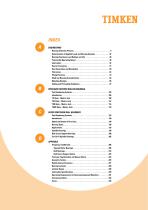
ENGINEERING Bearing Selection Process . . . . . . . . . . . . . . . . . . . . . . . . . . . . . . . . . . . . . . . . . 9 Determination of Applied Loads and Bearing Analysis . . . . . . . . . . . . . . . Bearing Reactions, Load Ratings and Life . . . . . . . . . . . . . . . . . . . . . . . . . . Permissible Operating Speed . . . . . . . . . . . . . . . . . . . . . . . . . . . . . . . . . . . . . Lubrication . . . . . . . . . . . . . . . . . . . . . . . . . . . . . . . . . . . . . . . . . . . . . . . . . . . . . . Run-In Procedures . . . . . . . . . . . . . . . . . . . . . . . . . . . . . . ....
Open the catalog to page 3
TIMKEN MACHINE TOOL CATALOG ABOUT THE TIMKEN COMPANY The leading authority on tapered roller bearings, Timken today applies its deep knowledge of metallurgy, tribology and mechanical power transmission across a variety of bearings and related systems to improve reliability and efficiency of machinery and equipment all around the world. Timken (NYSE: TKR; www.timken.com) engineers, manufactures and markets bearings, gear drives, belts, chain and related products, and offers a spectrum of powertrain rebuild and repair services. To view more Timken catalogs, go to www.timken.com/catalogs for interactive...
Open the catalog to page 4
Introduction ABOUT THIS CATALOG Timken offers an extensive range of bearings and accessories in both imperial and metric sizes. For your convenience, size ranges are indicated both in millimeters and inches. Contact your Timken sales representative to learn more about our complete line for the special needs of your application. USING THIS CATALOG We are committed to providing our customers with maximum service and quality. This catalog contains dimensions, tolerances and load ratings, as well as an engineering section describing fitting practices for shafts and housings, internal clearances,...
Open the catalog to page 5
TIMKEN MACHINE TOOL CATALOG PURCHASER’S EXCLUSIVE REMEDY/SELLER’S EXPRESS LIMIT OF LIABILITY Purchaser’s exclusive remedy for any warranty claim, or for any claim arising out of the purchase or use of our products, shall be the replacement of said products. We will replace our products, without charge to the purchaser, f.o.b. our point of shipment. We will not be liable for any consequential, incidental, or other damages sustained by purchaser, including but not limited to, loss of profits or revenue, loss of use of product, cost of capital, cost of substituted product, facilities, services,...
Open the catalog to page 6
SHELF LIFE AND STORAGE OF GREASE-LUBRICATED BEARINGS AND COMPONENTS To help you get the most value from our products, Timken provides guidelines for the shelf life of grease-lubricated ball and roller bearings, components and assemblies. Shelf life information is based on Timken and industry test data and experience. When removing a product that is not individually packaged from a bulk pack container, the container should be resealed immediately after the product is removed. The storage area temperature should be maintained between 0° C (32° F) and 40° C (104° F); temperature fluctuations should...
Open the catalog to page 7
TIMKEN MACHINE TOOL CATALOG Inasmuch as Timken is not familiar with a customer’s particular storage conditions, these guidelines are strongly suggested. However, the customer may very well be required by circumstance or applicable government requirements to adhere to stricter storage requirements. Most bearing types are typically shipped protected with a corrosionpreventive compound that is not a lubricant. Such bearings may be used in oil-lubricated applications without removal of the corrosion-preventive compound. When using some specialized grease lubrication it is advisable to remove the...
Open the catalog to page 8
Bearing Selection Bearing Selection Process . . . . . . . . . . . . . . . . . . . . . . . . . . . . . 9 Determination of Applied Loads and Bearing Analysis . . . . 32 Bearing Reactions, Load Ratings and Life . . . . . . . . . . . . . . . 38 Permissible Operating Speed . . . . . . . . . . . . . . . . . . . . . . . . . . 49 Lubrication . . . . . . . . . . . . . . . . . . . . . . . . . . . . . . . . . . . . . . . . . . 52 Run-In Procedures. . . . . . . . . . . . . . . . . . . . . . . . . . . . . . . . . . . . 57 Heat Generation and Dissipation . . . . . . . . . . . . . . . . . . . . . . . 60 Tolerances...
Open the catalog to page 9
TIMKEN MACHINE TOOL CATALOG
Open the catalog to page 10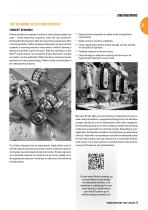
ENGINEERING THE BEARING SELECTION PROCESS TIMKEN® BEARINGS Timken provides an extensive variety of rolling bearing types and sizes – to the extent that customers need not look elsewhere. Knowing that the bearing is often the most critical component within a moving assembly, Timken engineers take great care to ensure the customer is receiving maximum value when a Timken® bearing is selected to perform a given function. With the acquisition of the Fafnir® brand, Timken can provide the proper bearing for virtually any motion-control application. With more than a century of proven experience in bearing...
Open the catalog to page 11
Typical considerations in machine design also include optimization of controllable variables affecting application performance: Bearing design. Installation and handling requirements of the bearing, as well as shaft and housing preparation. Presence of adequate sealing for the exclusion of contaminants; types of foreign materials possible. Lubricating method (lubrication type and delivery system). Bearing shaft and housing arrangement; shaft and housing material. Maintenance procedures and intervals. Boundary (or fixed) conditions that should be taken into consideration include: External loads,...
Open the catalog to page 12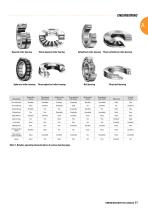
Tapered roller bearing Spherical roller bearing Thrust tapered roller bearing Cylindrical roller bearing Thrust cylindrical roller bearing Thrust spherical roller bearing Tapered roller bearing Thrust tapered roller bearing Pure radial load Pure axial load Combined load Ball bearing Thrust ball bearing Cylindrical roller bearing Thrust cylindrical roller bearing Spherical roller bearing Thrust spherical roller bearing Ball bearing Thrust ball bearing Moment load High stiffness Quiet running Locating position (fixed) Non-locating position (floating) Table 1. Relative operating characteristics...
Open the catalog to page 13All TIMKEN catalogs and technical brochures
 National® Industrial Seals
716 Pages
 TIMKEN® ECOTURN® SEAL
2 Pages
 Timken® Lubricants
6 Pages
 Quick-Flex Couplings
68 Pages
 Matched Bearing Assemblies
16 Pages
 Cylindrical Roller Bearings
108 Pages
 AP Bearings
84 Pages
 UC Series Ball Housed Units
24 Pages
 Type E Housed Units
40 Pages
 Ball Housed Units
180 Pages
 SNT Plummer Blocks
120 Pages
 SAF Housed Units
126 Pages
 Thrust Bearings
138 Pages
 Quick-Flex Coupling Catalog
68 Pages
 Bearing interchange guide
163 Pages
 UC-SERIES
24 Pages
 Commercial Vehicle Catalog
417 Pages
 Quick-Flex Coupling
64 Pages
 Timken Drives Roller Chain Catalog
112 Pages
 Industrial Maintenance Manual
157 Pages
 Timken SAF Housed Unit Catalog
126 Pages
 Timken Ball Housed Unit Catalog
180 Pages
 Timken® SNT Plummer Block Catalog
120 Pages
 BALL BEARINGS
214 Pages



Archived catalogs
 Timken Engineering Manual
210 Pages
 Timken Ball Bearings Catalog
217 Pages
 COMPETENCYBASED TRAINING
5 Pages
 Spherical Roller Bearings
236 Pages
 Timken Industrial Seals
40 Pages
 Ball Bearings
6 Pages
 IsoClass Bearings
8 Pages
 Maintenance Tools
16 Pages
 Industrial Products
56 Pages
 Precision Rotary Assemblies
2 Pages
 Ceramic Bearings
2 Pages


