


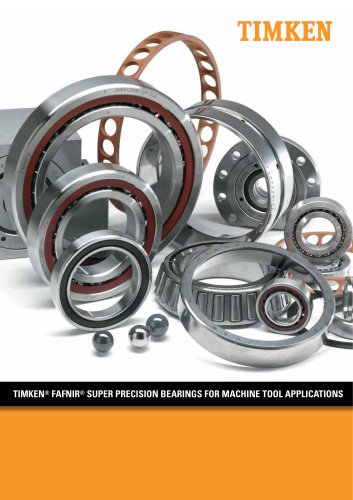
Super Precision Bearings for Machine Tool Applications Catalog

Super Precision Bearings for Machine Tool Applications Catalog
Timken is a prominent provider of friction management solutions, specializing in bearings and related products for machine tool applications. The company focuses on innovation, quality, and enhancing customer performance and productivity.
The catalog details the engineering aspects of bearing selection, including applied loads, bearing reactions, load ratings, permissible operating speeds, lubrication, and run-in procedures. It also addresses heat generation, tolerances, fitting practices, and mounting designs.
Timken offers various styles of precision tapered roller bearings, such as TS, TSF, TXR, and TSHR, in metric and inch sizes, designed for high-performance requirements in rotational accuracy and rigidity.
The catalog introduces super precision ball bearings optimized for high-speed and high-accuracy applications, available in different contact angles and configurations.
Timken provides a comprehensive range of rolling bearings and related products, including tapered, spherical, cylindrical, and ball bearings, along with lubrication and condition monitoring solutions.
Timken is a diversified industrial manufacturer focused on reducing friction and enhancing machinery efficiency, operating globally across various industries.
The catalog includes dimensions, tolerances, and load ratings for various bearing types, offering guidance on fitting practices, internal clearances, and materials.
Timken offers a limited warranty ensuring products are free from defects in material and workmanship for a specified period, detailed in the catalog.
Proper maintenance and handling are crucial to avoid injury. Installation instructions and lubrication must be followed, and bearings should not be spun with compressed air.
The exclusive remedy for warranty claims is product replacement, with Timken replacing products free of charge at the point of shipment. They are not liable for consequential damages.
All products are sold under Timken's Terms and Conditions of Sale, which supersede previous editions.
Shelf life depends on factors like lubricant bleed rates and storage conditions, with guidelines provided for maintaining original packaging and controlling temperature and humidity.
Selection involves considering external loads, operating temperatures, and environmental factors, focusing on rotational accuracy, system rigidity, and service life.
A matrix provides an overview of various bearing types and their performance characteristics, such as load capacity, stiffness, and speed.
These bearings are crucial for machine tools requiring high accuracy, reliability, and productivity, addressing speed, stiffness, accuracy, and load capacity.
Timken bearings meet or exceed industry tolerance standards, ensuring smooth performance, with comparisons between tapered roller bearings and ball bearings.
Enhancements in speed, noise control, and temperature management can be achieved through cage design, material choice, and lubrication.
Timken super precision ball bearings are designed for high accuracy and repeatability, with strict controls over non-specified parameters affecting performance.
The importance of preload in distributing loads among rolling elements and its effect on bearing capacity is explained.
Timken provides a range of precision bearings tailored to meet specific application needs, focusing on enhancing machine tool performance through optimized design and material selection.
The document outlines the calculation of dynamic equivalent axial and radial loads for different types of bearings, including thrust angular contact ball bearings and tapered roller bearings.
Consultation with a Timken representative is emphasized when radial loads are expected or for specific bearing selection advice.
Equations are provided for calculating dynamic equivalent radial loads, considering factors such as the direction of externally applied axial loads and the mounting type.
The document details the calculation of bearing life using the L10 life equation, introducing the Bearing Systems Analysis (BSA) approach.
Several factors influencing bearing life are discussed, including debris life factor, reliability life factor, material life factor, hardness life factor, load zone life factor, and lubrication life factor.
Tables and figures illustrate load equations, reliability factors, and the effects of debris on bearing surfaces.
Oil mist lubrication and metered air/oil systems are discussed for high-speed spindles, with a comparison of various lubrication systems based on cost and speed capabilities.
Run-in cycles for tapered roller bearings and ball bearings are outlined, emphasizing temperature monitoring to prevent overheating.
Special sealing is required to prevent coolant contamination, with grease deflectors or oil collection systems necessary depending on the lubrication method.
Equations are provided to calculate heat generation and dissipation for tapered roller bearings and ball bearings.
The relationship between bearing preload and operating temperature is discussed, emphasizing the need for balance to maintain proper temperatures while achieving desired rigidity.
The internal geometry of bearings significantly affects heat generation, with high-speed designs optimizing internal geometries to balance load capacity, stiffness, and heat generation.
Heat dissipation in ball bearing spindles varies with lubrication methods, with grease lubrication relying on conduction and oil lubrication dissipating heat through both conduction and the oil itself.
Tapered roller bearings are manufactured to specific tolerance classes, differing between inch and metric systems.
The importance of coaxiality and angularity in bearing ring seats is emphasized, with tolerances depending on the bearing class, size, and application.
The shaft fit ensures proper attachment of the inner ring to prevent creeping and wear, with suggested fits for super precision ball bearings provided.
Housings should be made of cast iron or steel, with precise machining to ensure roundness and alignment.
Good spindle accuracy relies on proper design, machining, and fitting practices, with various mounting designs suggested to optimize stiffness, speedability, and assembly ease.
Shafts should be made from hardened steel and ground for balance and accuracy, with locking devices essential for maintaining accurate settings.
The "box-type" mounting uses three bearings, with two nose bearings fixed and a tail bearing floating to accommodate thermal expansion.
Tapered roller bearings are highlighted for their use in fundamental spindle designs, offering specific advantages in certain applications.
Three-support mountings are recommended for heavily loaded or long spindles, with simple mounting involving two single-row bearings.
The spindle is supported by one bearing at the nose and another at the tail, offering a simple isostatic design.
A typical spindle arrangement combines a Hydra-Rib bearing at the tail and a TS bearing at the nose.
These bearings are typically mounted for oil circulation lubrication but can also be designed for grease lubrication.
Back-to-back (DB) mounting provides axial and radial rigidity, suitable for applications with overturning loads.
Used for high-speed applications to maintain consistent load despite temperature changes.
Aligning the high points of runout on bearing components optimizes spindle accuracy.
The operating setting affects spindle performance, including accuracy and dynamic stiffness.
The document discusses the optimization of spindle alignment with housing through bearing spread optimization.
During the initial operation period, radial thermal expansion is not immediately compensated by axial expansion.
Preloading is achieved by grinding stock off the inner and outer ring faces, ensuring compressive forces bring the balls into contact with raceways.
Figures illustrate the effects of different preload conditions on axial and radial deflection for super precision ball bearings.
The document details the Timken bearing part numbering system, which accommodates international standards.
Timken's precision tapered roller bearings are highlighted for their stiffness, load-carrying capacity, and reliability.
The document provides comprehensive technical guidance on bearing optimization, thermal effects, preloading, and selection.
To maintain precision in equipment, it is recommended to replace bearings with those of equivalent precision class as originally specified.
Replacing bearings alone may not restore original accuracy if surrounding components have defects.
Follow the guidelines in the Engineering Section for both replacement and original equipment purposes.
The document details various types of precision tapered roller bearings, including single-row and two-row bearings.
Precision tapered roller bearings are used in machine tools, printing presses, optical grinders, and more.
TS is the basic type, consisting of an inner ring (cone) and an outer ring (cup), often used in opposing pairs.
TDO has a double outer race and two single inner races, often used where overturning moments are significant.
TXR bearings have two sets of races and rollers at right angles, offering high resistance to overturning moments.
TSMA bearings have axial oil holes for lubrication at high speeds.
Timken offers various precision levels and modifications to meet specific application demands.
The document includes detailed tables with dimensions, load ratings, and part numbers for various bearing types.
The document outlines the importance of coaxiality and angularity in bearing ring seats, emphasizing the need for perpendicularity and flatness of shoulders.
The shaft fit ensures proper attachment of the inner ring to prevent creeping and wear.
Housings should be made of cast iron or steel, with precise machining to ensure roundness and alignment.
Good spindle accuracy relies on proper design, machining, and fitting practices.
Shafts should be made from hardened steel and ground for balance and accuracy.
The "box-type" mounting uses three bearings, with two nose bearings fixed and a tail bearing floating to accommodate thermal expansion.
Tapered roller bearings are highlighted for their use in fundamental spindle designs.
Three-support mountings are recommended for heavily loaded or long spindles.
The spindle is supported by one bearing at the nose and another at the tail.
A typical spindle arrangement combines a Hydra-Rib bearing at the tail and a TS bearing at the nose.
These bearings are typically mounted for oil circulation lubrication.
Back-to-back (DB) mounting provides axial and radial rigidity.
Used for high-speed applications to maintain consistent load despite temperature changes.
Aligning the high points of runout on bearing components optimizes spindle accuracy.
The operating setting affects spindle performance.
The document discusses the optimization of spindle alignment with housing through bearing spread optimization.
During the initial operation period, radial thermal expansion is not immediately compensated by axial expansion.
Preloading is achieved by grinding stock off the inner and outer ring faces.
Figures illustrate the effects of different preload conditions on axial and radial deflection for super precision ball bearings.
The document details the Timken bearing part numbering system.
Timken's precision tapered roller bearings are highlighted for their stiffness, load-carrying capacity, and reliability.
The document provides comprehensive technical guidance on bearing optimization, thermal effects, preloading, and selection.
To maintain precision in equipment, it is recommended to replace bearings with those of equivalent precision class as originally specified.
Replacing bearings alone may not restore original accuracy if surrounding components have defects.
Follow the guidelines in the Engineering Section for both replacement and original equipment purposes.
The document details various types of precision tapered roller bearings, including single-row and two-row bearings.
Precision tapered roller bearings are used in machine tools, printing presses, optical grinders, and more.
TS is the basic type, consisting of an inner ring (cone) and an outer ring (cup), often used in opposing pairs.
TDO has a double outer race and two single inner races, often used where overturning moments are significant.
TXR bearings have two sets of races and rollers at right angles, offering high resistance to overturning moments.
TSMA bearings have axial oil holes for lubrication at high speeds.
Timken offers various precision levels and modifications to meet specific application demands.
The document includes detailed tables with dimensions, load ratings, and part numbers for various bearing types.
Catalog excerpts

TIMKEN MACHINE TOOL CATALOG TIMKEN WHERE YOU TURN The world turns to Timken for innovation to move ahead of the comptition. Our contributions to advancing work and living standards - through innovations surrounding friction management and power transmission - are invaluable. We have played a role in virtually all major technologies that have shaped our age, from automobile travel to artificial hearts. You'll find our products wherever you turn - on land, sea and in space. When customers turn to us, they are turning to a worldwide team of highly trained and experienced associates. Because of our...
Open the catalog to page 3
Introduction TECHNOLOGY THATMOVES YOU Today, major industries turn to Timken for our ability to influence the fundamentals of motion through the creation, transfer, and control of power. We invest in people, attracting scholars, engineers and specialists from around the world. We invest in tools - computers, manufacturing equipment and state-of-the-art laboratories. We invest in the future by identifying new concepts that will help Timken and its customers make their mark for years to come. Innovation is one of our core values. The return on our technology investment has grown exponentially....
Open the catalog to page 4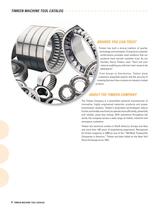
TIMKEN MACHINE TOOL CATALOG BRANDS YOU CAN TRUST Timken has built a strong tradition of quality, i technology and innovation. A long listof customer \ certifications provides solid vidence that our I products have earned customer trust. As our I founder, Henry Timken, said, "Don't set your I name to anything you will ever have cause to be ashamed of." From design to distribution, Timken gives customers expanded options and the security of knowing that each box contains an industry-trusted roduct. ABOUT THE TIMKEN COMPANY The Timken Company is a diversified industrial manufacturer of innovative,...
Open the catalog to page 5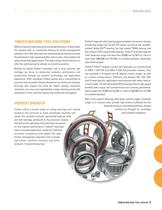
Introduction TIMKEN MACHINE TOOL SOLUTIONS When it comes to improving machine tool performance, Timken leads the industry with an unmatched offering of friction management solutions. Our roller bearings and related products and services set the standard in high-speed spindles, ball screws, rotary tables and other demanding applications. This wide variety means that we can offer the right bearing for almost any machine position. Backed by global Timken innovation and a long machine tool heritage, we focus on enhancing customer performance and productivity through our product technology and application...
Open the catalog to page 6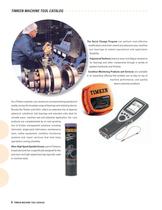
TIMKEN MACHINE TOOL CATALOG The Quick Change Program can perform cost-effective modifications and minor rework procedures to your machine tool bearings to extend operational and application flexibility. Engineered Surfaces improve wear and fatigue resistance for bearings and other components through a variety of applied treatments and finishes. Condition Monitoring Products and Services are available in an expanding offering that enables you to stay on top of machine performance, and quickly detect potential problems. As a Timken customer,you receive an uncompromising standard of quality across...
Open the catalog to page 7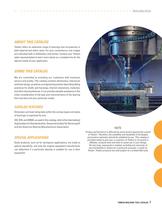
Introduction ABOUTTHIS CATALOG Timken offers an extensive range of bearings and accessories in both imperial and metric sizes. For your convenience, size ranges are indicated both in millimeters and inches. Contact your Timken sales representative to learn more about our complete line for the special needs of your application. USING THIS CATALOG We are committed to providing our customers with maximum service and quality. This catalog contains dimensions, tolerances and load ratings, as well as an engineering section describing fitting practices for shafts and housings, internal clearances, materials,...
Open the catalog to page 8
TIMKEN MACHINE TOOL CATALOG LIMITED WARRANTY We warrantfora period ofone year(unless a shorter period applies to a particularproduct) from the date of shipment that ourproducts shall be free of defects in material and workmanship, as shall be determined by our manufacturing standards, and shall conform to the description on the face of ourquotation orthis acknowledgment. THE WARRANTY DESCRIBED HEREIN SHALL BE IN LIEU OF ANY OTHER WARRANTY, EXPRESS OR IMPLIED, INCLUDING BUTNOT LIMITED TO ANY IMPLIED WARRANTY OF MERCHANTABILITY OR FITNESS FOR A PARTICULAR PURPOSE. The terms contained herein constitute...
Open the catalog to page 9
Introduction SHELF LIFE AND STORAGE OF GREASE-LUBRICATED BEARINGS AND COMPONENTS Timken guidelines for the shelf life of grease-lubricated rolling bearings, components and assemblies are set forth below. Shelf life information is based on test data and experience. Shelf life should be distinguished from lubricated bearing/component service life as follows: Shelf life of the grease-lubricated bearing/component represents the period of time prior to use or installation. The shelf life is a portion of the anticipated aggregate service life. It is impossible to accurately predict service life due...
Open the catalog to page 10
TIMKEN MACHINE TOOL CATALOG Inasmuch as Timken is not familiar with a customer's particular storage conditions, these guidelines are strongly suggested. However, the customer may very well be required by circumstance or applicable government requirements to adhere to stricter storage requirements. Most bearing types are typically shipped protected with a corrosion-preventive compound that is not a lubricant. Such bearings may be used in oil-lubricated applications without removal of the corrosion-preventive compound. When using some specialized grease lubrication it is advisable to remove the...
Open the catalog to page 11
12 TIMKEN MACHINE TOOL CATALOG
Open the catalog to page 13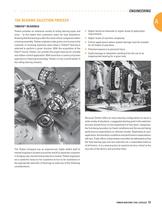
ENGINEERING THE BEARING SELECTION PROCESS TIMKEN® BEARINGS Timken provides an extensive variety of rolling bearing types and sizes - to the extent that customers need not look elsewhere. Knowing that the bearing is often the most critical component within a moving assembly, Timken engineers take great care to ensure the customer is receiving maximum value when a Timken® bearing is selected to perform a given function. With the acquisition of the Fafnir® brand, Timken can provide the proper bearing for virtually any motion-control application. With more than a century of proven experience in bearing...
Open the catalog to page 14All TIMKEN catalogs and technical brochures
 National® Industrial Seals
716 Pages
 TIMKEN® ECOTURN® SEAL
2 Pages
 Timken® Lubricants
6 Pages
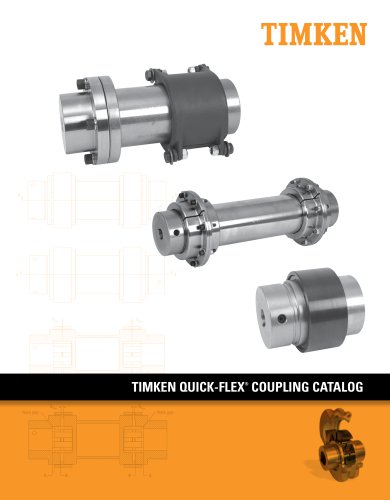
 Quick-Flex Couplings
68 Pages
 Matched Bearing Assemblies
16 Pages
 Cylindrical Roller Bearings
108 Pages
 AP Bearings
84 Pages
 UC Series Ball Housed Units
24 Pages
 Type E Housed Units
40 Pages
 Ball Housed Units
180 Pages
 SNT Plummer Blocks
120 Pages
 SAF Housed Units
126 Pages
 Thrust Bearings
138 Pages
 Quick-Flex Coupling Catalog
68 Pages
 Bearing interchange guide
163 Pages
 UC-SERIES
24 Pages
 Commercial Vehicle Catalog
417 Pages
 Quick-Flex Coupling
64 Pages
 Timken Drives Roller Chain Catalog
112 Pages
 Industrial Maintenance Manual
157 Pages
 Timken SAF Housed Unit Catalog
126 Pages
 Timken Ball Housed Unit Catalog
180 Pages
 Timken® SNT Plummer Block Catalog
120 Pages
 BALL BEARINGS
214 Pages



Archived catalogs
 Timken Engineering Manual
210 Pages
 Timken Ball Bearings Catalog
217 Pages
 COMPETENCYBASED TRAINING
5 Pages
 Spherical Roller Bearings
236 Pages
 Timken Industrial Seals
40 Pages
 Ball Bearings
6 Pages
 IsoClass Bearings
8 Pages
 Maintenance Tools
16 Pages
 Industrial Products
56 Pages
 Precision Rotary Assemblies
2 Pages
 Ceramic Bearings
2 Pages


