


Spherical Roller Bearings

Spherical Roller Bearings
Timken is a global leader in metallurgy, friction management, and mechanical power transmission, offering a wide range of products and services to enhance productivity across various industries. Their offerings include drive train kits, durable housings, couplings, repair services, and roller chains, supported by a global team of 17,000 employees dedicated to improving customer operations.
Timken's spherical roller bearings are engineered to handle heavier loads and faster speeds, meeting the demands for increased equipment uptime and performance. With over a century of experience, Timken provides custom solutions that enhance equipment efficiency and reduce maintenance costs, supported by technical leadership and engineering support.
Timken has evolved from a bearing producer to a supplier of friction management and power transmission solutions. Their material enhancements improve bearing life and protect against debris and corrosion, with precision manufacturing ensuring global consistency and a robust distribution network for easy access worldwide.
Timken's spherical roller bearings offer increased performance, longer life, and lower operating costs due to optimized internal geometries and improved cage and roller piloting design. Their engineering and manufacturing processes adhere to stringent standards, ensuring consistent quality globally.
Timken bearings run cooler than competitors, leading to longer lubricant and bearing life. They have industry-leading load and speed ratings, allowing for higher performance and reliability, with advanced design features contributing to superior performance in demanding applications.
Timken's commitment to innovation, quality, and customer support makes it a trusted partner for industries worldwide. Their spherical roller bearings are engineered to deliver exceptional performance, reliability, and cost-effectiveness.
Timken provides an extensive portfolio of friction-management products and services, adhering to a strict global quality management system. Their bearings, made from high-performance steel, are designed for various applications and industries.
- Tapered Roller Bearings: Suitable for harsh conditions, handling radial and thrust loads with high power density and long life.
- Cylindrical Roller Bearings: Designed to minimize drag and heat, extending equipment life and reducing maintenance costs.
- Spherical Roller Bearings: Capable of handling misalignment, contamination, and high temperatures, offering high load and speed ratings.
- Thrust Bearings: Optimized for axial loads combined with challenging conditions.
- Ball Bearings: Engineered for a wide range of applications, supporting high-speed operations under various load conditions.
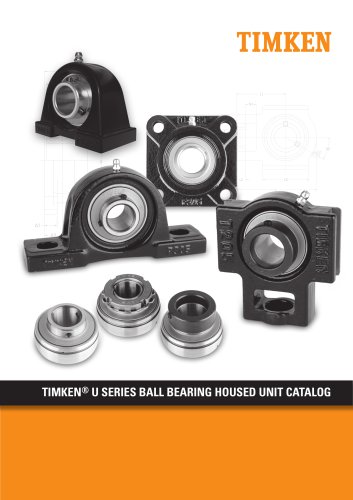
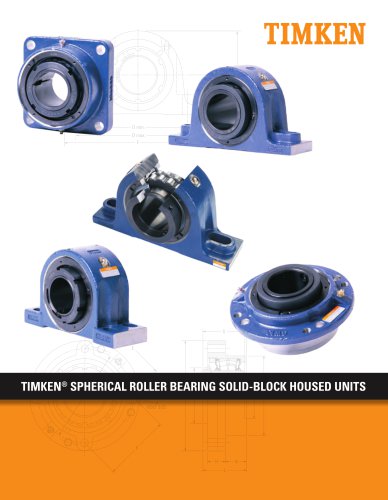
Timken offers a variety of housed units designed to protect bearings in harsh environments, providing benefits like easy maintenance and high protection against contaminants.
Timken's lubricants and lubrication systems are essential for maximizing performance and uptime, offering a range of grease formulations and automated lubrication systems.
Timken provides specialized bearing solutions, including corrosion-resistant and debris-resistant bearings, with unique surface finishes and coatings to enhance performance.
Timken offers components like seals, couplings, and chains designed to withstand extreme conditions and protect machinery.
Timken provides tools and services to extend bearing life and simplify maintenance, including remanufacturing and repair services.
Timken offers training programs for plant professionals, covering all phases of bearing performance with hands-on training and facility tours.
The catalog is designed to help users find suitable bearings, with guidelines on shelf life and storage, emphasizing the importance of proper storage to maintain product integrity.
Timken recommends keeping products in original packaging until use, avoiding damage to packaging, and adhering to storage guidelines to ensure product longevity.
- Products should be placed into service promptly after removal from packaging.
- Bulk pack containers should be resealed immediately after removing a product.
- Do not use products beyond their shelf life; consult a Timken sales engineer for shelf life limits.
- Maintain storage temperatures between 0º C (32º F) and 40º C (104º F) with minimal fluctuations.
- Keep relative humidity below 60% and surfaces dry.
- Ensure the storage area is free from contaminants and isolated from vibrations.
- Avoid extreme conditions.
- Most bearing components are shipped with a corrosion-preventive compound, which is not a lubricant.
- For oil-lubricated applications, the compound need not be removed, but it should be removed for some specialized grease applications.
- Avoid excessive force during mounting or dismounting.
- Follow all tolerance, fit, and torque recommendations.
- Ensure proper alignment and never weld housed units.
- Do not heat components with an open flame or operate at temperatures above 250˚ F (121˚ C).
- Timken products are subject to various regulatory standards including REACH, RoHS, ATEX, and CE Marking.
- Consult Timken sales engineers for compliance information.
- Proper maintenance and handling are critical to avoid risks of injury or damage.
- Timken offers various spherical roller bearing designs with different cage types for specific applications.
- Optional features include lubrication grooves and oil holes for enhanced lubrication.
- Specific designs are available for vibratory applications with reduced tolerances and specific clearances.
- Metric system tolerances are provided for spherical roller bearings, detailing deviations and runout specifications.
- Tables summarize specifications and classes for spherical roller bearings, including boundary dimension tolerances.
The document provides detailed specifications for the inner ring of RIC reduction on tapered shafts. It includes measurements for minimum permissible RIC after installation for various taper ratios (1:12 and 1:30) and different bearing sizes ranging from 20 mm to 1000 mm. The specifications are presented in both metric and imperial units.
The document outlines a step-by-step procedure for mounting, fitting, setting, and installing spherical roller bearings. Key steps include:
- Measuring unmounted radial internal clearance (RIC) using a feeler gauge.
- Confirming RIC values against specifications using provided tables.
- Calculating suggested RIC reduction due to installation.
- Determining maximum and minimum RIC after mounting.
- Evaluating mounted RIC against minimum permissible RIC after installation.
The document advises consulting a Timken sales engineer for specific cases involving non-steel shaft materials or thin-walled shafts. It also provides guidance on using tables to determine shaft and housing fits, and calculating resultant fits and RIC reductions.
Two examples are provided to illustrate the calculation of RIC reduction using spherical roller bearings with tapered and cylindrical bores. These examples include detailed calculations for determining unmounted and mounted RIC, as well as evaluating fit selections.
The document emphasizes the importance of confirming RIC designation selection against operating speeds, particularly for bearings operating at speeds exceeding 70% of the thermal speed rating. It also suggests using the heat expansion method for installing cylindrical bore bearings to achieve a tight interference fit on the shaft.
Two primary methods are used for heating bearings: a tank of heated oil and induction heating. The oil should not exceed 121°C (250°F), with 93°C (200°F) being sufficient for most applications. Induction heating is rapid but should not exceed 93°C (200°F). Bearings should be heated for 20-30 minutes until they expand enough to slide onto the shaft easily. Thermal crayons can be used to check temperatures.
When using a tight fit inner ring, the assembly method depends on whether the bearing has a cylindrical or tapered bore. Cleanliness is crucial, and the environment should be free from dust and moisture. All components should be cleaned and inspected for dimensional accuracy before installation.
Shaft surfaces must be clean and free from nicks and burrs. For stationary housing and rotating shaft applications, a ground finish of 1.6 µm (65 µin.) Ra maximum is recommended. Housing bores should be finished to 3.2 µm (125 µin) Ra maximum.
Never apply pressure to the outer ring for a shaft press fit or to the inner ring for a housing press fit. Avoid using steam or hot water for cleaning bearings to prevent rust. Do not heat bearings beyond 149°C (300°F). The arbor press method is suitable for smaller bearings, using a soft steel tube slightly larger than the shaft.
Use a feeler gauge to measure the reduction in radial internal clearance (RIC) during installation. Lubricate the tapered shaft with machine oil and slide the bearing onto the shaft. Tighten the locknut to achieve the desired interference fit and RIC reduction.
Tables provide guidelines for specifying shaft and housing fits based on operating conditions. Different fits are recommended for various load conditions and applications, such as stationary inner ring loads, rotating inner ring loads, and very heavy loads.
3D models and 2D drawings are available for download at cad.timken.com.
The document provides detailed specifications for Timken spherical roller bearings, including tolerance ranges, shaft and housing fits, and operating temperature limits. Tolerances are shown as variances from nominal bearing outer diameters, with specific ranges provided for different bearing sizes.
Guidelines for specifying shaft and housing fits are outlined, with charts provided for different operating conditions. The document emphasizes the importance of considering temperature effects on bearing performance and equipment design.
The document references DIN Standard 623 for bearing stability designations and provides maximum operating temperatures for different stability levels (S0 to S4). It also includes ASTM standards for material specifications.
Recommendations are given for material selection based on operating temperatures, with tables listing suitable materials, chemical compositions, and hardness levels. The document advises consulting Timken sales engineers for non-standard heat stability or high-temperature steel grades.
- Tolerance ranges are specified from +0 to listed values.
- Maximum operating temperatures for stability designations range from 150°C (302°F) to 350°C (662°F).
- Material recommendations include low-alloy carbon-chromium steels and corrosion-resistant stainless steels, with specific hardness and dimensional stability data.
- Bearings should not exceed specified temperature limits to maintain performance and dimensional stability.
- Lubrication limitations are discussed, highlighting the impact of temperature on grease performance.
- Equipment designers must consider temperature effects on precision and thermal expansions, with prototype testing recommended to define operating temperature ranges.
ISO Viscosity System
This section outlines the ISO viscosity system for industrial oils, focusing on general-purpose rust and oxidation (R&O) lubricating oils and industrial extreme-pressure (EP) gear oils.
These oils are commonly used in industrial applications for lubricating Timken bearings. They are made from solvent-refined, high viscosity-index petroleum oil with corrosion and oxidation inhibitors. The viscosity index is a minimum of 80, with a pour point of -10°C (14°F). Viscosity grades range from ISO/ASTM 32 to 220, with higher grades suitable for low-speed/high-temperature applications and lower grades for high-speed/low-temperature applications.
Used for heavily loaded industrial equipment, these oils must withstand abnormal shock loads. They are composed of highly refined petroleum oil with corrosion, oxidation inhibitors, and EP additives. The viscosity index is also a minimum of 80, with a pour point of -10°C (14°F). Viscosity grades range from ISO/ASTM 100 to 460, with higher grades for high-temperature/slow-speed applications and lower grades for low-temperature/high-speed applications.
Grease lubrication is suitable for low-to-moderate speed applications. Greases consist of a base oil, thickening agent, and additives. Common thickeners include lithium, aluminum, and calcium compounds, each with specific properties like water resistance and temperature stability. Synthetic greases offer advantages in wide temperature ranges, from -73°C (-100°F) to 288°C (550°F).
Contamination from abrasive particles and water can significantly reduce bearing life. Greases like calcium and aluminum-complex are highly water-resistant. Grease selection should consider consistency, temperature stability, and resistance to chemical reactions. Timken offers a range of application-specific greases for various industrial needs.
Proper grease application is crucial, with the bearing cavity typically kept one-third to one-half full to avoid excessive heat generation. Relubrication should occur at regular intervals to maintain bearing performance.
Timken provides a range of lubricants designed for industrial operations, including high-temperature, anti-wear, and water-resistant additives. Grease is preferred over oil for ease of use in bearing lubrication, requiring periodic relubrication. Proper grease application involves packing it between rolling elements, with specific methods for tapered roller bearings.
Grease can be applied by hand or using a mechanical grease packer. The relubrication cycle depends on operating temperature and sealing efficiency. High temperatures and inefficient seals necessitate more frequent regreasing. Grease should be replaced when contaminated or degraded.
Grease consistency varies and is measured by penetration number. The NLGI classification provides a standard for grease grades. Compatibility between different grease types is crucial to avoid improper lubrication.
Polyurea and lithium-based greases are recommended for general-purpose lubrication, especially in moist environments. Grease selection should consider consistency, operating temperature, and the presence of extreme pressure additives for heavy loads.
Lithium, lithium complex, and calcium sulfonate greases are suitable for various applications. They should be smooth, homogeneous, and free from corrosive materials. The viscosity of the base oil should match the application speed and load.
For high-speed applications, lighter base oil viscosity is recommended, while heavier viscosity is suitable for low-speed applications. Grease fill should be adjusted based on application speed and housing void.
Thermal Reference Speed is based on ISO 15312 standards, balancing heat generation and conduction. Limiting Speed considers cage behavior and material wear. Both speeds require specific conditions and may need consultation with a Timken engineer for applications exceeding catalog values.
Timken's spherical roller bearings are designed for high radial loads and consistent performance under challenging conditions. They feature superior design and technical support, with specific nomenclature and modification codes for various applications.
Timken provides high-performance plummer block housings designed for heavy-duty applications. These housings are engineered for easy assembly and disassembly, featuring split construction and alignment aids. They are suitable for shaft sizes ranging from 20 to 400 mm and are used in various industrial applications such as conveyors and rolling mills.
Timken's plummer block housings are available for both tapered and cylindrical bore bearings. They are constructed from high-grade cast iron, with options for steel and ductile iron. The housings are precision-fitted with dowel pins to ensure a precise fit and are not interchangeable as separate parts.
Plummer blocks can be mounted using either tapered adapter sleeves or directly on shouldered shafts. The adapter mount allows for flexibility in axial positioning and accommodates light thrust loads. For heavy thrust loads, a direct straight bore mounting is recommended.
Timken offers various sealing options to protect bearings, including double-lip, V-ring, labyrinth, and taconite seals. Each seal type is designed to meet specific application needs, with considerations for temperature, speed, and contamination resistance.
The housings are designed for grease lubrication but can be modified for oil systems. Bearings with lubrication grooves should have fresh lubricant fed directly to the center to ensure proper distribution.
Proper installation is crucial for optimal performance. The process involves cleaning the work area, checking shaft specifications, aligning the housing, and ensuring correct seal installation. Detailed steps are provided for mounting housings with double-lip seals.
Load ratings for spherical roller bearings are provided, and the ability of the plummer block to carry the load should be considered. For non-standard conditions, consultation with a Timken sales engineer is recommended.
1. General Preparation:
Ensure the work area is clean and the shaft seat is dimensionally accurate. The shaft should be free from imperfections, and the surface roughness of the support surface should not exceed Ra ≤ 12.5 μm. Ensure flatness within specified limits.
- Position the housing on the support surface and fit attachment bolts without tightening.
- Mount the labyrinth ring and bearing on the shaft, filling the bearing with grease.
- Install the shaft with bearing and labyrinth rings in the housing base.
- Align the housing base using vertical markings and tighten the attachment bolts.
- Install the cap onto the base and tighten the cap bolts to the specified torque.
- Insert the hollow O-ring cord in the grooves of the labyrinth rings.
- Position the housing and fit attachment bolts without tightening.
- Arrange the V-ring with sealing washer on the shaft.
- Mount the bearing and fill it with grease.
- Install the shaft with bearing and sealing washers in the housing base.
- Align the housing base and tighten the attachment bolts.
- Install the cap onto the base and tighten the cap bolts.
- Coat the V-ring counterfaces with grease and push the V-ring seals into position.
- Position the housing and fit attachment bolts without tightening.
- Mount the first V-ring and labyrinth ring on the shaft.
- Mount the bearing and fill it with grease.
- Install the shaft with bearing and seals in the housing base.
- Align the housing base and tighten the attachment bolts.
- Install the cap onto the base and tighten the cap bolts.
- Rotate the shaft and supply grease until it purges from the labyrinth rings.
- Proper maintenance and handling are critical to avoid risks of injury or equipment damage.
- Overheated bearings can ignite explosive atmospheres; special care is needed in such environments.
- Do not use damaged housed units.
- For normal applications, fill the bearing void to 100% and housing void to 40-60%.
- For low-speed applications, fill the housing void to 60-100%.
- For high-speed applications, fill the housing void to 30-40%.
- Detailed torque specifications for cap and attachment bolts are provided in the table.
- Basic numbers for ordering plummer block housings and components are listed, including options for cast iron, cast steel, and ductile iron housings.
- Housings are available in cast iron, with options for cast steel (prefix 'S') or ductile iron (prefix 'D').
- Each housing includes a cap, base, and cap bolts.
- Locating rings, adapter sleeve assemblies, and seals are specified for each housing type.
- Locating Rings: Minimum two required for fixed position, sold individually.
- Adapter Sleeve Assembly: Includes sleeve, locknut, and lockwasher.
- Seals: Labyrinth, taconite, double-lip, and V-ring seals are available, with specific packaging details.
- Dimensions and mass are provided for both two-bolt and four-bolt housings, with detailed measurements for each component.
- Tables list dimensions such as A, A1, A2, A3, H, H1, H2, J, J1, J2, L, N, N1, and G in millimeters, along with housing mass in kilograms.
- Basic numbers for ordering plummer block housings and components are listed in tables.
- Specific part numbers are provided for different shaft diameters and housing types.
- 3D models and 2D drawings are available for download at cad.timken.com.
Timken provides engineering and manufacturing capabilities for heavy-duty pillow blocks, offering benefits such as expert consultation for applications involving large shaft sizes. The catalog covers sizes from 1.37795 to 11.811 inches (35-300 mm) and special sizes up to 1000 mm. Applications include conveyors, mining, and heavy structures. Features include split construction for easy assembly and disassembly, with benefits like quick cap removal without damage.
Timken's pillow blocks are available with tapered or cylindrical bore bearings. The split construction allows for easy maintenance, and the units are doweled for precise fit. Standard materials include high-grade cast iron, with options for cast steel. Most blocks use four-bolt mounting to ensure stability and prevent lubricant loss.
Spherical roller bearing pillow blocks can be mounted on straight shafts using tapered bore bearings and adapters, allowing flexibility in axial positioning. For heavy thrust loads or precise axial location, direct straight bore mounting is recommended. Fixed and float positions are available, with stabilizing rings used for fixed positions.
Pillow blocks are designed for grease and oil-bath lubrication, with options for circulating oil systems. Triple-ring labyrinth seals help retain lubricants and exclude contaminants. For harsh environments, DUSTAC® seals offer additional protection.
Load ratings are provided in the catalog, with life calculation formulas available in the Engineering Manual. Proper mounting procedures are crucial to avoid excessive heating and reduced performance.
The catalog provides detailed specifications for SAF225 and SAF226 series, including assembly components and options for fixed or float units. Assemblies are typically cast iron, with options for cast steel or ductile iron. Four-bolt bases are standard unless noted otherwise.
- Tapered-bore bearings can be mounted on adapter sleeves or directly on tapered shaft seats. Proper fit is crucial to avoid issues like turning of the bearing inner race, uneven loading, severe inner race hoop stress, and insufficient support.
- Accurate shaft taper measurement is essential, with ring gages and sine bar gages being the two accepted methods.
- Sine bar gages are preferred for their precision and ease of use, especially for large shafts.
- Sine bar gages are available in various sizes for 1:12 and 1:30 shaft tapers, including 3 inch to 14 inch for 1:12 tapers and 4 inch to 12 inch for 1:30 tapers.
- Each set includes sine bar gages, a sine bar saddle, a web clamp, and optionally, a wooden box.
- Consultation with a Timken sales engineer is recommended for specific needs and availability.
- The document includes a table listing sine bar sizes and their corresponding bearing part numbers, indicating compatibility with various tapered bore bearings.
- An extensive index of metric and inch accessories for spherical roller bearings is provided, detailing adapter sleeves, withdrawal sleeves, and hydraulic nuts for different bearing bores.
- Ensure precise manufacturing and maintenance of shaft tapers to prevent premature bearing wear.
- Use sine bar gages for accurate measurement of shaft size and taper.
- For additional sizes and specific requirements, contact a Timken sales engineer.
The document provides detailed specifications for various components related to spherical roller bearings and hydraulic nuts. It includes measurements in both metric and inch units, covering dimensions such as diameter, length, and thread specifications.
Instructions are provided for selecting appropriate shaft limits and dimensions for specific applications. The document references additional tables for further guidance on shaft limits.
The document adheres to American National Threads Class 3 for certain components and Acme General Purpose Threads Class 3G for others. Tolerances for specific dimensions are also specified.
Recommendations include consulting additional tables for shaft limits and ensuring compatibility with specified thread classes.
The document includes tables listing part numbers, dimensions, piston lengths, areas, and weights for HMVC hydraulic nuts. Key data points include major diameter, thread count, and assembly weight.
The document is part of the Timken Spherical Roller Bearing Catalog, which offers downloadable 3D models and 2D drawings. It highlights Timken's expertise in improving machinery reliability and performance across various markets.
Catalog excerpts

Timken Spherical Roller Bearing Catalog
Open the catalog to page 1
SPHERICAL ROLLER BEARING METRIC ACCESSORIES NOTES TIMKEN SPHERICAL ROLLER BEARING CATALOG
Open the catalog to page 2
TIMKEN OVERVIEW SPHERICAL ROLLER BEARING CATALOG INDEX TIMKEN OVERVIEW. . . . . . . . . . . . . . . . . . . . . . . . . . . . . . . . . . . . . . . . . 2 INTRODUCTION . . . . . . . . . . . . . . . . . . . . . . . . . . . . . . . . . . . . . . . . . . . . 4 SHELF LIFE POLICY . . . . . . . . . . . . . . . . . . . . . . . . . . . . . . . . . . . . . . . . 12 ENGINEERING . . . . . . . . . . . . . . . . . . . . . . . . . . . . . . . . . . . . . . . . . . . . 15 Bearing Types and Cages . . . . . . . . . . . . . . . . . . . . . . . . . . . . . . . . . . . 16 Metric System Tolerances . . . . . . . ....
Open the catalog to page 3
TIMKEN OVERVIEW GROW STRONGER WITH TIMKEN Every day, people around the world count on the strength of Timken. Our expertise in metallurgy, friction management and mechanical power transmission helps them accelerate improvements in productivity and uptime. We supply products and services that can help keep your operations moving forward, whether you need drive train kits for commercial vehicles, durable housings for bearings in dirty environments, couplings that avoid metal-to-metal contact between motors and gearboxes, repair services for bearings and gearboxes, roller chain for dry, abrasive...
Open the catalog to page 4
TIMKEN OVERVIEW INCREASE YOUR EQUIPMENT UPTIME In addition to high-quality bearings and mechanical power transmission components, we provide valuable integrated products and services. For example, we offer repair services, on-site technical support and industrial services for inspecting, repairing and upgrading gearboxes, electric motors and controls. Additionally, we offer a broad selection of seals, premium lubricants, lubricators, couplings and chain to keep your operations moving smoothly. Our 12 technology centers in the United States, Europe and Asia help pioneer tomorrow’s innovations...
Open the catalog to page 5
SPHERICAL ROLLER BEARING INTRODUCTION INDUSTRIAL INNOVATOR Today, manufacturing and s support at their plants, and processing equipment handle o options for additional support from heavier loads, faster speeds and app application engineers who specialize e. greater expectations than ever before. var in a variety of industrial applications. ents As finished-product quality requirements increase, producers continue to place a very high CORE CAPABILITIES premium on equipment uptime and performance. Timken has evolved from its early roots as a bearing Timken has more than a century of experience developing...
Open the catalog to page 6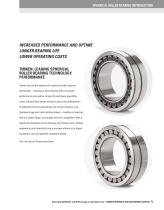
SPHERICAL ROLLER BEARING INTRODUCTION INCREASED PERFORMANCE AND UPTIME LONGER BEARING LIFE LOWER OPERATING COSTS TIMKEN. LEADING SPHERICAL ROLLER BEARING TECHNOLOGY, PERFORMANCE Timken has set the standard for spherical roller bearing technology – resulting in bearings that offer increased performance and uptime, longer life and lower operating costs. Industry best design practices led to the development of optimized internal geometries and surface finishes, and improved cage and roller piloting design – resulting in bearings that run cooler, faster, and longer than the competition. With a significant...
Open the catalog to page 7
SPHERICAL ROLLER BEARING INTRODUCTION ADVANCED BEARING AND CAGE DESIGN Type EJ Bearing Design Increased Performance Stronger Results Above pitch cage design increases cage stiffness. Reduces stress under shock loading or high acceleration conditions. Cage pocket guides roller.* Eliminates the need for a center guide ring – reducing friction and lowering bearing operating temperatures. Hardened cage on all sizes.* Provides wear resistance and fatigue strength at higher levels. Face slots in cage.* Provides better oil lubricant flow and contaminant purging, and reduces weight. Better able to handle...
Open the catalog to page 8
SPHERICAL ROLLER BEARING INTRODUCTION BROADEST RANGE IN THE INDUSTRY, 25MM BORE TO 1250MM BORE Timken offers the broadest range of sizes in both steel cage and brass cage designs for spherical roller bearings. Bore (mm) Cage ▶ Brass Steel Brass Steel Brass Steel Brass Steel Brass Steel Brass Steel Brass Steel Brass Steel Brass Steel Brass Steel Brass Steel Download 3D Models and 2D Drawings at cad.timken.com. • TIMKEN SPHERICAL ROLLER BEARING CATALOG
Open the catalog to page 9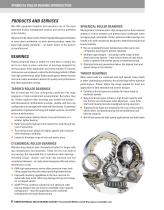
SPHERICAL ROLLER BEARING INTRODUCTION PRODUCTS AND SERVICES We offer equipment builders and operators one of the most extensive friction-management product and service portfolios in the industry. We also strictly adhere to the Timken Quality Management System in every plant worldwide, so each bearing product meets the same high quality standards – no matter where in the world it is manufactured. BEARINGS Putting advanced ideas in motion for more than a century has led to our best-in-class collection of bearings designed for every purpose, every application and every industry. If it moves, chances...
Open the catalog to page 10
SPHERICAL ROLLER BEARING INTRODUCTION BALL BEARINGS From electric motors to agricultural implements to food processing equipment, Timken ball bearings are engineered to perform in a wide range of applications and conditions. Radial ball bearings tolerate relatively high-speed operation under various load conditions Angular contact ball bearing designs include contact angles that support both radial and axial loads HOUSED UNITS SNT/SAF PLUMMER (PILLOW) BLOCK HOUSED UNITS Customizable design, interchangeable components and reliable spherical roller bearings deliver the heavy-duty performance that...
Open the catalog to page 11
SPHERICAL ROLLER BEARING INTRODUCTION HIGH-PERFORMANCE BEARING SOLUTIONS Timken provides a variety of high-performance bearing solutions, including Timken® AquaSpexx®, DuraSpexx® and thin dense chrome bearings for corrosion protection. Our debrisresistant bearings are ideal for contaminated and/or marginal lubrication conditions. We also provide customized bearing solutions such as special race profiles to meet special application requirements. In addition to component geometry and metallurgy, we find many ways to enhance bearing performance by applying unique surface finishes and special coatings...
Open the catalog to page 12All TIMKEN catalogs and technical brochures
 National® Industrial Seals
716 Pages
 TIMKEN® ECOTURN® SEAL
2 Pages
 Timken® Lubricants
6 Pages
 Quick-Flex Couplings
68 Pages
 Matched Bearing Assemblies
16 Pages
 Cylindrical Roller Bearings
108 Pages
 AP Bearings
84 Pages
 UC Series Ball Housed Units
24 Pages
 Type E Housed Units
40 Pages
 Ball Housed Units
180 Pages
 SNT Plummer Blocks
120 Pages
 SAF Housed Units
126 Pages
 Thrust Bearings
138 Pages
 Quick-Flex Coupling Catalog
68 Pages
 Bearing interchange guide
163 Pages
 UC-SERIES
24 Pages
 Commercial Vehicle Catalog
417 Pages
 Quick-Flex Coupling
64 Pages
 Timken Drives Roller Chain Catalog
112 Pages
 Industrial Maintenance Manual
157 Pages
 Timken SAF Housed Unit Catalog
126 Pages
 Timken Ball Housed Unit Catalog
180 Pages
 Timken® SNT Plummer Block Catalog
120 Pages
 BALL BEARINGS
214 Pages



Archived catalogs
 Timken Engineering Manual
210 Pages
 Timken Ball Bearings Catalog
217 Pages
 COMPETENCYBASED TRAINING
5 Pages
 Timken Industrial Seals
40 Pages
 Ball Bearings
6 Pages
 IsoClass Bearings
8 Pages
 Maintenance Tools
16 Pages
 Industrial Products
56 Pages
 Precision Rotary Assemblies
2 Pages
 Ceramic Bearings
2 Pages


