


Industrial Maintenance Manual

Industrial Maintenance Manual
This manual provides essential guidelines for the maintenance and handling of industrial bearings, emphasizing the importance of proper practices to prevent equipment failure and ensure safety.
Failure to follow maintenance instructions, such as proper lubrication and handling, can lead to equipment failure and serious injury. Specific warnings include avoiding spinning bearings with compressed air and not disassembling unitized bearings.
Proper handling and inspection are crucial for maintaining bearing performance and longevity. This includes careful storage, removal, cleaning, and inspection of bearings to prevent damage and ensure reliability.
Bearings should be stored in a dry environment, away from moisture and temperature fluctuations, to prevent rust and corrosion. They should remain in their protective packaging until installation.
Bearings must be removed with care to avoid damage. Various tools, such as pullers, can assist in this process. Heating methods can be used for tight fits, but extreme heat should be avoided to prevent altering the bearing's properties.
After removal, bearings should be thoroughly cleaned using appropriate solutions to remove contaminants. Inspections should be conducted to check for damage and wear, ensuring bearings are within tolerance specifications.
Bearing installation should only occur when ready to mount, keeping them in packaging until then to protect against contamination.
Proper tools and lubrication are critical for maintaining bearing performance. Timken provides a range of products and services, including condition monitoring and repair services, to support maintenance efforts.
Adhering to the guidelines in this manual will help extend the life of bearings and improve equipment performance, reducing downtime and maintenance costs.
When installing new bearings, retain the manufacturer's lubricant and preservatives to protect against corrosion and fingerprints. Ensure a clean environment free from contaminants during installation. Plan the installation process by confirming the correct replacement bearing, necessary components, and tools, including lubricants if required. This preparation minimizes exposure to contamination and handling damage.
Do not disassemble unitized bearings. Remove oil or rust inhibitors before heating parts to prevent fire hazards. Use mild steel bars for installation or removal to avoid high-speed fragment release. Check for burrs on ring seats and backing surfaces to prevent damage.
Bearings may become damaged due to improper handling or wear. Damaged bearings can often be repaired or refurbished. If a bearing is damaged prematurely, analyze the damage for insights.
Thoroughly clean machine components near the installation site, focusing on mounting surfaces and housings. Ensure shafts are clean and free from nicks or burrs. Repair damaged housing or shafts using fitted sleeves or metal spray.
For tight fits, heat bearings or housings to expand them for easier installation. Use methods like oil baths or induction heaters, ensuring temperatures do not exceed 120ºC (250ºF). Avoid direct contact with heat sources and allow sufficient soak time for even heating.
Follow specific temperature limits for heating or cooling bearings to prevent metallurgical changes. Avoid using torches for heating as they can cause irreparable damage.
Use an arbor press and mounting tube for smaller bearings. Ensure the tube is clean and properly sized to avoid contact with rolling elements. Apply steady pressure to press the bearing into place.
Bearing clearance, or preload, is crucial for accommodating thermal growth and misalignment. Tapered roller bearings allow for adjustable clearance, while other types have predefined settings.
Internal clearance settings vary by bearing type and application. Tapered roller bearings offer flexibility in setting clearance for optimal performance. Radial ball bearings have standard practices for assembly with specific clearances.
Internal clearance is crucial for absorbing the effects of press fitting bearing rings during mounting. It compensates for thermal expansion and provides a contact angle post-mounting. Radial measurement is preferred as it relates directly to shaft and housing fits, as prescribed by the American Bearing Manufacturers Association (ABMA).
RIC is defined as the average outer ring raceway diameter minus the average inner ring raceway diameter minus twice the ball diameter. It is measured by moving the outer ring horizontally, with multiple readings taken for accuracy. The document provides a detailed table of acceptance limits for various bore diameters and clearance designations (C2, C0, C3, C4, C5) according to Timken and ABMA standards.
End play is an alternative method for measuring internal clearance, used in special applications. It involves clamping one ring and applying a reversing load to the other, measuring the total movement parallel to the bearing axis.
For spherical roller bearings with tapered bores, a greater interference fit is required, reducing RIC. An example calculation shows how to adjust RIC after mounting, considering factors like shaft material and interference fit. The document emphasizes consulting with Timken representatives for specific applications.
The document includes extensive tables detailing radial internal clearance limits for various bearing sizes and types, both cylindrical and tapered bores. These tables provide minimum and maximum values for different clearance codes, aiding in selecting the appropriate bearing for specific applications.
Cylindrical roller bearings are available with different Radial Internal Clearance (RIC) designations, such as Timken 'R' Clearance or ISO/ABMA 'C' Clearance. The clearance required depends on the operating precision, speed, and fitting practice. Standard clearances are listed based on bore size, with larger clearances reducing the operating zone and increasing roller load but reducing bearing life.
The document outlines a 12-point measurement procedure for inspecting bearing journals or housing bores. This involves using two-point gauges accurate to 0.002 mm or 0.0001 inches, measuring the shaft at four positions (0°, 45°, 90°, 135°) across three planes. Measurements are recorded and compared to suggested tolerance limits to evaluate diameter size, roundness, and taper.
Timken suggests consulting engineers for unique applications or special operating conditions. The document emphasizes the importance of machining supporting elements like journals, housings, and shafts to appropriate dimensions to ensure bearing longevity. It also provides guidelines for surface finishes and tolerances for shafts and housings, referencing ABMA Standard 7 for radial ball, spherical, cylindrical, and metric series tapered roller bearings.
The tables provide minimum and maximum values for RICs across different bore sizes, indicating the expected range of mounted RIC following suggested push-up values. For example, for a bore size of 100-120 mm, the C0 clearance ranges from 0.015 mm to 0.090 mm.
Proper installation and maintenance practices are crucial for bearing performance and life. The working environment must be clean, and accepted care and handling techniques should be used during bearing installation and removal. Mating component geometry and materials should meet industry standards.
After cleaning, inspect bearings, housing, and shaft to determine if they can be reused or need replacement. Replace bearings showing fatigue spalling, heat discoloration, rust, damaged cage, or noticeable wear. Inspect all components closely, especially the outer and inner rings for nicks or burrs, and the race for unusual wear or spalls. Use a metal probe to check for damage in smaller bearings. Larger bearings may require removal of inspection rollers for thorough inspection. Seals should also be inspected and replaced if worn or damaged.
Bearings can be damaged through improper handling or normal wear. Timken provides resources for analyzing bearing damage and offers repair services for large bearings, potentially saving up to 60% of replacement costs.
Do not remove bearings from packaging until ready to mount. Ensure housing and shaft are not damaged. Proper fit is crucial; rotating rings require a tight fit, while stationary rings may have a loose fit. Use proper drivers to press inner rings onto shafts, avoiding misalignment and cage damage. Outer rings can be pressed into housing with a driver. Heating bearings can ease installation, but temperatures should not exceed specified limits.
Timken tapered roller bearings allow for setting adjustments to optimize performance. Preload or end play settings depend on application requirements. Measure preload by reading torque from shaft rotation. For end play, use a dial indicator to measure axial movement. Adjust bearings using threaded shafts with nuts or housing with outer ring followers.
Fixtures can determine the required shim amount for bearing adjustments. Measure the distance from the outer ring back face to the housing face and compare with the outer ring follower to determine shim pack requirements.
For applications requiring a spacer between inner rings, measure the spacer length using a specific method to ensure accurate bearing adjustment. Calculate the spacer width using the formula provided, considering desired end play or preload.
This document is an excerpt from the Industrial Bearing Maintenance Manual, focusing on the installation and maintenance of spherical and cylindrical roller bearings. It provides detailed procedures for mounting bearings, calculating radial internal clearance (RIC), and ensuring proper fit and function.
Installation Procedure:
1. Position the roller at the top of the inner ring on both sides of the bearing.
2. Use a feeler gauge to measure the radial internal clearance (RIC) before installation.
3. Lubricate the tapered shaft and slide the bearing onto it.
4. Tighten the locknut to achieve the desired interference fit, monitoring RIC reduction.
5. Ensure the remaining RIC meets or exceeds the minimum mounted clearance.
6. Secure the lockwasher tang into the locknut slot.
For a bearing number 22328K C3, the initial RIC is 0.178 mm. The suggested RIC reduction is between 0.065 to 0.090 mm. After installation, the RIC should be 0.101 mm.
Mounting Options:
- Adapter mounts allow flexibility in axial positioning and accommodate light thrust loads.
- Direct straight bore mounting is recommended for heavy thrust loads or precise axial location.
- Fixed position requires a stabilizing ring to prevent axial movement.
- Float position allows axial movement to compensate for thermal expansion.
Types and Applications:
- One-row, two-row, and four-row cylindrical bearings are available, each suited for different applications.
- Commonly used in industries such as pulp and paper, power generation, and mining.
- Bearings can have separable inner and outer races, offering high radial load capacity.
- Bearings are packaged to protect against dirt and moisture.
- Do not remove bearings from packaging until ready for installation to prevent contamination.
This manual provides comprehensive guidelines for the proper installation and maintenance of roller bearings, emphasizing the importance of correct RIC measurement and adjustment to ensure optimal bearing performance.
- Cleaning and Installation: Refer to the General Bearing Handling and Inspection Section for proper cleaning and installation techniques for anti-friction bearings.
- Mounting Cylindrical Bore Bearings: Different methods are used depending on the bearing size and application. Key rules include ensuring cleanliness, planning the work, and inspecting and preparing all components.
- Heat Expansion Method: Used for tight interference fits on shafts. Bearings can be heated using a tank of heated oil or induction heating, ensuring temperatures do not exceed 120˚C (250˚F).
- Arbor Press Method: Suitable for smaller bearings, involves pressing the bearing onto the shaft or into the housing using an arbor press and a mounting tube.
- Shaft and Housing Finish: Surfaces must be clean and free from nicks. Specific finish recommendations are provided based on the application.
- Thrust Bearings: Designed for heavy thrust loads, with various types available including ball, spherical roller, cylindrical roller, and tapered roller thrust bearings.
- Shaft and Housing Fits: Guidelines are provided for shaft and housing fits related to operating conditions, including tolerance symbols and examples of applications.
- Thrust Bearings Specifications: Includes sizes and applications for different types of thrust bearings.
The document provides detailed specifications for various types of bearings, including KRR, G-KRR, RA-RR, GRA-RR, and GYA-RR types. It lists shoulder diameters, housing bore dimensions, and fit tolerances for different bearing models. The specifications include both metric and imperial measurements, highlighting maximum and minimum dimensions for loose and tight fits.
The document outlines procedures for handling, cleaning, and installing bearings. It emphasizes the importance of maintaining cleanliness and proper handling to prevent contamination. Installation guidelines are provided, including the preparation of shafts and housings.
For bearings without inner rings, the document specifies the required hardness and surface finish of the shaft used as the inner raceway. It provides formulas for calculating minimum case depth and outlines tolerances for shaft diameter and circular form deviation.
Recommendations are given for the design and material selection of shafts and housings. The document advises on the use of specific materials and hardness levels to ensure optimal bearing performance. It also suggests design attributes like special coatings and engineered polymer cages to enhance performance.
The tables in the document provide critical data on bearing dimensions and tolerances. They specify the shoulder diameter, housing bore dimensions, and fit tolerances for various bearing types and sizes. This data is essential for selecting the appropriate bearing for specific applications.
The document highlights the applications of needle roller bearings in automotive, agricultural, and industrial equipment. It notes the benefits of high load capacity, reduced maintenance, and extended bearing life.
Detailed mounting techniques for drawn cup bearings are provided, emphasizing the importance of using a true round housing to ensure proper fit and function.
Drawn cup bearings require precise installation to ensure proper alignment and function. They must be pressed into their housing using a specialized tool to avoid misalignment. It is crucial not to hammer the bearings into place, as this can cause damage. For open-end bearings, a positive stop on the press tool is recommended to ensure correct positioning. The installation tool should have a pilot to aid in starting the bearing true in the housing.
Misalignment can occur due to incorrect mounting or deflection during operation, leading to uneven stress distribution and reduced bearing life. The document provides maximum slope values for different bearing widths to prevent this issue.
Various tools are available to facilitate the installation and removal of bearings, including impact fitting tools, induction heaters, and pullers. Induction heaters offer a controlled heating method that is environmentally friendly, while pullers are used for removing press-fitted components.
Proper lubrication is essential for optimal bearing performance and longevity. Timken offers a range of lubricants, including oils and greases, tailored to specific applications and environments. The choice between oil and grease depends on factors such as bearing design and operating conditions. The document also discusses the importance of selecting the correct oil viscosity for different applications.
Oil is preferred for high-speed applications and where heat dissipation is necessary. It offers better lubrication at high speeds or temperatures and can be cooled to reduce bearing temperature. Oil is easier to handle and control but harder to retain, leading to higher lubricant losses compared to grease. It can be introduced to bearings through various methods such as drip-feed, wick feed, pressurized systems, oil bath, or air-oil mist, each suited to specific applications. Oil is also easier to keep clean in recirculating systems.
Common oil delivery systems include:
- Oil Bath: Bearings rotate through a sump or reservoir, with oil levels maintained to reduce churning in high-speed applications.
- Circulating System: Consists of a reservoir, pump, piping, and filter, ensuring adequate oil supply for cooling and lubrication while removing contaminants.
- Oil-Mist: Used in high-speed applications, allowing precise control of lubricant amount and preventing contaminants through pressurized air and oil flow.
Grease is a solid-to-semi fluid product with a thickening agent that releases oil under load. There is no universal grease; each has specific properties. Synthetic lubricating fluids can perform at extreme temperatures. Polyurea grease is notable for its performance in various applications. Grease consistency, measured by a penetrometer, is crucial for stability during operation. Grease becomes softer when sheared and thicker at lower temperatures.
Greases have upper temperature limits for continuous operation. Exceeding these limits can degrade grease and damage bearings. The dropping point is when grease liquefies, and it should be at least 40°C above the highest expected temperature. Grease life is halved for every 10°C increase in temperature.
Water can accelerate bearing damage, but certain greases offer water resistance. Sodium soap greases emulsify with moisture, which can be advantageous in some applications.
Choosing the right grease depends on its properties, application conditions, and environmental factors. Grease should be packed into bearings to ensure proper distribution. The relubrication cycle depends on operating temperature and sealing efficiency. Proper grease amount is crucial to avoid lubrication starvation or excessive churning.
These are used where grease might be harmful, space is limited, or relubrication is difficult. They are packed with stable greases for long life.
Some applications require lubricants with special properties, such as chemical resistance or suitability for food handling. Timken offers specific greases for various environments.
- Timken Construction and Off-Highway Grease: Suitable for high sliding wear, dirty environments, and slow speeds with shock loading. Used in agriculture, mining, cement plants, and heavy industry.
- Timken Ball Bearing Electric Motor Grease: Designed for electric motors, alternators, and generators, handling heavy loads and wet conditions.
- Timken Mill Grease: Used in aluminum, paper, and steel mills, as well as offshore rigs, suitable for extreme temperatures and severe loads.
- Timken Synthetic Industrial Grease: Ideal for wind energy main bearings and marine applications, suitable for ultra-high speeds and extreme low temperatures.
- Timken Ultra-High Speed Spindle Grease: Used in machine tools like grinding, drilling, and milling, suitable for moderate speeds and loads.
- Timken Multi-Use Lithium Grease: General industrial applications, suitable for pins, bushings, and water pumps.
- Edge Relief: Both shaft and housing bore should have an edge chamfer to prevent defects.
- Surface Finish: Specific roughness averages are required for different seals, with perpendicular finish direction to the shaft axis.
- Surface Hardness: Rockwell C-scale hardness specifications are provided for different seals.
- Solid Seal Installation: Use proper installation methods to avoid damage, following a star pattern to ensure proper seating.
- Split Seal Installation: Suitable for ambient pressure applications, ensuring the seal protrudes slightly from the housing surface.
- Isolator Installation: Inspect equipment before installation, ensuring proper orientation and seating of the isolator.
- Inspect sealing areas for leaks and ensure the sealing lip is not in a worn groove.
- Post-installation inspection is crucial to ensure proper function and avoid seal damage.
Catalog excerpts

Industrial Bearing Maintenance Manual
Open the catalog to page 1
WARNING Failure to observe the following warnings could create a risk of serious injury. Proper maintenance and handling practices are critical. Failure to follow installation instructions and to maintain proper lubrication can result in equipment failure. Never spin a bearing with compressed air. The rolling elements may be forcefully expelled. CAUTION Failure to observe the following cautions could create a risk of injury. Do not attempt to disassemble unitized bearings. Remove oil or rust inhibitor from parts before heating to avoid fire or fumes. If a hammer and bar are used for installation...
Open the catalog to page 2
Timken - Where You Turn . . . . . . . . . . . . . . . . . . . . . . . . . . . . . . . . . . 5 General bearing handling and inspection . . . . . . . . . . . . . . . 9 Shaft and housing requirements . . . . . . . . . . . . . . . . . . . . . . . . 31 Shaft and housing tolerances abma Standard 7 . . . . . . . 37 Tapered roller bearings . . . . . . . . . . . . . . . . . . . . . . . . . . . . . . . . . 55 spherical roller bearings . . . . . . . . . . . . . . . . . . . . . . . . . . . . . . . 89 Cylindrical roller bearings . . . . . . . . . . . . . . . . . . . . . . . . . . . . 101 Needle roller bearings...
Open the catalog to page 3
Timken - Where You Turn
Open the catalog to page 4
TIMKEN - WHERE YOU TURN Timken - Where You Turn Maintenance professionals around the world turn to Timken to help improve the performance and extend the life of their equipment. The information in this manual will help you follow proper industrial maintenance practices to get the most out of your Timken products and the equipment in which they operate. You will find practical information describing how to install, adjust, lubricate and maintain all of the primary types of anti-friction bearings. We have also included additional information on maintenance tools and proper lubrication. Engineering...
Open the catalog to page 6
General bearing handling and inspection General Bearing Handling And Inspection. . . . . . . . . . . . . . . . 11 . Bearing Storage. . . . . . . . . . . . . . . . . . . . . . . . . . . . . . . . . . . . . . . . . 11 Removing Bearings From Equipment. . . . . . . . . . . . . . . . . . . . . . 12 Damaged Bearings . . . . . . . . . . . . . . . . . . . . . . . . . . . . . . . . . . . . . . 14 Installation. . . . . . . . . . . . . . . . . . . . . . . . . . . . . . . . . . . . . . . . . . . . . . 14 Lubrication. . . . . . . . . . . . . . . . . . . . . . . . . . . . . . . . . . . . . . . . . . . . ....
Open the catalog to page 7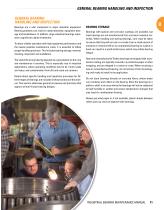
GENERAL BEARING HANDLING AND INSPECTION General Bearing Handling and Inspection Bearings are a vital component in major industrial equipment. Bearing problems can result in costly downtime, equipment damage and breakdowns. In addition, large industrial bearings represent a significant capital investment. To attain reliable operation with high equipment performance and the lowest possible maintenance costs, it is essential to follow proper handling practices. This includes bearing storage, removal, cleaning, inspection and installation. The useful life of any bearing depends to a great extent...
Open the catalog to page 9
GENERAL BEARING HANDLING AND INSPECTION Removing bearings from equipment Each type of bearing design has a unique removal process. Regardless of the bearing type, the bearing must be removed with extreme care. If done incorrectly, you can damage the bearings, shafts or housings, requiring expensive repairs. For smaller bearings, there are a variety of pullers available to assist with bearing removal (Fig. 1). Information concerning special pullers or other removal devices can be obtained by contacting your Timken representative. Fig. 2 Eyebolts can be inserted into lifting holes Fig. 1 Pullers...
Open the catalog to page 10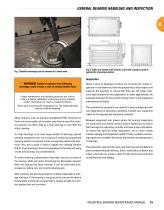
GENERAL BEARING HANDLING AND INSPECTION Fig. 3 Smaller bearings can be cleaned in a wash tank Fig. 4 Tanks are heated with electric coils and a pump is used to agitate the cleaning solution Inspection WARNING Failure to observe the following warnings could create a risk of serious bodily harm. Proper maintenance and handling practices are critical. Failure to follow installation instructions and to maintain proper lubrication can result in equipment failure. Never spin a bearing with compressed air. The rolling elements may be forcefully expelled. Alkali cleaners, such as trisodium phosphate...
Open the catalog to page 11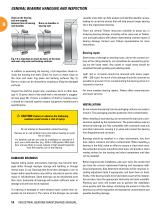
GENERAL BEARING HANDLING AND INSPECTION Chips on the bearing seat are trapped between face of bearing and shoulder Burrs on shoulder or bearing seat valuable clues that can help analyze and identify possible causes, leading to corrective actions that will help ensure longer bearing life in the replacement bearing. There are several Timken resources available to assist you in analyzing bearing damage, including online resources at Timken. com and publications with photos representing common types of bearing damage. Contact your Timken representative for more information. Bearing repair Fig. 5...
Open the catalog to page 12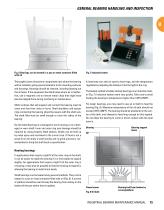
GENERAL BEARING HANDLING AND INSPECTION Fig. 6 Bearings can be heated in a pan or metal container filled with oil Thoroughly clean all machine components near where the bearing will be installed, giving special attention to the mounting surfaces and housings. Housings should be cleaned, including blowing out the oil holes. If the equipment has blind holes where air is ineffective, use a magnetic rod to remove metal chips that might have become lodged there during machining or maintenance. A heat lamp can also be used to heat rings, and the temperature regulated by adjusting the distance from...
Open the catalog to page 13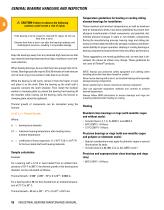
GENERAL BEARING HANDLING AND INSPECTION CAUTION Failure to observe the following cautions could create a risk of injury. If the bearing is to be reused or returned for repair, do not use heat from a torch. Extreme heat from a torch can alter the bearing hardness and metallurgical structure, resulting in irreparable damage. Keep the bearings away from any localized high-heat source that may raise the bearing temperature too high, resulting in race hardness reduction. When heating bearings, be sure that they have enough time to fully heat. Bearings typically require 20 to 30 minutes of soak time...
Open the catalog to page 14All TIMKEN catalogs and technical brochures
 National® Industrial Seals
716 Pages
 TIMKEN® ECOTURN® SEAL
2 Pages
 Timken® Lubricants
6 Pages
 Quick-Flex Couplings
68 Pages
 Matched Bearing Assemblies
16 Pages
 Cylindrical Roller Bearings
108 Pages
 AP Bearings
84 Pages
 UC Series Ball Housed Units
24 Pages
 Type E Housed Units
40 Pages
 Ball Housed Units
180 Pages
 SNT Plummer Blocks
120 Pages
 SAF Housed Units
126 Pages
 Thrust Bearings
138 Pages
 Quick-Flex Coupling Catalog
68 Pages
 Bearing interchange guide
163 Pages
 UC-SERIES
24 Pages
 Commercial Vehicle Catalog
417 Pages
 Quick-Flex Coupling
64 Pages
 Timken Drives Roller Chain Catalog
112 Pages
 Timken SAF Housed Unit Catalog
126 Pages
 Timken Ball Housed Unit Catalog
180 Pages
 Timken® SNT Plummer Block Catalog
120 Pages
 BALL BEARINGS
214 Pages



Archived catalogs
 Timken Engineering Manual
210 Pages
 Timken Ball Bearings Catalog
217 Pages
 COMPETENCYBASED TRAINING
5 Pages
 Spherical Roller Bearings
236 Pages
 Timken Industrial Seals
40 Pages
 Ball Bearings
6 Pages
 IsoClass Bearings
8 Pages
 Maintenance Tools
16 Pages
 Industrial Products
56 Pages
 Precision Rotary Assemblies
2 Pages
 Ceramic Bearings
2 Pages


