


APTM Bearings for Industrial Applications

APTM Bearings for Industrial Applications
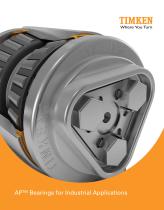
Timken's APTM (All-Purpose) railroad bearings, introduced in 1954, are notable for their high load capacity and adaptability, making them suitable for various industrial applications. Key benefits include cost savings from self-contained units, pre-greased and preassembled components, high-quality seals, and a design that ensures positive roller alignment and reduced friction.
APTM bearings offer reduced installation costs, fewer assembly parts, and exceptional protection with minimal maintenance. The tapered roller construction ensures even load distribution, and case-hardened components resist fatigue and wear.
Timken's subsidiary, Rail Bearing Service Corporation, provides reconditioning services for bearings used in railroad and industrial equipment.
The bearing assembly includes components like narrow adapters, full bore housings, axle end caps, and locking plates, designed to be pressed onto the axle as a sealed unit for secure and efficient operation.
Detailed dimensions and ratings for various bearing classes are provided, including bore size, outside diameter, and dynamic ratings, crucial for selecting the appropriate bearing for specific applications.
AP bearings are identified using a five-digit numeric code that describes component parts, lubrication, performance codes, and internal clearance, ensuring consistency in ordering and replacement.
Typical applications for APTM bearings include crane bridge axles, stadium roofs, and continuous casting machine rollers, each requiring specific mounting designs and auxiliary parts.
Technical details such as shaft/axle dimensions, housing dimensions, and auxiliary parts are provided to assist in proper installation and maintenance of the bearings.
Guidelines for press fit force requirements, shaft stress calculations, and bearing life equations are included to ensure optimal performance and longevity of the bearings.
Instructions for assembly and disassembly of bearings are provided, along with lubrication guidelines to maintain efficiency and reduce wear.
The procedure for ordering APTM bearings is outlined, including methods for identifying basic and special assembly numbers.
Detailed specifications for various classes of APTM bearings are provided, including dimensions, tolerances, and material requirements for different bearing classes.
Assembly and disassembly procedures emphasize storing bearing assemblies in a clean, dry place and provide step-by-step instructions for pressing bearing assemblies onto shafts using appropriate tools.
Recommendations include using specific lubricants and avoiding lead compounds, with an emphasis on using protective equipment during installation.
Two primary methods for installing AP bearings are discussed: the Hydraulic RAM Method and the Threaded Rod and Nut Method, highlighting the cost-effectiveness and time efficiency of each.
Instructions for removing bearing assemblies using a press or portable fixtures are provided, emphasizing proper alignment and contact with the backing ring.
A table details grease capacities for different bearing classes, specifying the normal initial charge and additional grease required to fill the assembly.
Timken AP bearings are prelubricated with AAR-approved grease, with recommendations for optimal performance in various conditions.
AP bearings can be ordered using two methods: purchasing basic bearing assemblies and required auxiliary parts separately, or purchasing complete assemblies or kits using overall assembly numbers.
Detailed tables provide specifications for various classes of bearings, including cone numbers and assembly numbers, with illustrations of typical mounting arrangements.
Proper maintenance and handling are critical to avoid serious harm, with emphasis on following installation instructions and maintaining proper lubrication.
Timken AP bearings are a critical component in many industrial applications, offering durability and efficiency. The document serves as a comprehensive guide for selecting, installing, and maintaining these bearings.
Catalog excerpts
APTM Bearings for Industrial Applications
Open the catalog to page 1
2 AP™ BEARINGS FOR INDUSTRIAL APPLICATIONS
Open the catalog to page 2
Introduction Development and Advantages. . . . . . . . . . . . . . . . . . . . . . . . . . . . . . . . . . . 7 Bearing Reconditioning . . . . . . . . . . . . . . . . . . . . . . . . . . . . . . . . . . . . . . . . . 7 Description of Parts. . . . . . . . . . . . . . . . . . . . . . . . . . . . . . . . . . . . . . . . . . . . . 8 Basic Bearing Assembly Dimensions and Ratings. . . . . . . . . . . . . . . . . 9 Overall Dimensions . . . . . . . . . . . . . . . . . . . . . . . . . . . . . . . . . . . . . . . . . . . . 10 How to Identify Assembly Numbers and Part Numbers Bearing Assembly Numbers . ....
Open the catalog to page 3
4 AP™ BEARINGS FOR INDUSTRIAL APPLICATIONS
Open the catalog to page 4
Development and Advantages. . . . . . . . . . . . . . . . . . . . . . . . . . . . . 7 Bearing Reconditioning. . . . . . . . . . . . . . . . . . . . . . . . . . . . . . . . . . . 7 Description of Parts. . . . . . . . . . . . . . . . . . . . . . . . . . . . . . . . . . . . . . . 8 Basic Bearing Assembly Dimensions and Ratings. . . . . . . . . . 9 Overall Dimensions. . . . . . . . . . . . . . . . . . . . . . . . . . . . . . . . . . . . . . 10
Open the catalog to page 5
INTRODUCTION intrODuction When Timken introduced its revolutionary APTM (All-Purpose) railroad bearings in 1954, it was a railroad industry milestone. Decades later, Timken is a leader in the friction management and power transmission industries and continues to lead in advancing bearing technology through continuous innovation and development. In addition to railroad applications, AP bearings are successfully used in many types of industrial applications. This can be attributed to many factors including the bearing’s high load carrying capacity and its adaptability to a wide variety of applications....
Open the catalog to page 7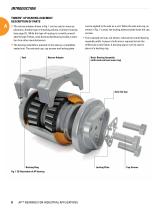
Timken® AP Bearing Assembly Description of Parts ••The narrow adapter shown in Fig. 1 can be used in many ap- plications. Another type of mounting utilizes a full bore housing (see page 21). While this type of housing is currently unavailable through Timken, most bearing distributors provide a selection from other manufactuerers. ••The bearing assembly is pressed on the axle as a completely sealed unit. The axle end cap, cap screws and locking plate Vent Narrow Adapter can be applied to the axle as a unit. When the axle end cap, as shown in Fig. 1 is used, the locking plate provided locks the...
Open the catalog to page 8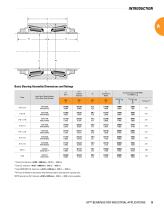
Basic Bearing Assembly Basic Bearing Assembly Dimensions and Ratings Inner Race (Cone) Number Outer Race (Cup) Number C Outer Race Width Cone bore tolerance + 0.025 – 0.000 mm (+ .0010 in. – .0000 in.) K Factor is defined as the tapered roller bearing radial to axial dynamic capacity ratio. NOTE: Special cup O.D. tolerance +0.102 + 0.076 mm (+ .0040 in. + .0030 in.) also available. APTM BEARINGS FOR INDUSTRIAL APPLICATIONS
Open the catalog to page 9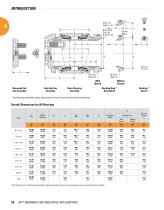
With Shroud Basic Bearing Assembly Without Shroud Backing Ring (1) Assemblies Backing ring assemblies and/or backing spacer may be used on either side of the bearing. Overall Dimensions for AP Bearings db D Outside Diameter Backing Ring With Shroud Without Shroud On Classes B, C, and D the lubricant fitting extends beyond the axle end cap. Dimensions given include the lubricant fitting. C Outer Race Width APTM BEARINGS FOR INDUSTRIAL APPLICATIONS
Open the catalog to page 10
How to Identify Assembly Numbers and Part Numbers Bearing Assembly Numbers. . . . . . . . . . . . . . . . . . . . . . . . . . . . . . 13 Standard Part Numbers. . . . . . . . . . . . . . . . . . . . . . . . . . . . . . . . . . 14
Open the catalog to page 11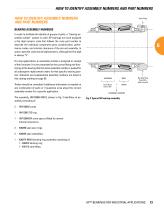
HOW TO IDENTIFY ASSEMBLY NUMBERS AND PART NUMBERS How to Identify Assembly Numbers and Part Numbers Vent Fitting Bearing Assembly Numbers In order to facilitate the identity of groups of parts, a “bearing assembly number” system is used. AP bearings are each assigned a five digit numeric code that follows the cone part number to describe the individual component parts, prelubrication, performance codes, and internal clearance of the pre-set assembly. In some cases the code may be alphanumeric, although the first digit is always “9”. For new applications, an assembly number is assigned on receipt...
Open the catalog to page 13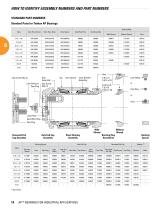
HOW TO IDENTIFY ASSEMBLY NUMBERS AND PART NUMBERS STANDARD PART NUMBERS Standard Parts for Timken AP Bearings Backing Ring Class Inner Race (Cone) Cone Spacer Seal Wear Ring Seal Assembly With Shroud Without Shroud Seal Assembly Cap Screw (Qty: 3) Lube Fitting or Pipe Plug Cone Spacer Cone & Roller Assembly Lube Fitting Pipe Plug or Vent Lock Plate Seal Wear Ring Pipe Plug Basic Bearing Assembly Backing Spacer Class With Shroud Backing Ring Assemblies Backing Spacer Pipe Plug Lube Fitting Without Shroud Backing Spacer Adapter (1) Recessed End Cap Lube Fitting Pipe Plug Pipe Plug Lock Plate Cap...
Open the catalog to page 14
mOUNTING dESIGNS Typical Applications. . . . . . . . . . . . . . . . . . . . . . . . . . . . . . . . . . . . . 17 Crane Bridge and Trolley Axles. . . . . . . . . . . . . . . . . . . . . . . . . . . 18 Moveable Stadium Roof. . . . . . . . . . . . . . . . . . . . . . . . . . . . . . . . . . 20 Table Rolls. . . . . . . . . . . . . . . . . . . . . . . . . . . . . . . . . . . . . . . . . . . . . . 21 Continuous Casting Machine Guide Rollers . . . . . . . . . . . . . . . 22 Elevator Sheaves. . . . . . . . . . . . . . . . . . . . . . . . . . . . . . . . . . . . . . . . 23 Ingot Cars. . . . . . . . ....
Open the catalog to page 15
MOUNTING DESIGNS mOUNTING dESIGNS Typical Applications Listed below are some of the various applications on which AP bearings are presently being used. Photographs and/or line drawings of some of these designs are shown on the following pages. •• •• •• •• •• •• •• •• •• Apron Feeders Auto Shredders Band Saws Barking Drums – Thrust Rollers Billet Ejectors Bucket Unloaders Calender Rolls Cam Rollers Cars -- Billet Grinder Cars -- Cable Cars -- Cane Cars -- Charging Box Cars -- Coke Guide Cars -- Coke Quench Cars -- Coke Screening Cars -- Furnace Cars -- Furnace Heat Shield Cars -- Hot Metal Cars...
Open the catalog to page 17All TIMKEN catalogs and technical brochures
 National® Industrial Seals
716 Pages
 TIMKEN® ECOTURN® SEAL
2 Pages
 Timken® Lubricants
6 Pages
 Quick-Flex Couplings
68 Pages
 Matched Bearing Assemblies
16 Pages
 Cylindrical Roller Bearings
108 Pages
 AP Bearings
84 Pages
 UC Series Ball Housed Units
24 Pages
 Type E Housed Units
40 Pages
 Ball Housed Units
180 Pages
 SNT Plummer Blocks
120 Pages
 SAF Housed Units
126 Pages
 Thrust Bearings
138 Pages
 Quick-Flex Coupling Catalog
68 Pages
 Bearing interchange guide
163 Pages
 UC-SERIES
24 Pages
 Commercial Vehicle Catalog
417 Pages
 Quick-Flex Coupling
64 Pages
 Timken Drives Roller Chain Catalog
112 Pages
 Industrial Maintenance Manual
157 Pages
 Timken SAF Housed Unit Catalog
126 Pages
 Timken Ball Housed Unit Catalog
180 Pages
 Timken® SNT Plummer Block Catalog
120 Pages
 BALL BEARINGS
214 Pages



Archived catalogs
 Timken Engineering Manual
210 Pages
 Timken Ball Bearings Catalog
217 Pages
 COMPETENCYBASED TRAINING
5 Pages
 Spherical Roller Bearings
236 Pages
 Timken Industrial Seals
40 Pages
 Ball Bearings
6 Pages
 IsoClass Bearings
8 Pages
 Maintenance Tools
16 Pages
 Industrial Products
56 Pages
 Precision Rotary Assemblies
2 Pages
 Ceramic Bearings
2 Pages


- TIMKEN steel bearing
- Synthetic lubricant
- Plastic seal
- TIMKEN ball bearing
- TIMKEN radial bearing
- Anti-corrosion lubricant
- Bearing lubricant
- TIMKEN single-row bearing
- Toroidal seal
- High-temperature lubricant
- Lipped gasket
- TIMKEN precision bearing
- Plain bearing
- Bearing grease
- Metal lubricant
- Bearing unit
- TIMKEN axial bearing
- Round seal