
- Catalogs
- TIMKEN Europe
- Timken Spherical Roller Bearing Catalog


- Company
- Products
- Catalogs
- News & Trends
- Exhibitions
Timken Spherical Roller Bearing Catalog

Timken Spherical Roller Bearing Catalog
Timken's Spherical Roller Bearing Catalog provides a comprehensive guide to their range of bearings and accessories, emphasizing quality, innovation, and dependability. It outlines Timken's friction management solutions, which enhance performance, fuel efficiency, and equipment longevity through integrated services beyond bearings, such as condition monitoring systems, encoders, sensors, seals, and lubricants.
Timken focuses on solving engineering challenges by investing in skilled personnel, advanced tools, and future-oriented research and development. Their commitment to sustainability is evident in their efforts to create systems with smaller, more efficient components to improve performance.
The Timken Quality Management System (TQMS) ensures continuous quality improvements across global operations. All production facilities and distribution centers adhere to relevant quality system standards.
The shelf life of grease-lubricated bearings is distinct from their design life and is influenced by storage conditions. Timken provides guidelines for optimal storage, emphasizing the importance of maintaining temperature and humidity levels and avoiding contamination and vibration.
Timken offers a broad range of spherical roller bearings, available in various sizes and configurations to meet demanding applications. Their product line includes bearings with stamped-steel or precision-machined-brass cages, and pillow blocks for easy assembly and disassembly. Accessories are available to facilitate safe and effective mounting and dismounting.
Timken's redesigned spherical roller bearings offer higher load and speed ratings, improved surface finishes, and innovative features to lower operating temperatures and increase load-carrying capabilities. New cage designs and optimized internal geometries enhance performance and extend bearing life.
Timken's spherical roller bearings are designed for superior performance, offering lower operating temperatures which extend bearing life by enhancing lubricant longevity. A decrease of 5°C in operating temperature can result in a 9% increase in bearing life. Timken bearings consistently operate at lower temperatures compared to competitors.
Timken's next-generation spherical roller bearings boast a 17% increase in thermal speed ratings. As a premium manufacturer, Timken ensures high-quality standards by producing super-clean, high-alloy bearing steels and adhering to a global quality management system.
The catalog covers various engineering aspects such as bearing design types, cage designs, fitting practices, and lubrication recommendations. Timken offers different styles of radial spherical roller bearings, with specific cage designs for different applications. The EJ, EM, and EMB bearings have been redesigned for higher load ratings and reduced operating temperatures.
Timken bearings can include features like the W33 lubrication groove and oil holes, which facilitate lubrication and reduce the need for additional machining. Bearings for vibratory applications are available with specific modifications for enhanced performance.
Cages in Timken bearings serve to separate rolling elements and improve lubrication flow. Different cage designs are available, including machined-brass and pin-type cages, each suited for specific applications.
Spherical roller bearings are manufactured to precise specifications with defined tolerances for dimensions such as bore and outer diameter. Timken provides detailed tables for these tolerances, ensuring proper selection and application of bearings.
Proper mounting and fitting are crucial for bearing performance. Timken provides guidelines for fitting practices, considering factors like precision, material, and surface finish. Bearings are often mounted in combination to allow for axial movement and accommodate thermal expansion.
Timken's spherical roller bearings are engineered for high performance and reliability, supported by comprehensive engineering resources and expert assistance.
The document outlines the specifications and procedures for mounting, fitting, setting, and installing spherical roller bearings, particularly focusing on tapered and cylindrical bore designs. It emphasizes the importance of proper maintenance, handling practices, and lubrication to prevent bearing and shaft damage.
Stationary inner-ring fitting depends on application loading, while rotating outer-ring applications require an interference fit. Loose fits are generally used for stationary outer rings to allow assembly, disassembly, and axial movement. Thin-walled or light-alloy housings require tighter press fits compared to thick-walled or solid shafts.
Warnings include the risk of death or serious injury if proper maintenance and handling practices are not followed. It is crucial never to spin a bearing with compressed air as it may expel rollers forcefully.
Tapered bore bearings simplify shaft mounting and dismounting. They require a tighter fit on the shaft than cylindrical bore bearings. The document provides guidelines for approximating clearance loss due to axial drive-up and suggests using a locknut and lockwasher for securing the inner ring.
Proper operation clearance is affected by fitting practices and thermal gradients, which increase with bearing speed. Radial clearance should be increased for speeds exceeding 70% of the speed rating. The document provides radial internal clearance (RIC) tolerances and emphasizes avoiding preloaded conditions to prevent premature damage.
The document includes tables detailing radial internal clearance limits for both cylindrical and tapered bore bearings. It provides examples of calculating RIC reduction using spherical roller bearings with both tapered and cylindrical bores, highlighting the importance of selecting appropriate RIC based on speed and fit.
For cylindrical bore bearings, a tight interference fit is required. The document describes heating methods, such as using a tank of heated oil or induction heating, to expand the bearing for easy mounting. It advises on temperature limits and timing to ensure proper installation.
To ensure proper bearing installation, the bearing should be positioned squarely against the shoulder while hot. Lockwashers and locknuts or clamping plates are used to secure the bearing. As the bearing cools, these should be tightened. For outer ring rotation, the housing can be expanded by heating. The bearing should not contact the heat source directly, and a screen should separate it from the bottom of the tank to avoid excessive temperature that could reduce ring hardness. Flame-type burners with automatic temperature control are recommended. If open heated oil baths are not allowed, a 15% soluble-oil water mixture can be used, heated up to 93°C (200°F).
For tight fit inner rings, assembly depends on whether the bearing has a cylindrical or tapered bore. Cleanliness is crucial, and the environment should be free from dust and moisture. All components should be cleaned and checked against specifications for dimensional accuracy. Shaft surfaces must be clean and free from nicks and burrs, with specific finish requirements depending on the application.
The arbor press method is used for smaller bearings, involving pressing the bearing onto the shaft or into the housing using a mounting tube. The tube should be made from soft steel and be slightly larger than the shaft. For tapered bore spherical roller bearings, a feeler gauge is used to measure RIC before installation. The bearing is lubricated and slid onto the shaft, with the locknut tightened to achieve the proper interference fit.
Tables provide guidelines for specifying shaft and housing fits based on operating conditions. Different fits are recommended depending on load conditions and application requirements. For example, a P6 fit is used for rotating outer ring loads, while an s4 fit is used for centrifugal force load applications.
These tables offer detailed specifications for shaft tolerances and fits, providing maximum and minimum values for various shaft diameters and fit types. These guidelines ensure proper bearing performance and longevity.
The document discusses the operating temperatures and material limitations of Timken spherical roller bearings. Standard bearing steels maintain a minimum hardness of 58 HRC up to 120 °C (250 °F). Timken bearings are dimensionally stabilized for various temperature ranges, with spherical roller bearings stabilized up to 200 °C (392 °F). Stability designations (S0 to S4) indicate maximum operating temperatures from 150 °C (302 °F) to 350 °C (662 °F).
Heat generation and dissipation are critical for bearing performance. Heat generation is calculated using the formula Qgen = k4n M, where torque and speed are factors. Heat dissipation involves conduction, convection, and radiation, with circulating oil systems playing a significant role.
The document references DIN Standard 623 for bearing stability designations. It also provides guidelines for material selection based on ASTM standards for various operating temperatures.
Bearings should operate within specified temperature limits to avoid damage. Lubrication is essential for minimizing friction and transferring heat. Oil is recommended for high-speed or high-temperature applications, while grease simplifies seal design and requires less frequent lubrication.
Table 13 lists stability designations and maximum operating temperatures. Table 14 provides chemical compositions and hardness recommendations for bearing materials. Table 15 outlines operating temperatures for cages, shields, and seals. Table 16 offers coefficients for torque equations, and Table 17 compares the advantages of oil and grease lubrication.
Operating temperatures affect lubricant film thickness and bearing life. Equipment designers must consider temperature effects on equipment performance. Prototype testing is advised to define operating temperature ranges. For temperatures exceeding standard limits, consult a Timken engineer for high-temperature steel options.
Oil lubrication systems are essential for maintaining the efficiency and longevity of bearings. The document outlines three primary systems: oil bath, circulating system, and oil-mist lubrication, each suited for specific applications.
This system involves a sump where the bearing's rolling elements pass through oil. The oil level should not exceed the center of the lowest rolling element to prevent churning, especially at high speeds.
Advantages include adequate oil supply for cooling and lubrication, metered oil delivery, contaminant removal, suitability for multiple bearings, and extended lubricant life. It typically consists of a reservoir, pump, piping, and filter, with a possible heat exchanger.
Used in high-speed applications, this system allows precise control of lubricant quantity. It involves atomizing oil with compressed air, ensuring adequate lubrication and preventing contaminants from entering the system.
Oils are categorized into petroleum and synthetic types. Petroleum oils are common for most applications, while synthetic oils, such as polyalphaolefins and silicones, are used in extreme temperatures due to their stability.
Oil viscosity selection depends on load, speed, and environmental factors. High-viscosity oils are for low-speed or high-temperature applications, while low-viscosity oils suit high-speed or low-temperature conditions. The document compares ISO/ASTM and SAE viscosity classifications.
Grease is used for low-to-moderate speed applications. It consists of a base oil, thickening agent, and additives. Different thickeners, such as lithium and calcium, offer varying properties like water resistance and temperature stability.
Contaminants like abrasive particles can cause bearing damage. Maintaining clean lubrication systems is crucial to prevent wear and extend bearing life.
Water and moisture can significantly damage bearings. While some lubricating greases offer protection, water-soluble greases like sodium-soap should be avoided in wet conditions. Water in lubricating oils can reduce bearing fatigue life by causing etching and promoting corrosion and hydrogen embrittlement in micro-cracks.
The choice of bearing grease depends on its physical and chemical properties, application, and environmental conditions. Grease should maintain consistency at operating temperatures without thickening or separating. It should be smooth, non-fibrous, and free from chemically active ingredients. Consultation with a lubricant supplier or Timken engineer is recommended for specific applications.
Timken offers application-specific lubricants designed for demanding industrial operations. These lubricants include high-temperature, anti-wear, and water-resistant additives. A selection guide is available, but it should not replace equipment builder specifications.
Proper grease quantity is crucial; too little can starve the bearing, while too much can cause churning and excessive temperatures. Bearings should be relubricated regularly, and grease should be packed to ensure it reaches between rolling elements. The relubrication cycle depends on operating temperature and sealing efficiency.
Grease consistency varies and is measured by penetration number. The National Lubricating Grease Institute (NLGI) classifies grease consistency, which can change when sheared.
Mixing greases can lead to improper lubrication. A compatibility chart is provided to guide grease selection.
Polyurea and lithium-based greases are preferred for general-purpose lubrication, especially in high moisture environments. Grease should be selected based on its consistency at operating temperatures and should not thicken or separate.
These greases are suitable for many Timken bearing applications. Special considerations are needed for extreme conditions. Lithium, lithium complex, or calcium sulfonate greases are recommended for most applications.
For high-speed applications, a lighter base oil viscosity is recommended, while lower-speed applications may require a heavier viscosity. For high-temperature operations, consultation with a Timken engineer is advised.
For industrial applications, the bearing void should be filled 100% and the housing void 40-60%. For high-speed applications, the bearing void should be filled 100% and the housing void 30-40%. The free volume of the bearing is estimated by calculating the 'solid ring' volume, weighing the bearing, and dividing by the density of steel. The grease volume is determined by multiplying the free volume by the grease density. Apply 75% of the grease to the cage and roller assembly, and the remainder to the inner and outer rings. Preservatives on bearing components are compatible with most industrial greases.
Timken spherical roller bearings are designed for high radial loads and consistent performance under misalignment, marginal lubrication, contamination, extreme speeds, and critical stresses. They feature superior design, reliable performance, and comprehensive technical support.
The catalog provides detailed nomenclature for identifying bearings, including bore size and modification codes. Common codes include tapered bore (K), steel cage (EJ), brass cage (EM/YM), and various radial internal clearances (C2, C3, C4, etc.).
Technical data such as shaft and housing fits, internal clearances, and tolerances are available in the engineering section of the catalog and the Timken Engineering Manual. Bearings with tapered bores for adapter-type mounting can be ordered with the suffix 'K'.
The catalog lists bearing part numbers, dimensions, load ratings, cage types, mounting data, and equivalent radial load factors. It also includes thermal speed ratings and weights for various bearings.
Tables provide modification codes and equivalence between current ISO and old ABMA part numbering. Figures illustrate nomenclature and equivalence between part numbers.
Timken's engineering and manufacturing capabilities in heavy-duty pillow blocks offer significant user benefits. The company provides expert engineering assistance for applications involving large shaft sizes, such as BOF trunnions, bridge blocks, and ball mills. Timken's pillow blocks are suitable for various applications, including conveyors, mining, cement, casters, rolling mills, and heavy movable structures.
Timken supplies pillow blocks with either tapered bore bearings with adapters for straight shafts or cylindrical bore bearings for shouldered shafts. The split construction allows for convenient assembly and disassembly, featuring pry-tool slots and the Pry-Lug fulcrum for easy bearing inspection, service, and replacement. The pillow blocks are made from high-grade, stress-relieved cast iron or cast steel and are designed for four-bolt mounting, with some smaller sizes available for two-bolt mounting.
Timken offers two mounting options: adapter vs. straight bore. Adapter-mounted spherical roller bearings allow for flexibility in axial positioning and accommodate light locational thrust loads. Straight bore mounting is recommended for applications with heavy thrust loads or requiring exact axial location. Timken pillow block assemblies are available in various series for both mounting types.
Timken pillow blocks can be installed in either fixed or float positions. The fixed position uses a stabilizing ring to prevent axial movement, while the float position allows for axial movement to compensate for thermal expansion or contraction.
For applications where the shaft end terminates inside the pillow block, end-closure inserts are available to seal out contaminants and retain lubricant. A minimum clearance is suggested between the shaft end and the closure to accommodate thermal expansion.
Timken pillow block housings are designed for grease and oil-bath lubrication and can be modified for circulating oil or oil/air-mist systems. A lubrication groove and oil holes in the bearing outer ring ensure proper lubrication distribution.
Timken pillow blocks come with precision triple-ring labyrinth seals to exclude foreign matter and retain lubricants. For highly contaminated environments, the DUSTAC® seal offers additional protection.
Load ratings for spherical roller bearings in pillow blocks are provided in the catalog, with life calculation formulas available in the Engineering Manual. The load rating figures apply when the load direction is toward the base of the pillow block.
The catalog provides detailed specifications for ordering complete pillow block assemblies, including housing cap and base, cap bolts, bearing, bearing adapter, locknut, lockwasher, stabilizing ring, and triple-ring seals. Assemblies are available in cast iron or cast steel, with four-bolt bases as standard.
The document provides detailed specifications for various EPS models, including dimensions and part numbers. It lists the sizes and corresponding components for each model, such as shaft seals and pillow block housings.
Instructions are provided for ordering shaft seals and pillow block housings with specific configurations. The document explains how to add suffixes to part numbers to specify desired features, such as DUSTAC shaft seals.
A step-by-step guide is included for installing shaft seals and bearings. Key steps involve checking shaft diameters, positioning V-ring seals, and ensuring proper alignment and compression of components.
The DUSTAC shaft seal is recommended for use in contaminated environments. It offers enhanced protection against contaminants and extends bearing life. The seal features a V-shaped nitrile ring that rotates with the shaft.
The document describes the use of sine bar gages for measuring tapered shafts. It lists available sizes and explains the importance of accurate shaft taper measurement to prevent premature bearing wear.
Timken offers a range of accessories for spherical roller bearings, including adapter sleeves, locknuts, and lockwashers. These accessories are designed to ensure a secure fit and facilitate installation and removal.
The document provides a detailed nomenclature for various accessories, including prefixes and suffixes used to describe different types of sleeves and locking devices.
Several tables list part numbers, sizes, and compatible bearings for different components. Figures illustrate design features and parts of sine gages.
- SNW Assembly: Comprises a sleeve, locknut, and lockwasher.
- SNP Assembly: Comprises a sleeve, locknut, and lockplate.
- Bearing Number: Identifies the specific bearing model.
- Accessory Numbers: Lists the corresponding sleeve, locknut, and lockwasher/lockplate numbers.
- Shaft Dimensions: Includes diameter and tolerance.
- Adapter Dimensions: Specifies dimensions B2, S, and D1.
- Assembly Weight: Provides the weight of the assembly in pounds.
- Bold shaft sizes indicate standard sizes. Non-standard accessories require specification of shaft size when ordering.
- Tolerance range is from +0 to the value listed.
- Specifications: The document provides detailed specifications for various bearing numbers, including accessory numbers, shaft dimensions, adapter dimensions, and assembly weights. It includes both inch and metric measurements.
- Procedures: Instructions are provided for ordering non-standard accessories, emphasizing the need to specify shaft size when deviating from standard sizes.
- Standards and Tolerances: The document outlines tolerance ranges for shaft diameters, indicating a range from +0 to a specified negative value, ensuring precision in fitting and assembly.
- Recommendations: The document suggests using standard shaft sizes for ease of ordering and compatibility with existing components.
- Pull-Type Sleeves: The tables list dimensions for SNW and SNP assemblies, which include a sleeve, locknut, and either a lockwasher or lockplate. The tables provide detailed measurements for each component, ensuring proper fit and function.
- Push-Type Sleeves: Similar tables are provided for push-type sleeves, detailing the dimensions and weights of the sleeves, locknuts, and lockwashers, along with removal nuts for ease of disassembly.
- Exigencies: The document stresses the importance of adhering to specified tolerances to ensure the proper functioning of the bearings and associated components.
- Parameters: Detailed parameters for each bearing and accessory are provided, including diameter, pitch, and length measurements.
- Limitations: The document notes the limitations in terms of tolerance ranges and the necessity of specifying shaft sizes for non-standard orders.
- Best Practices: It is recommended to use standard sizes where possible to facilitate easier ordering and compatibility with existing systems.
Catalog excerpts

TIMKEN Where You Turn
Open the catalog to page 1
TIMKEN OVERVIEW TIMKEN. WHERE YOU TURN. Turn to Timken to move ahead of the comptition and stand out as a leader in your industry. When you turn to us, you receive more than high-quality products and services; you acquire a worldwide team of highly trained and experienced associates, eager to help you keep production rates high and downtime low. Whether it is a wheel assembly for a family vehicle, bearings outfitted for a deep-sea oil drilling rig, repair services for rail bearings or steel for an aircraft engine shaft, we supply the products and services you need that help keep the world turning....
Open the catalog to page 3
TIMKEN OVERVIEW TECHNOLOGY THATMOVES YOU Innovation is one of our core values, and we're known for our ability to solve engineering challenges. We focus on improving performance in the most difficult applications, and we're passionate about creating technical solutions and services that help your equipment perform faster, harder, smoother and more efficiently. To do this, we invest in: People, attracting and hiring scholars, engineers and specialists from across the globe who are experts in mechanical power transmission, antifriction bearing design, tribology, metallurgy, clean steel production,...
Open the catalog to page 4
TIMKEN OVERVIEW A BRAND YOU CAN TRUST L The Timken brand stands for quality, innovation and dependability. I We take pride in the quality of our work, and you gain I the peace-of-mind of knowing that each box contains an industry-trusted product. As our founder Henry Timken I said, "Don't set your name to anything you will ever have " cause to be ashamed of." F We continue this mindset through the Timken Quality ' Management System (TQMS). With TQMS, we promote continuous quality improvements in our products and services to our global oprations and supply chain networks. It helps us ensure that...
Open the catalog to page 5
TIMKEN OVERVIEW ABOUTTHIS MANUAL Timken offers an extensive range of bearings and accessories in both imperial and metric sizes. For your convenience, size ranges are indicated in millimeters and inches. Contact your Timken engineer to learn more about our complete line for the special needs of your application. USING THIS MANUAL We are committed to providing our customers with maximum service and quality. This publication contains dimensions, tolerances and load ratings as well as an engineering section describing fitting practices for shafts and housings, internai clearances, materials and...
Open the catalog to page 6
TIMKEN OVERVIEW SHELF LIFE AND STORAGE OF GREASE-LUBRICATED BEARINGS AND Timken guidelines for the shelf life of grease-lubricated rolling bearings, components and assemblies are set forth below. Shelf life information is based on test data and experience. Shelf life should be distinguished from lubricated bearing/ component design life as follows: SHELF LIFE POLICY Shelf life of the grease-lubricated bearing/component represents the period of time prior to use or installation. The shelf life is a portion of the anticipated aggregate design life. It is impossible to accurately predict design...
Open the catalog to page 7
TIMKEN OVERVIEW Most bearing types are typically shipped protected with a corrosion-preventive compound that is not a lubricant. Such bearings may be used in oil-lubricated applications without removal of the corrosion-preventive compound. When using some specialized grease lubrications, it is advisable to remove the corrosion-preventive compound before packing the bearings with suitable grease. Some bearing types in this catalog are prepacked with general purpose grease suitable for their normal application. Frequent replenishment of the grease may be necessary for optimum performance. Care...
Open the catalog to page 8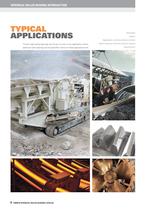
SPHERICAL ROLLER BEARING INTRODUCTION Gearboxes Casters tes, including shakeers screens Timken high-quality bearings can be put to work in any application where Heavy ^tioiwy industria| rjoirv^yoi- systems spherical roller bearings can be specified. Some of these applications are: lndustria| fans 8 TIMKEN SPHERICAL ROLLER BEARING CATALOG
Open the catalog to page 9
SPHERICAL ROLLER BEARING INTRODUCTION TIMKEN® SPHERICAL ROLLER BEARINGS - OFFERING SELECTION AND SUPERIOR PERFORMANCE Your success dpends on the performance of your equipment, especially when it faces harsh environments and high radial loads. To help keep uptime high and downtime low, turn to Timken® spherical roller bearings. These bearings are your best choice when conditions include heavy loads, when you have difficulties in establishing or maintaining housing alignment, or when shaft deflection can be expected. PRODUCT OFFERING Our spherical roller bearing product line is one of the broadest...
Open the catalog to page 10
SPHERICAL ROLLER BEARING INTRODUCTION TIMKEN® SPHERICAL ROLLER BEARINGS - OFFERING SELECTION AND SUPERIOR PERFORMANCE ■ continued C QUALITY SOLUTIONS As the only premium bearing manufacturer to also make super-clean, high-alloy bearing steels, we understand the critical quality link between materials and product performance. We also strictly adhere to the Timken Quality Management System in every plant worldwide, so each bearing product meets the same high performance standards - no matter where in the world it is manufactured. DEPENDABLE SERVICE Every Timken spherical roller bearing is backed...
Open the catalog to page 11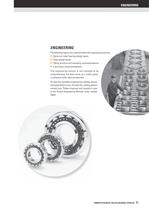
ENGINEERING ENGINEERING The following topics are covered within this engineering section: Spherical roller bearing design types. Օ Cage design types. ► Fitting practice and mounting recommendations. Lubrication recommendations. This engineering section is not intended to be comprehensive, but does serve as a useful guide in spherical roller bearing selection. To view the complete engineering catalog, please visit www.timken.com. To order the catalog, please contact your Timken engineer and request a copy of the Timken Engineering Manual, order number 10424. TIMKEN SPHERICAL ROLLER BEARING CATALOG...
Open the catalog to page 12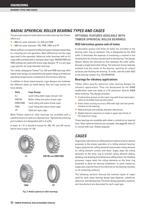
ENGINEERING BEARING TYPES AND CAGES RADIAL SPHERICAL ROLLER BEARING The principle styles of radial spherical roller bearings that Timken offers are: <400 mm outer diameter: EJ, EM and EMB Օ >400 mm outer diameter: YM, YMB, YMD and YP Above suffixes correspond to different types of designs depending on a bearing size and geometry. Main differences are the cage type used in the assembly. Spherical roller bearings with an EJ cage suffix are fitted with a stamped-steel cage. YM/EM/YMB and YMD suffixes are used with brass cage designs. YP is a pin-type cage specific for large diameter bearings. The...
Open the catalog to page 13All TIMKEN Europe catalogs and technical brochures
 Grease Interchange Guide
1 Page
 MAINTENANCE TOOLS
16 Pages
 Tapered Roller Bearing Catalog
760 Pages
 COMMERCIAL VEHICLE BEARING CATALOGUE
745 Pages
 INDUSTRIAL POWER TRANSMISSION BELTS
364 Pages
 Drive Engineer™ Web App
2 Pages
 Timken Safety End Caps
2 Pages
 HOUSED UNITS
2 Pages
 491A Disk Harrow Unit
2 Pages
 Deep Groove Ball Bearings
32 Pages
 National Indust Seals Catalog
716 Pages
 Industrial Seal Catalog
389 Pages
 ECOTURN LABYRINTH SEAL
2 Pages
 VHIN 600
2 Pages
 VHIN 550
2 Pages
 VHIS 400
2 Pages
 VHIS 200
2 Pages
 VHIS 150
2 Pages
 VHIS 100
2 Pages
 VHIS 75
2 Pages
 VHIS 35
2 Pages
 VHIN 33
2 Pages
 VHIN 10
2 Pages
 Maintenance-Tool-Catalog
16 Pages
 M9 Modular Magnetic Encoder
2 Pages
 MPS160
2 Pages
 Thrust Bearings
2 Pages
 M11 MODULAR MAGNETIC ENCODER
2 Pages
 UC-SERIES
2 Pages
 EMA Series Brochure
16 Pages
 Deep Groove Ball Bearing
40 Pages
 Large Bore Industrial Seal Catalog
388 Pages
 Timken Metals Product Catalog
220 Pages
 Timken Drives Roller Chain Catalog
112 Pages
 Timken SAF Housed Unit Catalog
126 Pages
 Timken Ball Housed Unit Catalog
180 Pages
 Timken® SNT Plummer Block Catalog
120 Pages
 NSC Info Section
34 Pages
 Timken Type E Housed Unit
40 Pages
 Quick-Flex Coupling
64 Pages
 Spherical Bearing
2 Pages
 Timken AP-2 Bearing
2 Pages
 AP? Bearing Product Sheet
2 Pages
 ADAPT Bearing Product Sheet
2 Pages
 ROLLER BEARING OFFERING
6 Pages
 Spherical Roller Bearing Catalog
200 Pages
 Cylindrical Roller Bearing Catalog
108 Pages
 Commercial Vehicle Catalog
417 Pages
 Timken Thrust & Plain Bearings
40 Pages
 Timken Ball Bearings
217 Pages
 Medium-Duty Application
37 Pages
 Industrial Maintenance Manual
157 Pages
 Mechanical Puller Catalog
20 Pages
 BALL BEARINGS
218 Pages
 ROLLER BEARINGS
476 Pages
 Engineering
176 Pages


Archived catalogs
 IsoClass Bearings
8 Pages
 Maintenance Tools
16 Pages
 Industrial Products
56 Pages
- TIMKEN steel bearing
- Synthetic lubricant
- Flexible coupling
- Shaft shaft coupling
- TIMKEN ball bearing
- TIMKEN radial bearing
- Anti-corrosion lubricant
- Bearing lubricant
- Flange coupling
- TIMKEN single-row bearing
- High-temperature lubricant
- TIMKEN precision bearing
- Plain bearing
- Rigid coupling
- TIMKEN bearing unit
- TIMKEN axial bearing
- Universal lubricant