
- Catalogs
- ThyssenKrupp Magnettechnik
- AlNiCo-Magnets


AlNiCo-Magnets
AlNiCo-Magnets
Catalog excerpts

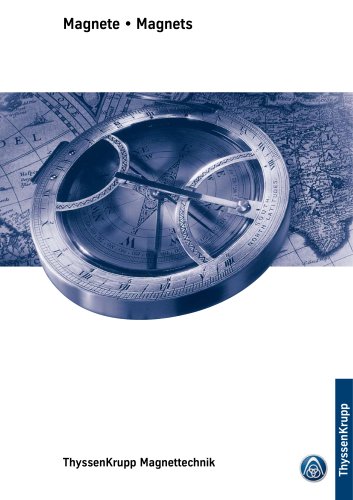
ThyssenKrupp Magnettechnik tk Magnete • Magnets
Open the catalog to page 1
Das Programm. Die Erfahrung. Das Know-how. Und die weltweiten Kontakte. • The range. The experience. The know-how. And the worldwide contacts. Das sind die entscheidenden Faktoren für die erfolgreiche Lösung von spezifischen Prob- lemen. Wir sind auf den Anwen der- und Beschaffungsmärkten der Welt zu Hause. Daher kennen wir die Entwicklungen und Tendenzen beim Einsatz von Magneten, Magnetsystemen und Komponenten und natürlich kennen wir die führenden Hersteller in aller Welt. Unsere Spezialisten mit langjähriger Erfahrung finden konstruktive Lösungen für Ihre ganz speziellen Anforderungen....
Open the catalog to page 2
Inhaltsverzeichnis • Contents 1 Qualitätsmanagement/Quality Management . . . . . . . . . . . . . . . . . . . . . . . . Hartferritmagnete/Hard Ferrite Magnets . . . . . . . . . . . . . . . . . . . . . . . . . . . AlNiCo‑Magnete/AlNiCo‑Magnets . . . . . . . . . . . . . . . . . . . . . . . . . . . . . . . 10 Samarium‑Cobalt‑Magnete/Samarium‑Cobalt‑Magnets . . . . . . . . . . . . . . . 1 Neodym‑Eisen‑Bor‑Magnete/Neodymium‑Iron‑Boron‑Magnets . . . . . . . . . 19 Kunststoffgebundene Magnete/Plastic Bonded Magnets . . . . . . . . . . . . . . Technische Informationen/Technical Information . . . . . ....
Open the catalog to page 3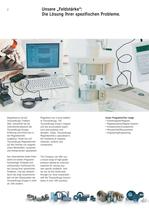
Unsere „Feldstärke“: Die Lösung Ihrer spezifischen Probleme. Magnetismus hat bei ThyssenKrupp Tradition. Über Jahrzehnte hat ein Unternehmensbereich der ThyssenKrupp-Gruppe Erfahrung und Know-how in der Magnettechnik aufgebaut. Heute hat sich ThyssenKrupp Magnettechnik auf den Vertrieb von magneti‑ schen Werkstoffen, Systemen und Komponenten spezialisiert. Magnetism has a long tradition at ThyssenKrupp. The ThyssenKrupp Group’s magnet unit has accumulated experi‑ ence and expertise over decades. Today, ThyssenKrupp Magnettechnik is specialized in the marketing of magnetic materials, systems...
Open the catalog to page 4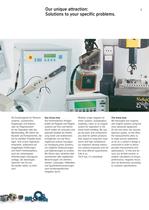
Our unique attraction: Solutions to your specific problems. Ob Einzelmagnete für Motoren systeme, Lautsprecher, Kupplungen und Rotoren oder als Magnetsystem für die Separation oder das Blechhandling. Wir liefern die Bauteile und Komponenten, die Sie für perfekte Produkte benö‑ tigen. Und unsere Ingenieure entwickeln, aufbauend auf langjährigen Erfahrungen und hoher Fachkompetenz, auch bei schwierigsten Anforderungen Lösungsvor schläge, die überzeugen. Sprechen Sie mit uns. Sie werden sehen, es lohnt sich! Das Know-how Auf hochmodernen Anlagen prüfen wir Magnete und Magnet systeme auf...
Open the catalog to page 5
Zertifiziertes QM-System nach DIN EN ISO 9001:2000 In den letzten Jahren haben die Anforderungen an Lieferanten zugenommen, die Übereinstimmung ihrer Arbeitsprozesse mit den Forderungen nationaler, internationaler und spe‑ zieller handelsbezogener QualitätsmanagementNormen nachzuweisen. Und dies auch bereits in der Bewerbungsphase um Aufträge. Qualitätsmanagement • Quality management Ein hoher Qualitätsstandard für alle Produkte und Dienstleistungen sowie eine effektive Begrenzung aller pro‑ duktbezogenen Risiken gehört zu den Grundlagen effektiver unternehmensweiter Qualitäts sicherungsprozesse....
Open the catalog to page 6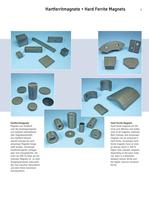
Hartferritmagnete • Hard Ferrite Magnets Hartferritmagnete Magnete aus Hartferrit sind die kostengünstigsten und weltweit verbreitetsten aller Magnetwerkstoffe. Aus Hartferrit können sowohl isotrope als auch anisotrope Magnete herge‑ stellt werden. Anisotrope Hartferritmagnete verfügen über eine Energiedichte, die mehr als 300 % höher als die isotroper Magnete ist. Je nach Ausgangsmaterial unterschei‑ det man zwischen Bariumferrit und dem höher koerzitiven Strontiumferrit. Hard Ferrite Magnets Hard ferrite magnets are the most cost effective and widely used of all magnetic materials. Both isotropic...
Open the catalog to page 7
Hartferritmagnete • Hard Ferrite Magnets Herstellung/Production Die Rohstoffe (im Wesentlichen Eisenoxit, Ba‑ riumkarbonat bzw. Strontiumkarbonat) werden nach der Eingangskontrolle gewogen, gemischt, vorgesintert und zu einem feinen Pulver mit hexagonalen Kristallen vermahlen. Bei isotropen Magneten wird anschließend das Vormaterial granuliert und verpresst. Die Herstellung aniso‑ troper Magnete unterscheidet zwei Verfahren. Im ersten wird das Vormaterial erst getrocknet und anschließend im Magnetfeld gepresst. Im zwei‑ ten Verfahren wird das Vormaterial unter Einfluss eines Magnetfeldes nassgepresst....
Open the catalog to page 8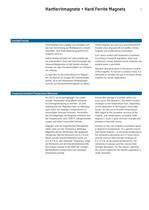
Hartferritmagnete • Hard Ferrite Magnets Toxizität/Toxicity Ferritmagnete sind ungiftig und verhalten sich bei ihrer Vernichtung auf Mülldeponien umwelt‑ freundlich. Eine Müllverbrennung greift Ferrit‑ magnete nicht an. Selbst direkter Kontakt mit Lebensmitteln gilt als unbedenklich. Nach den Bestimmungen des Lebensmittelgesetzes ist der direkte ständige Kontakt von allen Ferritwerkstoffen mit Trinkwas‑ ser zulässig. Zu beachten ist der Anteil Barium im Magne‑ ten. Da Barium zur Gruppe der Schwermetalle gehört, ist es bei bestimmten Anwendungen sinnvoll, auf Strontiumferritmagnete zu setzen....
Open the catalog to page 9
Hartferritmagnete • Hard Ferrite Magnets Magnetformen/Magnet Shapes Die Vorzugsrichtung verläuft in der Regel parallel zur Pressrichtung. Bohrungen und Nuten können daher nur in Pressrichtung eingebracht werden. Scharfe Kanten und Ecken sind möglichst zu vermeiden, da auf Grund der großen Sprödigkeit des Werkstoffes Risse und Ausbrüche entste‑ hen können. Neben dem Formpressen ist auch eine indirekte Formgebung möglich. Dabei wird die Endform (meist Klein- und Kleinstmagnete) aus fertig gesinterten größeren Blockmagneten herausgeschnitten. The preferred direction is usually parallel to the direction...
Open the catalog to page 10
Hartferritmagnete • Hard Ferrite Magnets Physikalische Eigenschaften/Physical Properties Einsatztemperatur Tmax = 250 °C Curie-Temperatur Tc = 450 °C Werkstoff/ Material Operating Temperature Tmax = 250 °C Curie Temperature Tc = 450 °C Dichte/ Density Elastizitäts Druck spez. elektr. modul/ festigkeit/ Härte/ Widerstand/ Modulus of Pressure Hardness Spec. elec. elasticity resistance resistance spez. Wärme/ Specific heat lin. Ausdehnungs spez. koeffizient/ Wärmeleit- Lin. expansion coefficient fähigkeit/ senkrecht/ parallel/ Specific parallel vertical thermal zur Vorzugsrichtung/ conduc...
Open the catalog to page 11All ThyssenKrupp Magnettechnik catalogs and technical brochures
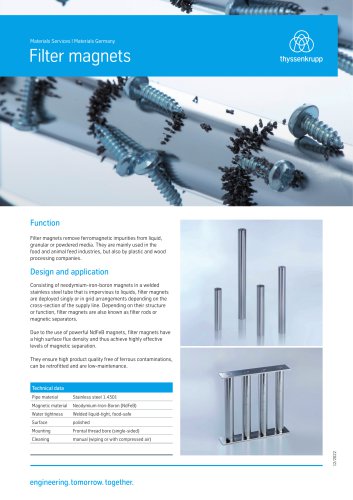 Filter magnets
2 Pages
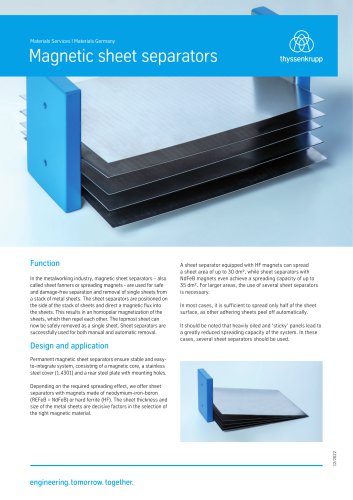 Magnetic sheet separators
3 Pages
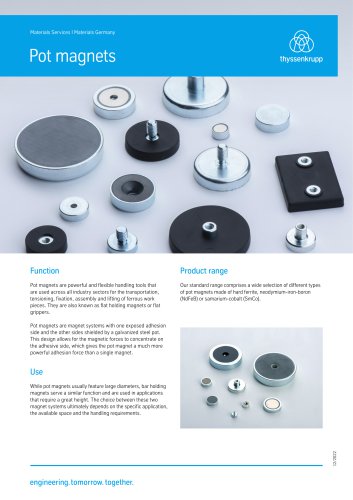 Pot magnets
8 Pages
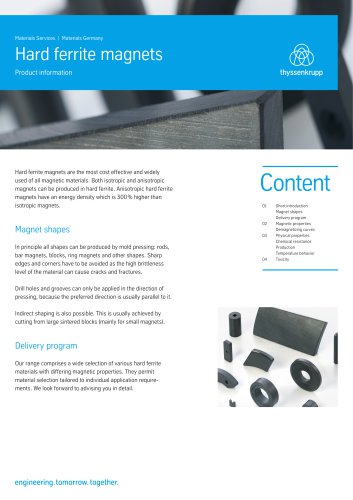 Hard ferrite magnets
4 Pages
 Magnets move us
9 Pages
 Spreading Magnets
8 Pages
 holding magnets
40 Pages


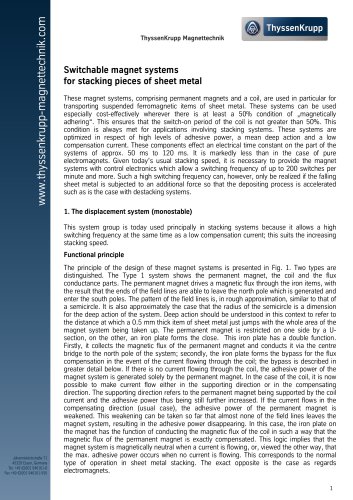


- Solids separator
- Liquids separator
- Eddy current separator
- Lifting magnet
- Separator for the food industry
- Neodymium magnet
- Cylindrical magnet
- Coated magnet
- Permanent lifting magnet
- Rectangular magnet
- Manually switched permanent lifting magnet
- Holding magnet
- Ring magnet
- Handling permanent lifting magnet
- Gaussmeter
- Samarium-cobalt magnet
- Destacker
- Disc magnet